Flags get studied under a field called vexillology, which sounds drier than it is. What it involves in practice is reading a country's own account of itself off a piece of cloth. The flags of the Americas are good material for that, because most were designed at or near a moment of separation from Europe, and they tend to say so directly.
Argentina: blue, white, and a sun with a face
The Argentine flag has three horizontal stripes, light blue on the outside and white in the middle, with the Sun of May at the center: a golden sun carrying a human face.
The colors are traced to the blue sky and the clouds seen during the May Revolution of 1810. The sun is Inti, the Incan sun god, which puts an indigenous deity at the middle of a flag raised by a republic breaking from Spain. For Argentinians the flag reads as the fight for independence rather than as anything astronomical.
Aruba: a star with four points
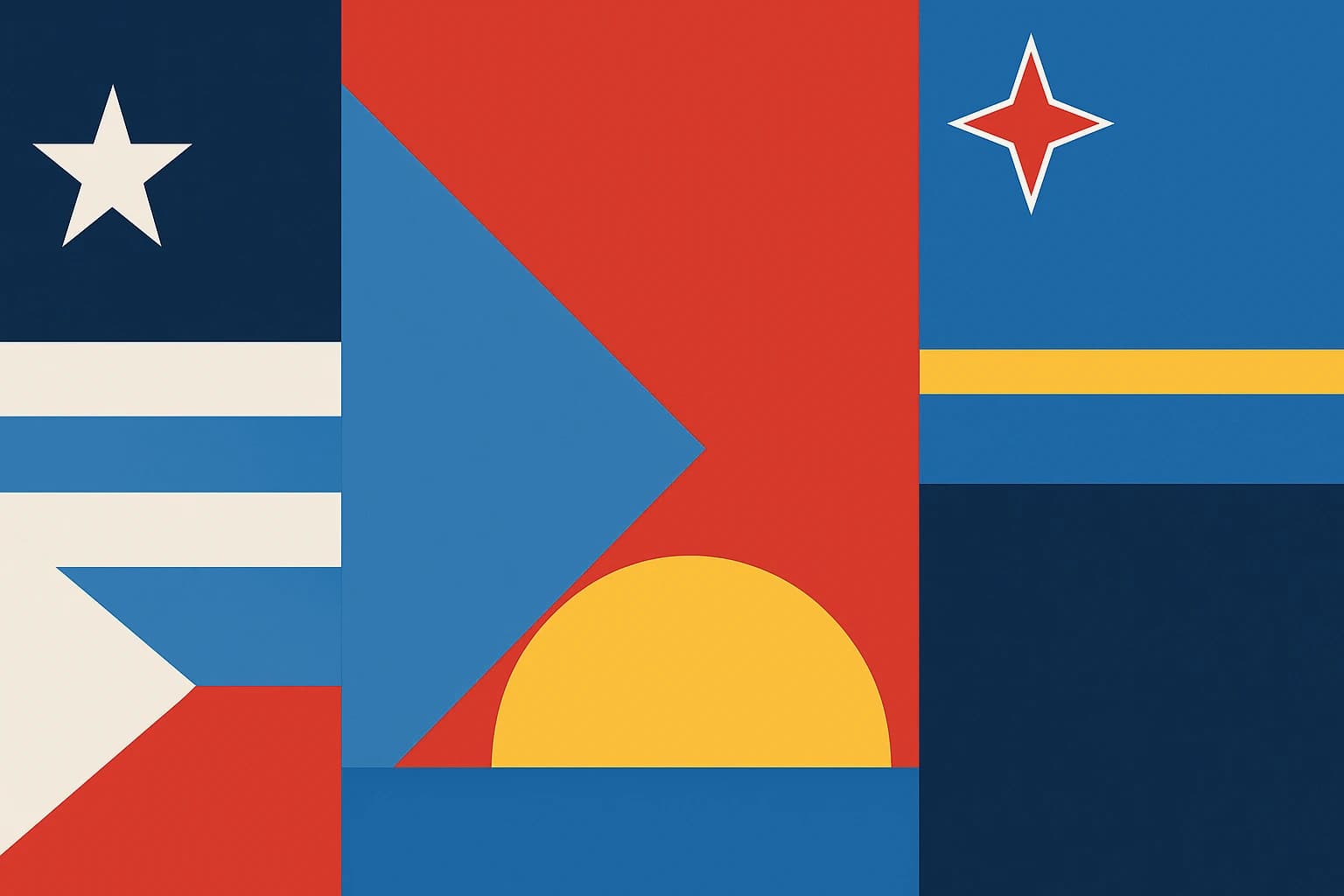
Aruba's flag is a light blue field with two narrow yellow horizontal stripes and a red star outlined in white.
Blue is the sky and the sea around the island. The yellow stripes are abundance and the island's minerals. The star's four points are the points of the compass, a reference to how much of the world has passed through Aruba and left something behind. During Carnival the flag is everywhere, which is when the claim about mixed influences is easiest to see.
Brazil, Chile, and Canada
Brazil's green and yellow with a blue globe covers both the landscape and the mixing of cultures within it.
Chile's red, white, and blue is plainer, resting on a history of courage, with a lone star for guidance.
Canada's maple leaf is the simplest of the three, standing for the country's nature and its unity in one shape.
How the designs changed
Colonization, independence movements, and cultural exchange all left marks on these flags. Many current designs are reinterpretations of older ones, and they get pulled at now by arguments about social justice and the environment the way earlier versions were pulled at by independence politics.
What the shared symbols do
Stars, stripes, and crosses recur across the hemisphere. They are usually read as unifying and they can do the opposite just as easily, since several flags in the Americas remain controversial because of what their symbols were historically attached to. A symbol that reads as unity to most people can read as a specific historical injury to others.
Flags now
National celebrations still put the flag at the center, and artists and social movements keep reusing them, reworking a design to say something about the present instead of the founding. That is not a departure from what flags do. It is the same act as the original design, carried out by different people.