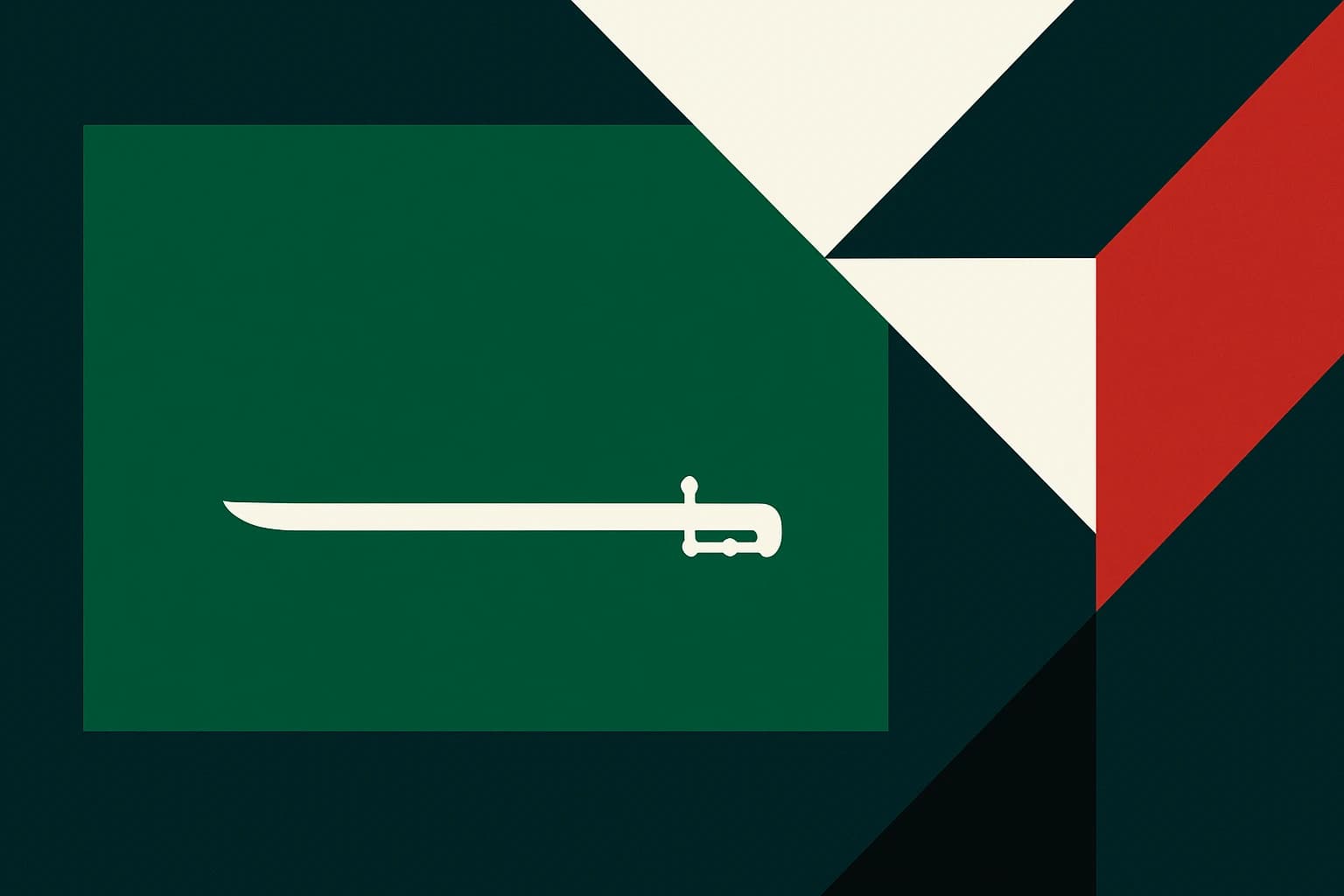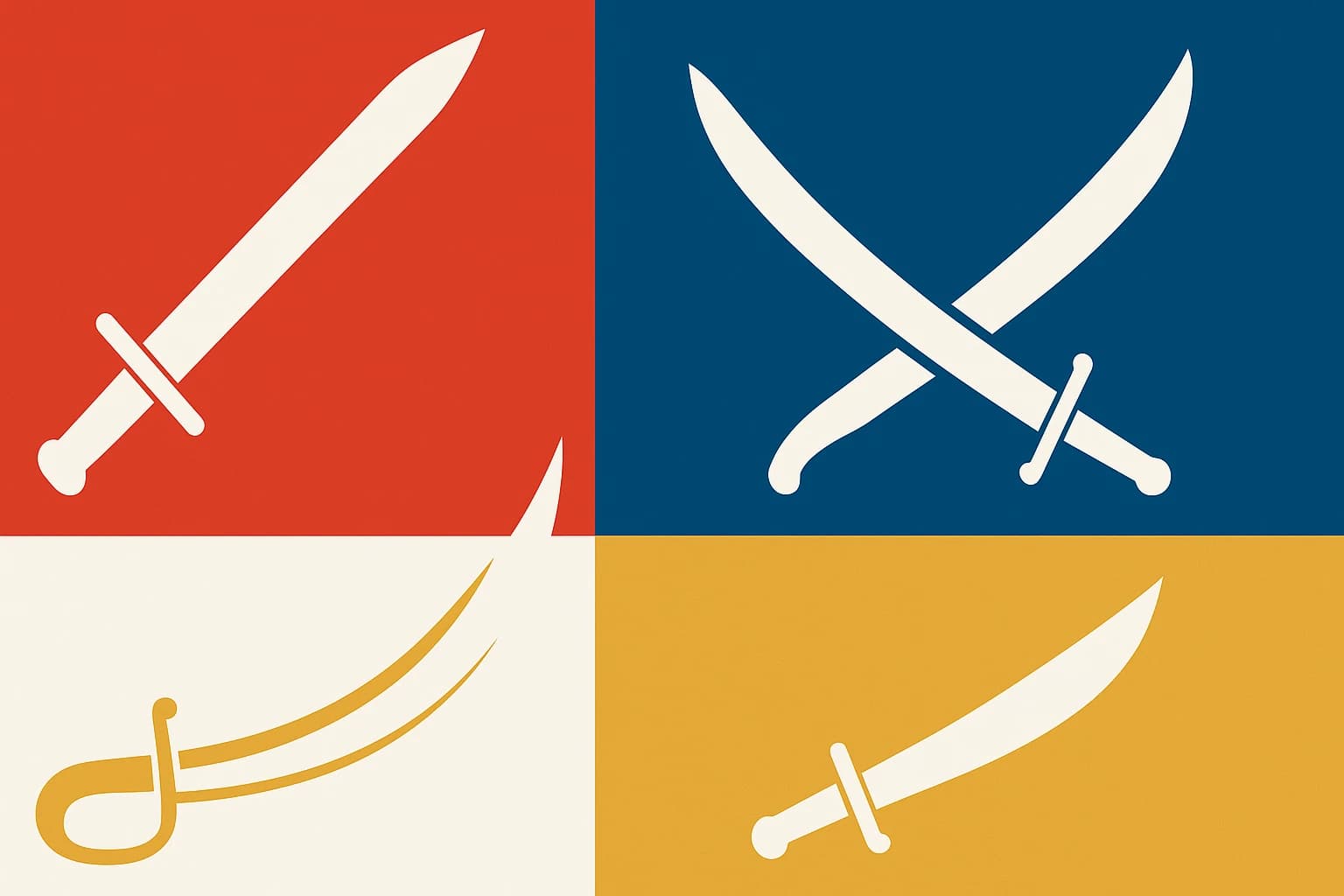
In 2026, at least four sovereign nations display a sword or dagger on their national flag. Saudi Arabia's white saif gleams beneath the shahada. Oman's khanjar dagger crosses two swords in a centuries-old royal emblem. Sri Lanka's golden lion grips a kastane sword on a crimson field. Kenya's Maasai shield and crossed spears guard a band of black, red, and green.
None of these are decorative flourishes. They are arguments about what a nation is and what it is willing to defend.
Some countries have doubled down on their bladed symbols. Others have spent decades debating whether a weapon on a flag sends the wrong message. Mozambique's AK-47 (a firearm, and a story for another article) is vexillology's most controversial national symbol, but the older and quieter debate is about swords, a weapon that predates the nation-state itself. Why did some countries choose the blade as their founding image, and why have others reconsidered? In a century built on soft power and diplomatic branding, does a sword read as heritage and sovereignty, or as aggression?
It depends entirely on who is holding the sword and who is looking at it.
Blades in medieval and early modern heraldry
Swords as symbols predate national flags by millennia. The flaming sword of Genesis. The sword of Damocles. The Prophet Muhammad's Dhul-Fiqar. Long before anyone stitched a flag together, the blade was already a symbol of authority, justice, and divine mandate.
In European heraldry from the 12th through 15th centuries, swords appeared on coats of arms to denote martial valor and the right to dispense justice. The sword of state carried before monarchs, like the Curtana of England, was a symbol of mercy as much as power. (The Curtana's tip is blunted, deliberately, to signify that the sovereign's justice is tempered. A small detail, but a telling one.)
Islamic heraldic traditions developed a parallel but distinct sword symbolism. The saif, the curved sword, represented both the expansion of faith and the defense of the ummah. That meaning directly informs the Saudi and Omani flags today.
The distinction that gets missed is this. In nearly all heraldic traditions the sword stood for legitimate authority and an obligation to protect rather than for aggression. A drawn sword meant readiness. A sheathed sword meant peace secured through strength. That is most of the reason modern nations kept the symbol: it was a claim about capacity, not appetite.
Saudi Arabia's saif
The Saudi flag's design dates to the early 20th century and was formalized in 1973. The white sword beneath the shahada ("There is no god but God; Muhammad is the messenger of God") is traditionally identified as the saif of Ibn Saud, founder of the modern Saudi state. But its symbolic roots reach back further, to the sword of Islam itself.
The sword performs double duty. It backs the shahada with sovereign power, and it signals the House of Saud's unification of the Arabian Peninsula by military conquest, specifically the Ikhwan campaigns of the 1920s. Religious and dynastic at once, two layers pressed into one image.
That produces complications you would not expect from a piece of cloth. Because the flag bears the shahada, Saudi Arabia enforces strict rules against flying it at half-mast, printing it on merchandise, or displaying it on the ground. The 2018 controversy over FIFA putting the flag on promotional soccer balls did not go over well. The sword shares that sanctity by proximity, since it cannot be separated from the sacred text above it.
Western commentators have read the sword as militaristic. Saudi officials and scholars frame it as the sword of the just ruler, a symbol of justice and national unity. Notably, Vision 2030's nation-branding push has not proposed changing the flag, which suggests the kingdom sees the sword as an asset rather than a liability.
The Saudi flag is also one of very few national flags that is genuinely double-sided. Both faces have to be manufactured separately so the shahada reads correctly from either direction, which makes it one of the most expensive flags in the world to produce.
Oman's khanjar and Sri Lanka's kastane
Oman's national emblem, two crossed swords behind a khanjar dagger in its sheath, appears in the upper-left canton of the flag and dates to the mid-18th century. The khanjar is not merely decorative. It is a living cultural object, worn by Omani men at formal occasions and recognized in UNESCO's Intangible Cultural Heritage discussions. The weapon on the flag is also the weapon in the wardrobe. That's a rare thing.
Sri Lanka's Sinha (lion) flag traces its lineage to the ancient Sinhalese kingdom. The lion gripping a kastane sword is mentioned in the Mahavamsa chronicle and has served as a royal symbol since at least the 15th century. When Sri Lanka redesigned its flag at independence in 1948 and again in 1972, the lion and its sword survived every revision, even as the flag added stripes representing Tamil and Muslim minorities.
Both cases point at the same pattern. The blade survives on a flag when it is embedded in a cultural identity that goes beyond warfare. Oman's khanjar is jewelry, coming-of-age ritual, and craft tradition. Sri Lanka's kastane is art history and dynastic myth. The weapon has been domesticated, for lack of a better word.
There is a counterpoint. Tamil minorities have read Sri Lanka's lion-and-sword flag as an exclusively Sinhalese symbol, and its ethno-nationalist resonance contributed to tensions during and after the civil war (1983 to 2009). The sword's meaning shifts with the viewer's political position. For one community the kastane is heritage. For another it is a reminder of exclusion.
Kenya's spears and the anti-colonial tradition
Kenya's flag features a Maasai shield and two crossed spears at its center, adopted at independence in 1963. The spears are framed as symbols of defense of freedom, a direct response to British colonial rule and the Mau Mau uprising (1952 to 1960).
That puts Kenya in a different category: the blade as anti-colonial statement. The spears do not reference pre-colonial monarchy or religious authority. They reference the act of resistance itself. Mozambique's AK-47 makes the same rhetorical move with a different weapon. We fought for this, and the weapon proves it.
Kenya's spears have faced less international controversy than Mozambique's rifle. The reason is telling. Spears are perceived as "traditional" and therefore less threatening, a perception that reveals more about Western biases than about the weapons themselves. A spear killed just as effectively as a rifle in its era. The distinction is aesthetic, not moral.
The broader pattern across the continent is worth noting. Post-colonial African nations were more likely to include weapons on flags than post-colonial Asian nations. This reflects how central armed liberation struggle was to African state-formation narratives in the 1960s. When you win your country with a weapon in your hand, you put that weapon on the flag. The logic is straightforward, even if outsiders find it uncomfortable.
Nations that debated disarming their flags
Mozambique's ongoing debate over its AK-47 is the most famous case. A 2005 flag redesign competition generated public discussion about whether the rifle should go. It stayed. But the broader trend includes other examples. Angola's machete on its flag has been periodically questioned.
Several post-Soviet states removed military symbols from Soviet-era emblems during redesigns in the 1990s. Those removals happened quickly and with little public debate, because the symbols belonged to an occupying ideology, not to national identity. The sword (or hammer, or star) wasn't theirs. Removing it was liberation, not loss.
The argument for removal typically centers on international image. Weapons on flags complicate diplomatic branding, tourism marketing, and bids for international organization leadership. The argument for retention centers on historical authenticity and the danger of erasing the sacrifice that produced the nation. Both arguments are reasonable. Neither is complete.
One fact shapes this whole debate without anyone naming it: no Western European national flag features a weapon. Not one. The sword of justice survives on England's royal arms, but not on any national flag. European nations took swords off their state arms and flags during the 19th and 20th centuries as they moved from martial monarchies to liberal democracies, and that history left behind an unexamined assumption that a "modern" flag should not carry a weapon. The standard feels universal and is actually provincial.
The removal debate is never about the weapon alone. It is a proxy fight over national identity, and removing a sword means choosing which version of the national story to tell: the one about building or the one about fighting. Most nations want to tell both, and a flag only has so much room.
Heritage, sovereignty, or threat?
In the current geopolitical moment, the sword on a flag is read through at least three competing lenses. The heritage preservation lens (the UNESCO/cultural patrimony frame). The sovereign assertion lens ("we define our own symbols," a frame particularly potent in the Global South). And the threat signaling lens (the Western liberal-internationalist frame that associates weapons with belligerence).
Saudi Arabia's sword is arguably more visible globally in 2026 than at any point in history. The kingdom's expanded role in international sports (FIFA hosting preparations, LIV Golf, esports), entertainment, and diplomacy means the flag appears in contexts its designers never imagined. Stadium jumbotrons. Streaming platform sponsorships. Esports tournament overlays. Every new venue is a new audience encountering the saif for the first time.
Which raises a principle worth stating plainly: flags are not logos. They are not designed to appeal to foreign consumers, and they are assertions of identity directed inward at least as much as outward. Judging a flag by international marketing standards misunderstands what it is for. In a hyperconnected world, though, the line between domestic symbol and global brand is collapsing regardless of what vexillologists think about it.
The pattern underneath all of this is that nations which kept swords on their flags are disproportionately nations whose sovereignty was contested, colonized, or recently forged. The sword is less a boast than a record. This nation exists because someone was willing to fight for it. Whether the world respects that or flinches from it says as much about the viewer as about the flag.
What the blade remembers
Nations that have sheathed or removed their symbolic blades were responding to changing ideas about statehood and international image. Nations that kept them, deliberately and in full awareness of the argument, were making a different calculation. Where a country's existence was won by force, or where its identity is inseparable from a martial tradition, the sword is not a problem to be solved.
In 2026, as in 1926, the meaning of a blade on a flag depends on whose hand holds it, whose history it invokes, and whose gaze it meets. The sword has never spoken for itself.