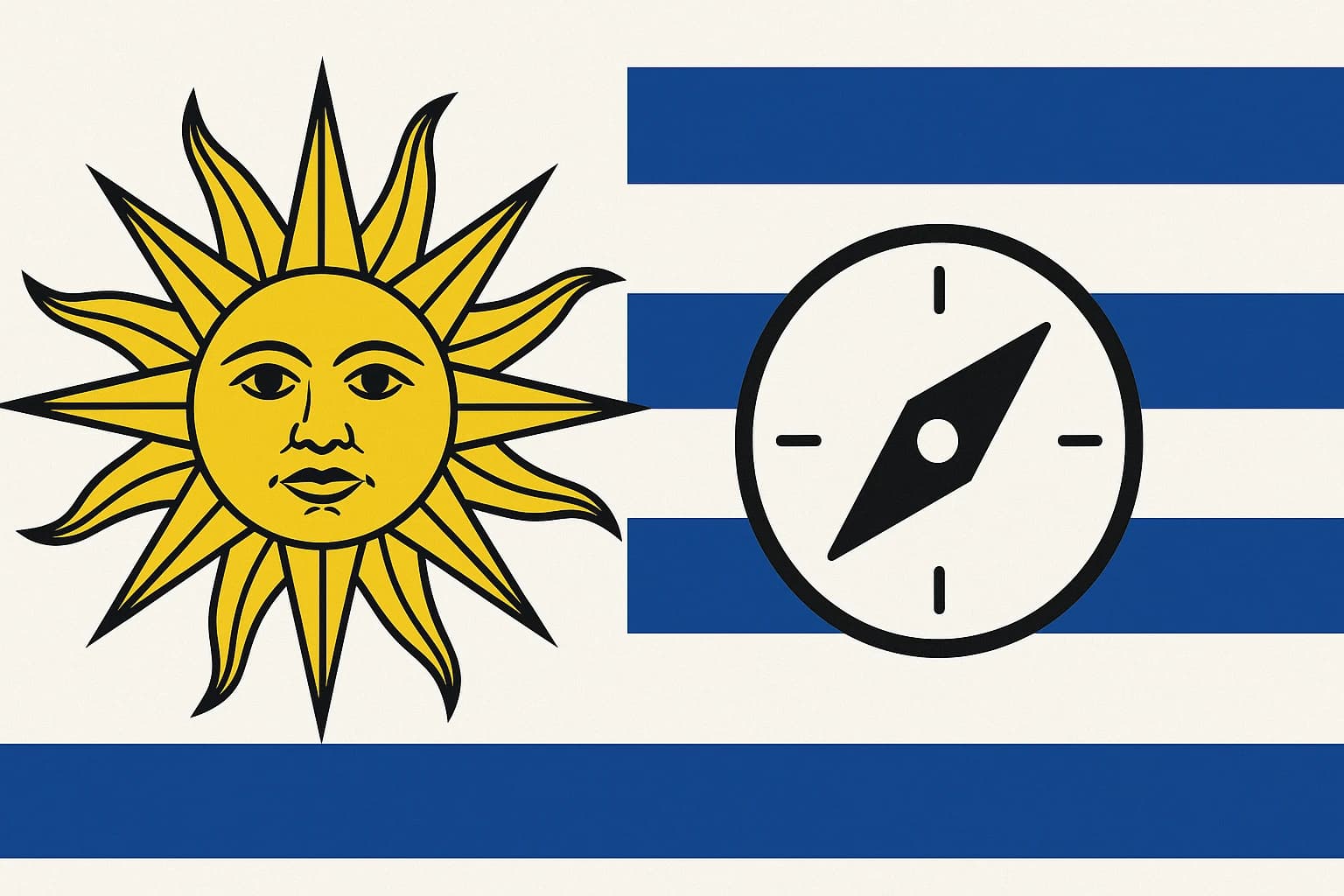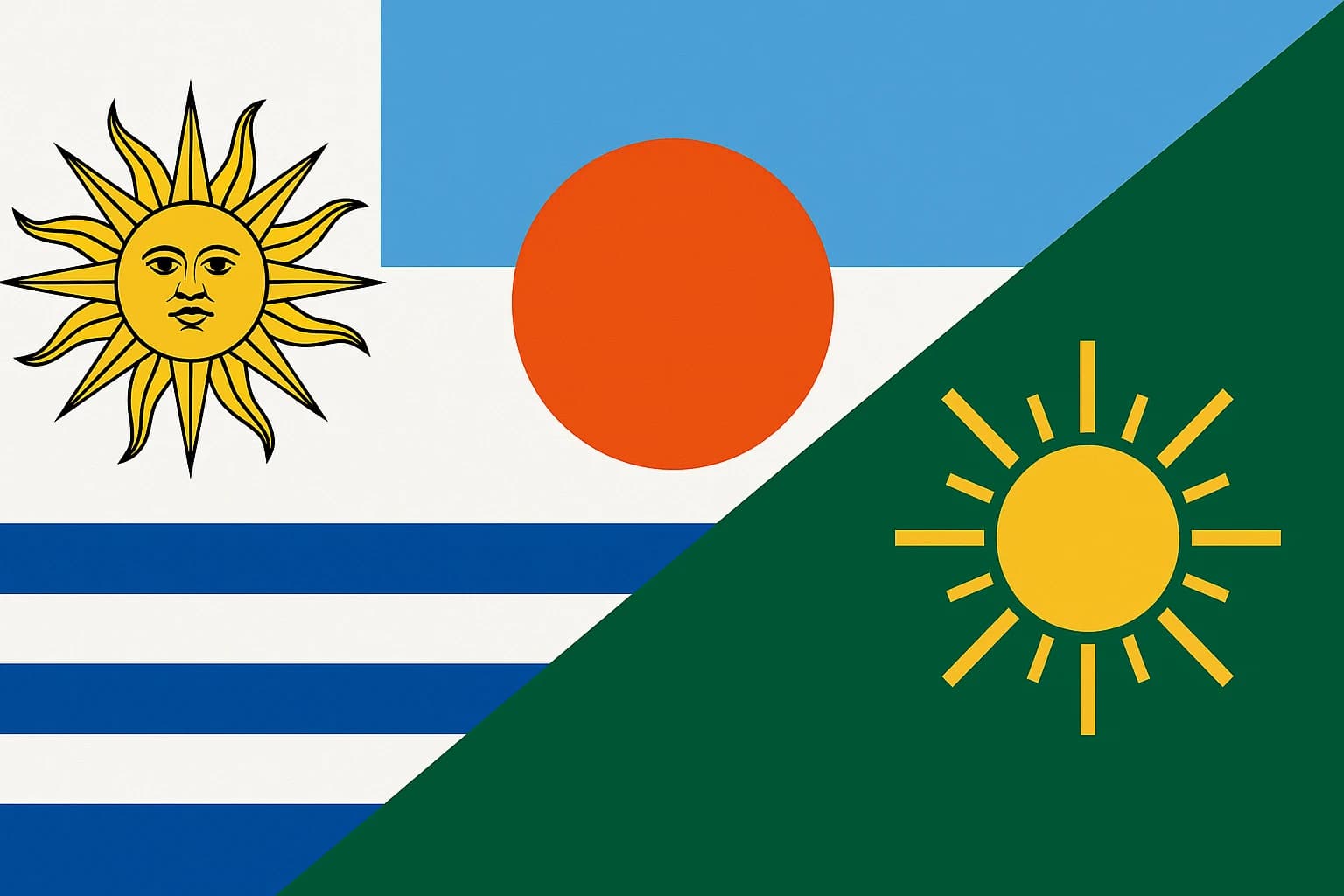
Strip the color from the flags of Argentina, Uruguay, and Bangladesh and you get the same thing three times: a circle, centered, radiating meaning. Three nations on three continents reached for the same shape when they needed to say something permanent about who they were.
None of them copied the others. Argentina's sun marks a specific Tuesday in 1810. Uruguay's sun sparked a diplomatic protest between two brand-new countries. Bangladesh's red disc carries the weight of a war that killed hundreds of thousands. Same shape, completely different arguments.
The sun keeps turning up not because nations borrow from each other but because it is the one image large enough to hold whatever meaning a people need to pour into it.
The most popular symbol nobody talks about
The sun appears on roughly one in six national flags worldwide, which makes it one of the most common symbols in vexillology. Flag scholarship spends remarkably little time asking why.
Part of the reason is that "sun on a flag" is not one category but dozens. North Macedonia's sun has bold radiating rays inspired by the ancient Vergina Sun.
Japan's Hinomaru is a stark red disc with no rays at all.
Kazakhstan places a golden orb beneath a soaring steppe eagle. These are wildly different design choices solving wildly different symbolic problems.
The tension running through all of it is universality against specificity. Every culture on Earth developed meaning around the sun independently, well before writing, organized religion, or the nation-state. That universal recognition is exactly what makes it useful when a specific political movement wants to claim it. The sun feels inevitable, and it feels like it was always yours.
Argentina and Uruguay share an almost identical face-bearing sun. Bangladesh's is a featureless red disc. The visual difference is small and the meaning gap is enormous, and the reason lies in the moments of crisis that made each country reach for the sky in the first place.
Argentina's Sun of May
May 25, 1810, Buenos Aires. A crowd gathers in the Plaza de Mayo as the first independent government junta takes shape, breaking from Spanish colonial authority. That is the May Revolution, and it gives Argentina's sun its name. The Sun of May is named for a date, not for the object in the sky.
The legend goes like this: as the crowds swelled in the plaza, the sun broke through heavy clouds, an omen taken as divine approval of the revolution. Whether or not that happened exactly as described, the image was immediately mythologized. Within years, it was inseparable from the republic's identity.
The timeline is worth noting. Manuel Belgrano created the Argentine flag in 1812 and his original design had no sun on it at all, just the blue and white stripes. The Sun of May was not officially added until 1818. It did not arrive with the flag; it was promoted onto it.
The design does a lot of work. Thirty-two alternating straight and wavy rays surround a human face. The face draws loosely on Incan solar imagery, the Inti, but the designers turned it into something else: a criollo republican symbol fusing Indigenous heritage with Enlightenment-era revolutionary ideals. It looks back at you.
Argentina's sun is really a calendar. It marks a specific Tuesday in May 1810 and insists the viewer remember it, and the face makes it a political actor rather than a cosmic object.
When a neighbor's symbol becomes a diplomatic incident
Look at Uruguay's flag and try not to do a double-take.
Uruguay's Sun of May is, for nearly all practical purposes, the same sun as Argentina's. Same face. Same rays. Same Incan-republican fusion. This is not a coincidence. It is a statement of shared political heritage from the independence movements of the Río de la Plata region.
The historical context makes this overlap inevitable. Uruguay, then called the Banda Oriental, was deeply entangled with Argentina's revolutionary wars. José Gervasio Artigas, Uruguay's founding hero, led forces allied with Buenos Aires before the two territories' political fates split apart. They fought the same revolution. They bled together. The shared sun reflects a shared revolutionary moment.
When Uruguay adopted its flag design in 1830, Argentina protested. Not with troops, but through formal diplomatic channels, on the grounds that Uruguay was appropriating an Argentine symbol. It is one of the rare moments in vexillological history where a flag design became a bilateral diplomatic issue between two newly formed states. Countries fight over borders and resources all the time. Going to the diplomatic mat over a sun with a face is rarer.
Uruguay's counter-argument was hard to dispute. The Sun of May belonged to the whole liberation movement of the southern cone, not to Buenos Aires alone, and Uruguayan soldiers had fought and died under that same sun.
What the dispute shows is that flags create ownership claims over shared history. The same image flown by two neighbors tells two slightly different stories about who gets to inherit a revolution. Argentina says this is ours. Uruguay says this is ours too. Both are right, and neither will budge.
Bangladesh's red disc
Bangladesh's flag drops the faces and rays entirely.
The red disc on the green field is not a sun in the traditional vexillological sense. No rays, no face, no mythological referent from an ancient dynasty. Its designers described it as the sun of a new dawn rising over a free Bengal, but the color is doing something more visceral than a sunrise.
The flag was designed in 1971, during the Bangladesh Liberation War. The scale of violence in that conflict remains contested and politically charged: estimates of those killed range from 300,000 to 3 million. The red, according to the flag's principal designer Quamrul Hassan and the architects of the independence movement, is the blood of those who died fighting for liberation from Pakistani rule. That is not a metaphor dressed up as symbolism. It is a wound placed at the center of a national identity.
One design detail deserves attention. The first version of the flag, the one flown during the war, had a gold map of Bangladesh inside the red disc. After independence was secured in 1972, the map came off. Removing it made the symbol more universal and the disc more purely symbolic. The map said "this specific place." The bare disc says "this specific cost."
Argentina's sun is a face looking back at a date. Bangladesh's disc is an abstraction looking forward at a dawn that cost everything.
The featurelessness is what makes it work. Keeping only the red circle on green produced a symbol that is at once specific, the Liberation War of 1971, and open to anyone: any dawn, any sacrifice, any people stepping into light after darkness. It refuses to explain itself, and that is the source of its force.
The politics of celestial symbolism
Why do nations, especially new or newly liberated ones, reach for the sun?
The answer is not really aesthetic. The sun is the original symbol of sovereignty. Every human culture organized meaning around it long before states, organized religion, or writing. No committee invented it and no designer proposed it. It was already there, already loaded, waiting to be claimed.
The sun carries a dual political valence that makes it uniquely attractive. On one hand, it represents authority from above. Monarchies, empires, and divine-right rulers have all used solar imagery. Louis XIV was the Sun King. The Japanese Emperor was considered a descendant of the sun goddess Amaterasu. The Incan Sapa Inca ruled as the son of Inti, the sun god. On the other hand, revolutions and independence movements reappropriate the sun as a symbol of liberation from below. A new dawn. A new day. A people stepping into light after colonial darkness.
That double reading is what makes the sun so useful to new nations. A freshly independent country needs a symbol that feels ancient and inevitable rather than something that looks like it was designed last week, and the sun supplies that instantly. We are not new. We have always been here.
There is an irony in two of these cases. Argentina's sun borrows from Incan imagery to legitimize a criollo republic whose leaders were of European descent. Bangladesh's inverts the celestial symbolism of Pakistan's flag, which uses a crescent and star with Islamic connotations, and replaces it with a pre-Islamic, agrarian image of a disc rising over green fields.
The sun's power is its emptiness. Every nation that puts one on a flag paints something entirely its own onto it.
Three flags, three arguments
Line the three up and you have three different sentences written with the same word. Argentina's sun says remember this specific day. Uruguay's says we share this inheritance. Bangladesh's says this is what liberation cost.
Flags are not pictures of things. They are arguments encoded in cloth, and the sun is the most versatile word in the vocabulary, meaning radically different things depending on the sentence it lands in. A face-bearing golden sun on blue and white stripes does not feel remotely like a featureless red disc on green.
There is a design lesson buried in that. A red disc is about as simple as a flag element gets, and simplicity is what leaves room for meaning to accumulate. Bangladesh's designers arrived at that by instinct and under extreme pressure.
If these three nations had seen each other's flags before designing their own, they probably would not have changed a thing. The meanings were too specific and too urgent for a substitute to work. Argentina needed a face to stare back at history. Uruguay needed to assert a shared inheritance. Bangladesh needed a circle the color of blood.