On March 2, 1971, a young student named A.S.M. Abdur Rab stood on the rooftop of a dormitory at the University of Dhaka and raised a flag that did not yet belong to any country. It was a crude but deliberate design: a red circle on a green field, with a rough gold map of East Pakistan at its center. Within weeks, the Pakistani military would launch Operation Searchlight, a systematic campaign of mass killing that would claim up to 3 million lives. Within nine months, that student flag would become the national banner of a brand-new country: Bangladesh.
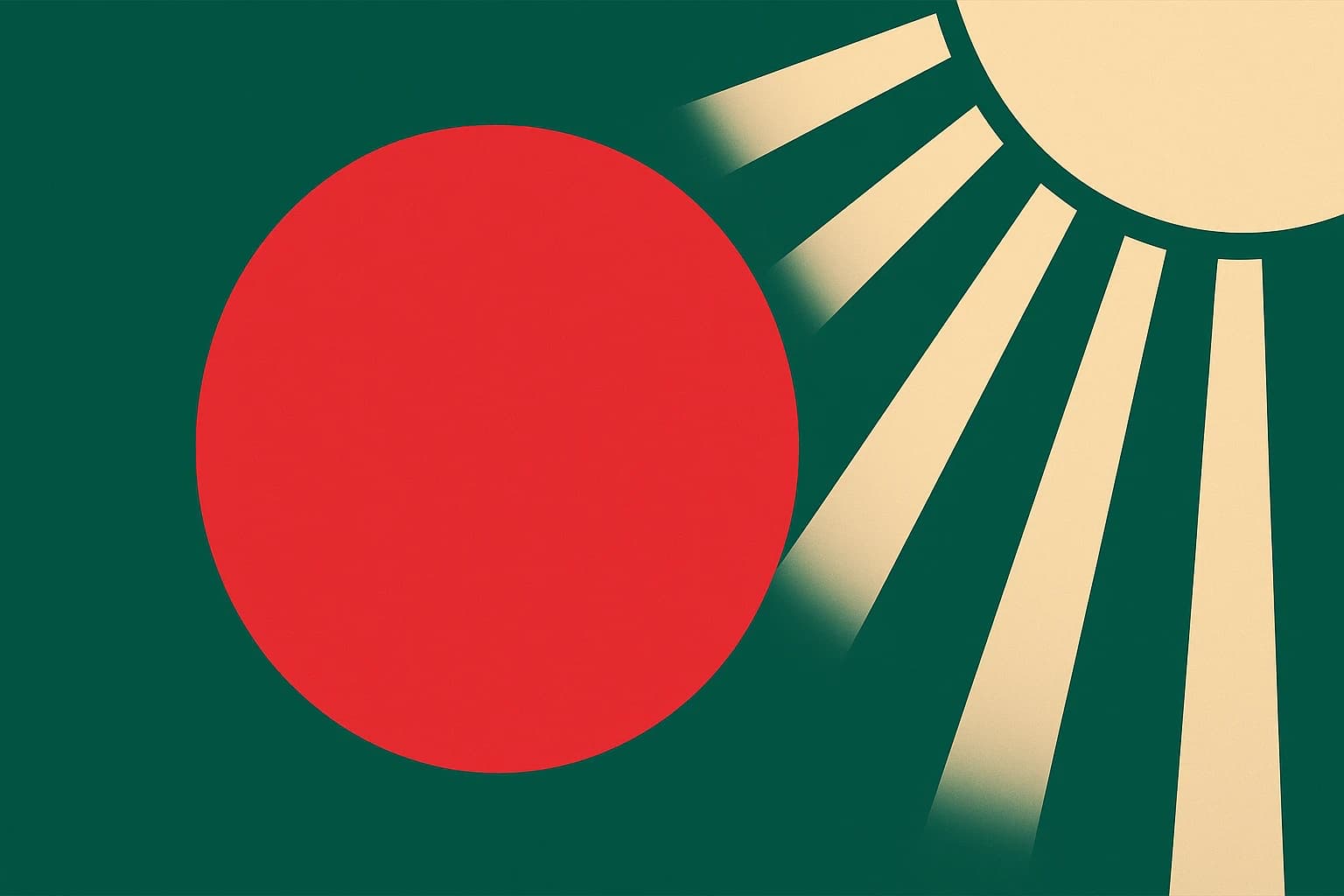
The flag of Bangladesh looks simple. A solid red disc offset slightly to the left on a dark green rectangle. Encoded in that geometry is one of the 20th century's most violent independence struggles, along with a great deal of student defiance and the urgent need of a newborn nation to declare itself real.
There is one design detail most people never notice: the red disc is not centered. It is shifted toward the hoist so that when the flag flies, the fabric's natural drape makes the circle appear centered to anyone watching. Even the physics of the cloth were bent to serve the symbolism.
East Pakistan reaches its breaking point
The flag makes more sense once you know the geography that made it necessary.
After the 1947 Partition of India, Pakistan was born as two separate landmasses divided by over 1,000 miles of Indian territory. West Pakistan held the capital, the military brass, and the political establishment. East Pakistan held more people, more poverty, and almost no power. The two wings shared a religion (Islam) but little else. West Pakistan spoke Urdu. East Pakistan spoke Bengali. And the West treated the East less like a partner and more like a colony.
The first fracture came early. In 1952, Bengali students took to the streets of Dhaka to protest the government's declaration of Urdu as the sole national language. Police opened fire. Students died. The Language Movement of 1952 became the founding trauma of East Pakistani identity, a direct precursor to the flag's symbolism of martyrdom and resistance. (Decades later, UNESCO would recognize February 21 as International Mother Language Day, a global holiday born from those killings in Dhaka.)
Then came Cyclone Bhola. In November 1970, one of the deadliest natural disasters in recorded history struck East Pakistan. Estimates range from 300,000 to 500,000 dead. The response from the West Pakistani government was negligent to the point of cruelty. Relief was slow, inadequate, and visibly indifferent. For millions of East Pakistanis, the message was clear: they were expendable.
The final crisis was political. In the December 1970 elections, Sheikh Mujibur Rahman's Awami League won a landslide majority in the Pakistani national assembly. East Pakistan had, through democratic means, earned the right to govern the entire country. President Yahya Khan and the West Pakistani establishment refused to transfer power, postponing the assembly and stalling for time.
After that, East Pakistan stopped asking for autonomy and started thinking about independence.
The student designers of Dhaka University
Flags usually follow nations. A country is born and then someone designs a flag for it. Bangladesh did it the other way around.
In 1970, while the political crisis was still building, student leaders at Dhaka University began designing a national flag for a country that did not yet exist. The group behind the effort was the Swadhin Bangla Biplobi Parishad, the Free Bengal Revolutionary Council, a clandestine student organization operating under the noses of the Pakistani state.
The original design was created by Quamrul Hasan, a prominent Bengali artist, with input from student leaders including Serajul Alam Khan. It featured a red circle on a green field with a gold silhouette map of East Pakistan inside the disc. Green for the Bengal delta. Red for the blood already spilled. Gold for the land they intended to claim.
On March 2, 1971, A.S.M. Abdur Rab unfurled that proto-flag at a massive rally on the Dhaka University campus, two weeks before the war began. This was sedition rather than symbolism in any safe, abstract sense. Raising the flag declared that East Pakistan intended to become something else entirely.
The flag spread fast. It appeared at Sheikh Mujib's historic March 7 speech at the Racecourse Ground (now Suhrawardy Udyan), where he told a crowd of millions: "The struggle this time is for our freedom. The struggle this time is for our independence." Demonstrators carried the flag through the streets of Dhaka, Chittagong, Rajshahi. It became the visual language of a movement that had passed the point of no return.
The flag was tactical rather than decorative, and raising it was irreversible. You cannot un-fly a flag of independence. Once it went up, the population, the Pakistani military, and the international community all understood that the goal was no longer autonomy within Pakistan.
Operation Searchlight and the nine months that followed
On the night of March 25, 1971, the Pakistani military launched Operation Searchlight.
It was a coordinated assault targeting Bengali intellectuals, students, police, and Hindu minorities across East Pakistan. Dhaka University was among the first targets. Soldiers entered dormitories and opened fire. Professors were dragged from their homes and executed. The scale of what followed over the next nine months remains contested but not in its horror. The Bangladeshi government cites 3 million dead. The Pakistani government acknowledges 300,000. Credible independent estimates generally place the toll at several hundred thousand to over a million killed, with widespread sexual violence used systematically as a weapon of war.
Sheikh Mujibur Rahman was arrested on the night of the crackdown and taken to West Pakistan. But the resistance did not die with his capture. The Mukti Bahini, the Liberation Forces, a guerrilla army of Bengali soldiers, students, and civilians, waged a nine-month war of resistance across the rivers, fields, and villages of East Pakistan.
They fought under that flag.
Mukti Bahini fighters carried it into battle and civilians flew it from their homes as acts of defiance. The Pakistani military understood exactly what it meant, and targeted homes and buildings displaying it. Raising the flag from your rooftop could get you killed.
India entered the war in December 1971, launching a two-week military campaign that broke the Pakistani army's hold on the east. On December 16, 1971, Lieutenant General A.A.K. Niazi signed the instrument of surrender in Dhaka, handing over 93,000 Pakistani troops. It remains the largest military surrender since World War II. That date, December 16, is now celebrated as Victory Day, Bijoy Dibosh, in Bangladesh.
Why the map was removed
When Bangladesh formally adopted its flag on January 17, 1972, the gold map of the country was gone. The red disc sat alone on the green field, and that was the whole design.
The practical reason was straightforward. A map is asymmetrical, so on the reverse of a flag it appears mirrored, and a mirrored map of your own country was considered unacceptable. Flags have to read correctly from both sides, and geography does not cooperate with that.
The symbolic reason ran deeper. Removing the map opened the flag's meaning up. The red disc no longer pointed at a specific territory, so it could be the rising sun over the Bengal delta, or the blood of the martyrs who died in 1952, in 1970, and in 1971, or the birth of a new nation at dawn. All of those readings coexist without cancelling each other out.
Quamrul Hasan's color choices survived the edit. The green field is the Bengal delta, a place where the rivers deposit so much silt that the land itself is constantly being made. The red carries both the dawn of independence and the human cost of getting there.
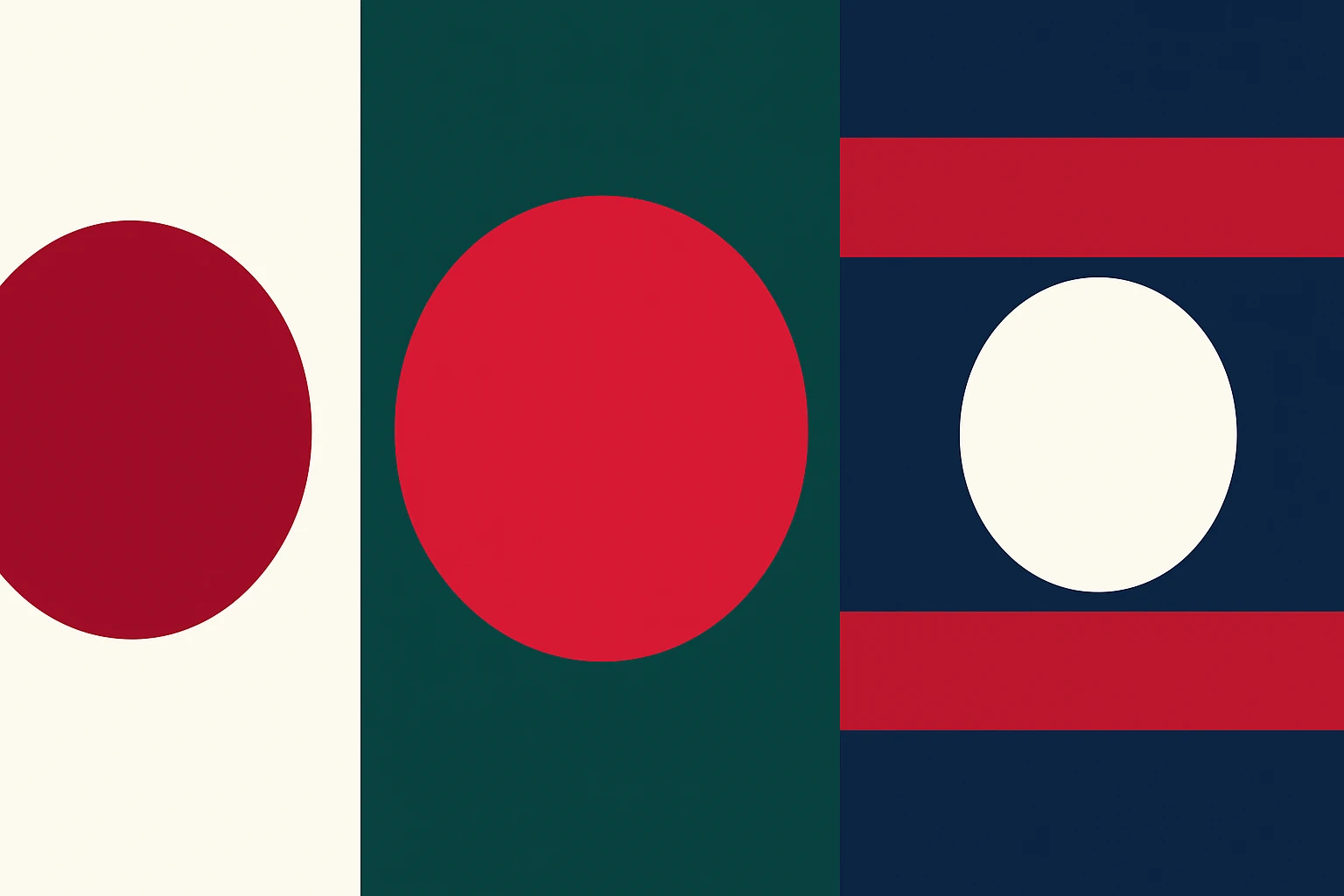
The visual comparison to Japan's Hinomaru is hard to miss, since Bangladesh's is one of only a few national flags with a solid disc on a single-color field, and the designers were aware of the kinship. Japan was one of the first major nations to recognize Bangladesh. But the symbolism is entirely distinct. Japan's red disc is the sun as a source of imperial and cultural identity going back centuries. Bangladesh's is a sunrise soaked in blood, the first morning of a country that did not exist the day before.
The offset disc
The red disc on Bangladesh's flag is not geometrically centered. The official specifications place the center of the disc at 9/20 of the flag's length from the hoist rather than at the midpoint, a deliberate shift toward the pole.
The reason is aerodynamics and perception. When a flag flies, the fabric near the free edge extends further from the observer than the fabric near the pole, which distorts what you see. A geometrically centered circle on a flying flag drifts toward the fly end and looks off. Shifting the disc toward the hoist compensates for that, so when the flag catches the wind the red circle sits at the visual center.
Bangladesh is not the only country to use this trick. Palau does the same thing with its golden disc on a blue field.
What makes Bangladesh's version worth pausing on is the context. This was a flag designed during a political crisis, refined during a genocide, and adopted by a government that was weeks old. Someone in the middle of all that took the time to calculate the exact optical correction needed to make a circle look right in the wind.
That is not a provisional movement making things up as it goes. The offset amounts to a fraction of the flag's length, and it tells you that the people involved expected the country to still be there in fifty years.
Flags as declarations of existence
Bangladesh's flag belongs to a specific category: the post-conflict national banner. Other nations born in violent struggle have made similar choices, encoding their wars of independence directly into their symbols.
Timor-Leste, which gained independence in 2002 after a brutal Indonesian occupation, adopted a flag whose red field and black triangle speak directly to the years of resistance and death.
South Sudan, the world's youngest country (2011), carries a green, red, white, and black design descended from the Sudan People's Liberation Movement's wartime banner.
Eritrea, independent since 1993 after a 30-year guerrilla war, placed an olive wreath on its flag to mark the hope for peace after three decades of fighting.
The tension in post-conflict flag design is real. A flag born in war has to honor the dead, rally the living, and project stability abroad, all at once. Lean too hard on the sacrifice and the flag becomes a wound that never heals. Lean too little and it betrays the people who died for it. Bangladesh's design gets through that with two colors and one shape. No text, no stars, no crescents, no coat of arms, and it still holds the cyclone, the language movement, the killing, the liberation, and the first sunrise.
The flag flies on Victory Day (December 16), Independence Day (March 26), and Language Movement Day (February 21). Each occasion pulls a different layer of the meaning forward, so the same red disc reads slightly differently on each date. Stripping the design back to two elements is what allowed that. A more specific flag, one with the map still on it, would have said one thing and only one thing.