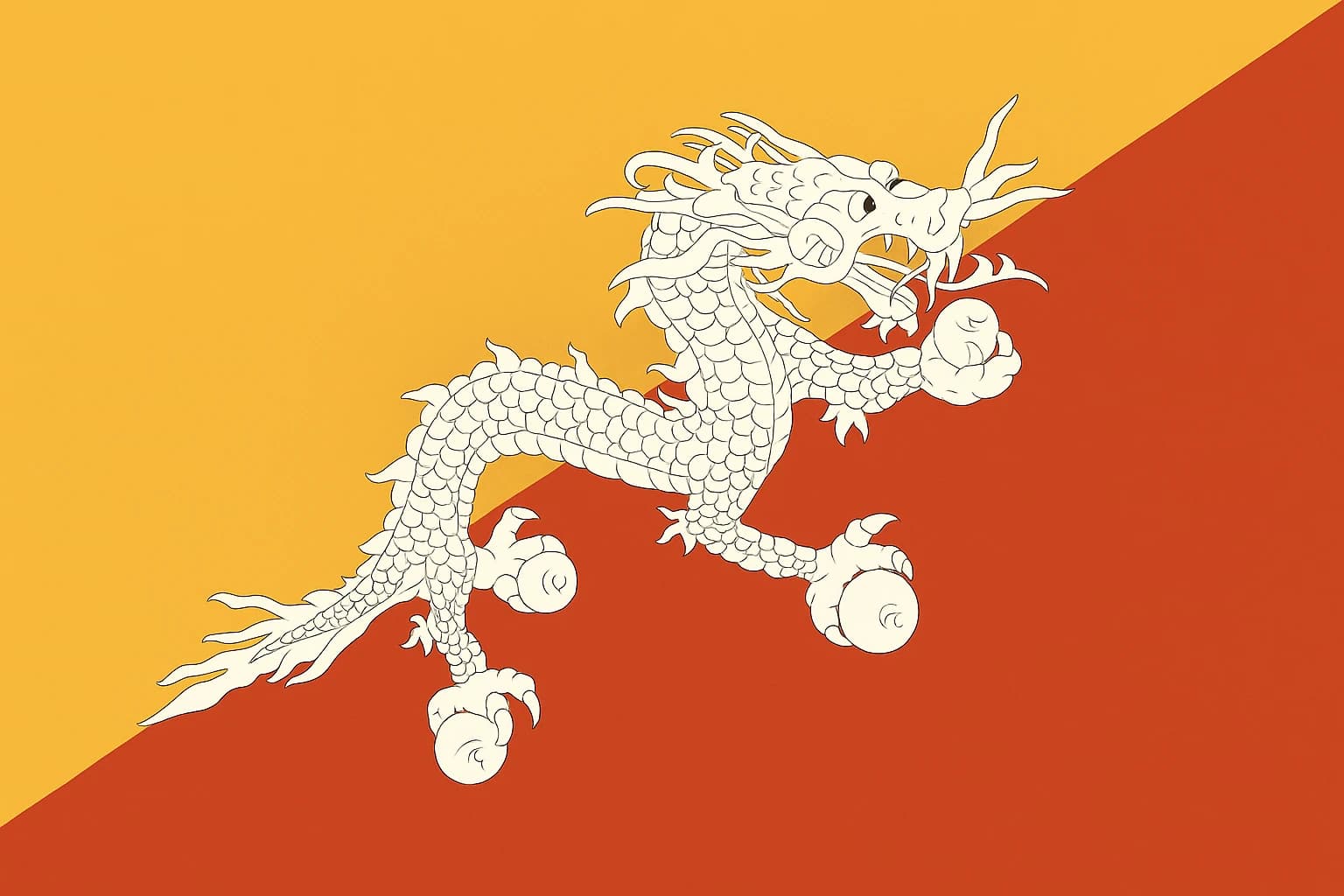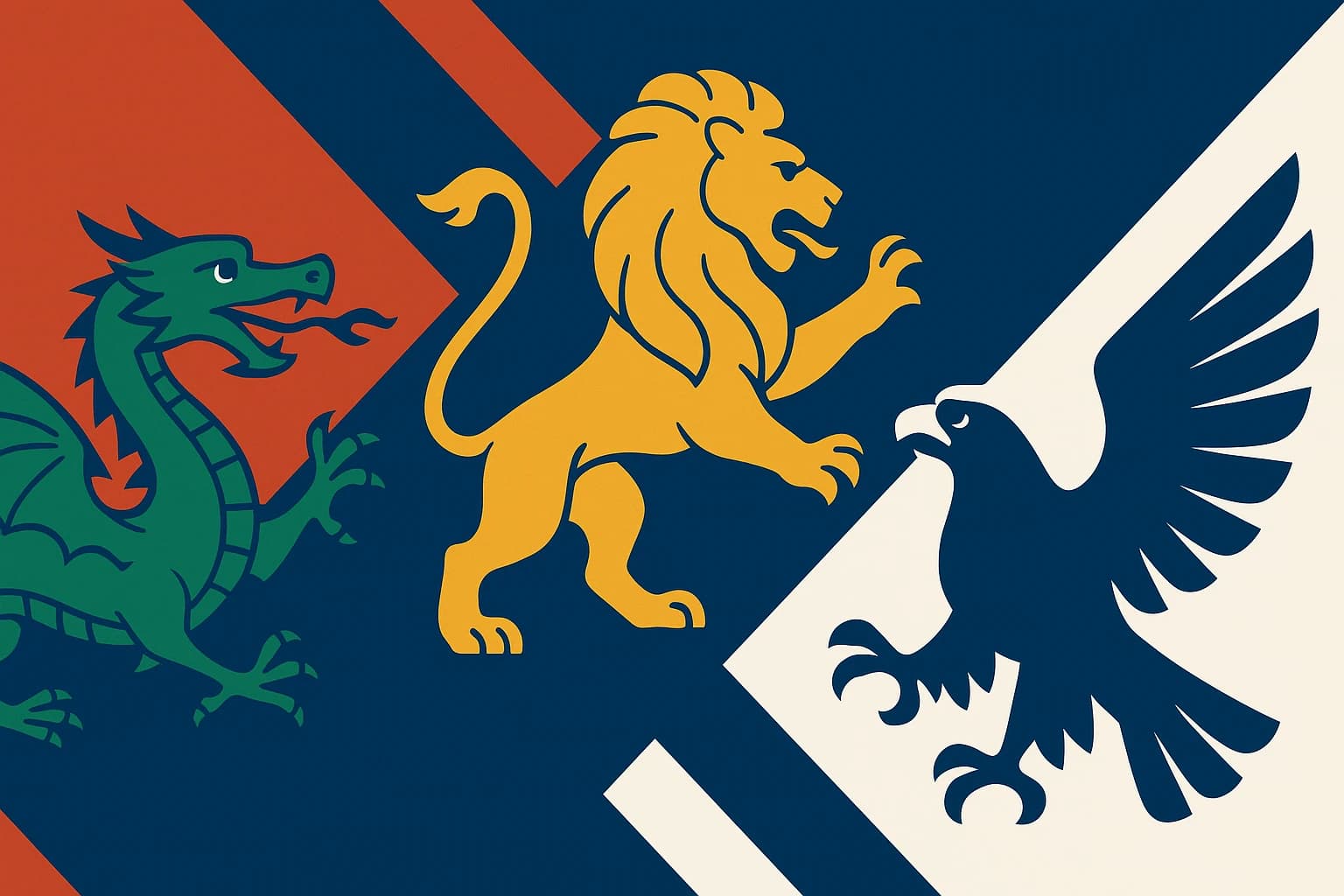
Sri Lanka has no wild lions. It never did. No fossil record, no cave paintings, no ecological niche for a big cat of that kind on a tropical island in the Indian Ocean. And yet, for over 2,500 years, a sword-wielding lion has stood at the center of this nation's identity. It survived the collapse of ancient kingdoms, the systematic erasure of colonial rule, and the violent fractures of a 26-year civil war. The flag Sri Lanka raised on February 4, 1948, was not a clean slate. It was an inheritance, and a declaration.
What does it mean for a symbol to outlast every empire that tried to replace it? The story runs from a 6th-century origin chronicle to the post-war politics of 2026, and there is a tension running through all of it that has never been resolved. The same flag that represents unbroken continuity for one community is experienced as exclusion by others.
A lion that never existed here
The story starts with the Mahavamsa, the great Pali chronicle compiled in the 6th century CE. It tells the origin story of the Sinhala people through the legend of Prince Vijaya, a semi-legendary figure said to be the grandson of an actual lion. "Sinha" means lion in Sanskrit. The Sinhala people, in their own founding narrative, are literally "the lion people."
The lion was never a real animal on this island. It was a totemic ancestor, a mythological claim to lineage and power, and that distinction matters. The bald eagle on the American seal points at a living creature found on the continent. The Sri Lankan lion was symbolic from its first appearance, about identity rather than nature.
The earliest physical evidence shows up on coins from the Anuradhapura Kingdom, dating to roughly the 3rd century BCE. Lion imagery stamped on currency, carved into stone, woven into royal ceremony. That makes the Sri Lankan lion one of the longest-running heraldic symbols in continuous use anywhere on Earth.
Compare that to Albania's double-headed eagle, which entered heraldic use via Byzantine borrowing during the medieval period. Or consider most European coats of arms, which coalesced during the 12th and 13th centuries. The Sri Lankan lion predates them by over a thousand years.
A symbol born from myth also bends to politics. The lion's meaning was never fixed; it was inherited, reshaped, and claimed by whoever held power at the time, which is why it has lasted and why it keeps causing trouble.
How a mountain kingdom turned a myth into a flag
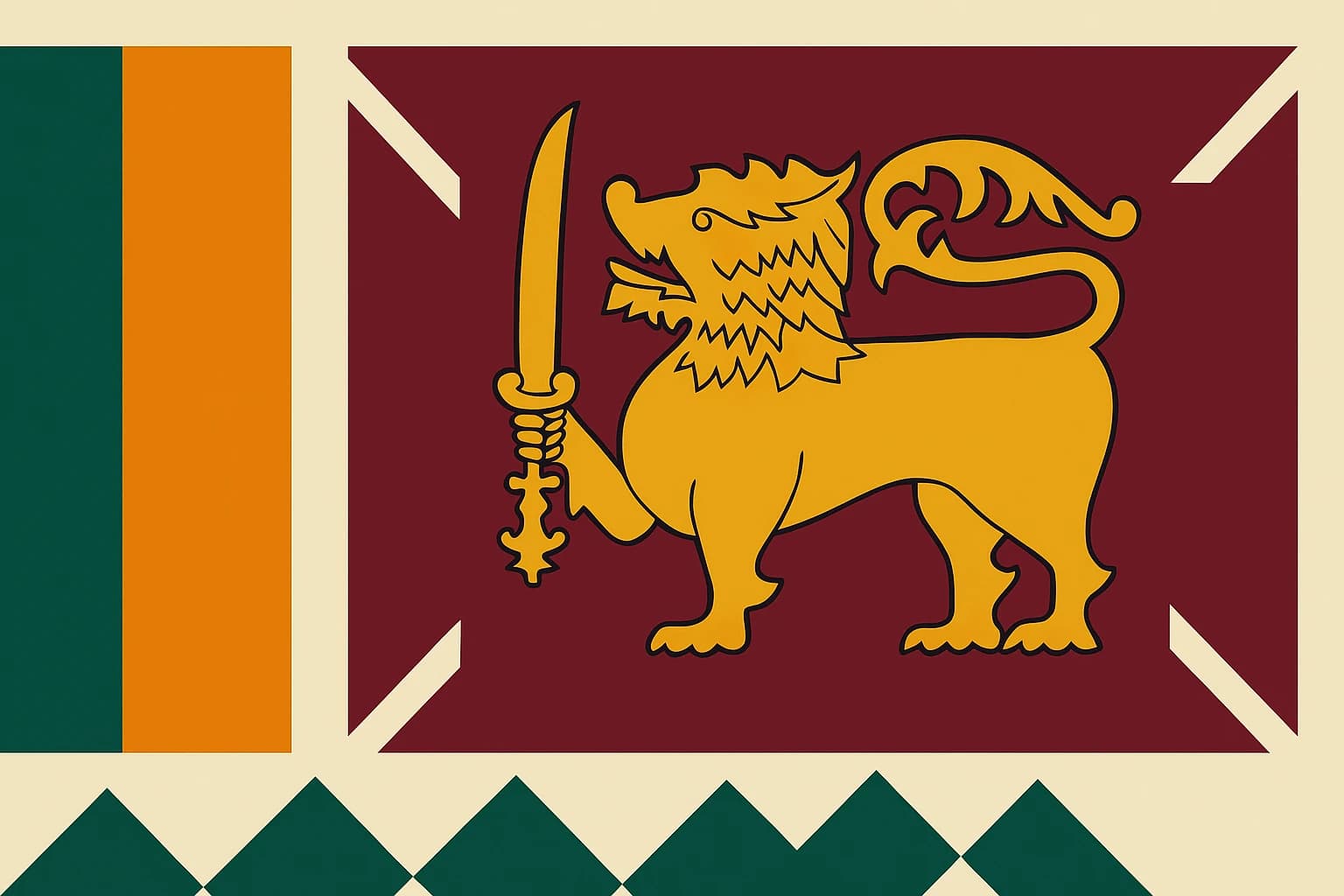
The Kandyan Kingdom, which lasted from 1469 to 1815, is the direct political ancestor of the modern Sri Lankan flag. The lion on today's flag descends explicitly from the Kandyan royal standard: a golden lion on a crimson background, holding a kastane sword upright in its right forepaw. The sword read as sovereignty. The color read as blood and courage.
What makes Kandy's role so important is survival. The Portuguese colonized the coastal lowlands from 1505 to 1658, dismantling maritime Sinhalese kingdoms and imposing Catholic conversion. The Dutch replaced them from 1658 to 1796, establishing trade monopolies and their own administrative systems. Both controlled the coasts. Neither conquered Kandy.
Tucked in the central highlands behind dense jungle and mountain terrain, Kandy held on. The royal regalia stayed intact and Buddhist institutions continued without interruption. The lion standard flew over the Temple of the Tooth, the most sacred Buddhist site in Sri Lanka, and it was carried into battle. It was a political claim rather than a decoration: we are still here.
The British would succeed where Portugal and the Netherlands had failed, and even they could not fully bury the lion.
Colonial erasure, and what survived underneath
In 1815, the British annexed the Kandyan Kingdom through the Kandyan Convention, a negotiated surrender rather than a military conquest. That distinction mattered. It meant the Kandyan chiefs retained a degree of symbolic legitimacy, even as real power shifted to Colombo and London.
What the British replaced the lion with was bureaucratic and generic. Ceylon got the Union Jack and a Colonial Blue Ensign with a badge featuring an elephant, not a lion. The elephant was naturalistic, safe, and stripped of any mythological claim to sovereignty.
But the lion did not vanish. It persisted in Buddhist temples, in Kandyan cultural ceremonies, in the visual language of a growing independence movement. By the late 19th century, figures like Anagarika Dharmapala were using Sinhala-Buddhist iconography, lion imagery included, as a counter-colonial weapon. The Temperance Movement of the 1910s and the Ceylon National Congress, founded in 1919, carried these symbols forward.
Compare this to Barbados, where colonial severance was so complete that independence required building a national identity almost from scratch, the broken trident on their flag symbolizing a clean break from the past.
In Ceylon the break was never clean. The symbol went underground and stayed there, so when the lion returned in 1948 it was a reclamation rather than an invention.
The four panels and the fight over the flag's edges
At independence, Prime Minister D.S. Senanayake's government adopted a flag centered on the Kandyan lion standard: maroon background, golden lion, sword raised. To the left of the lion panel they added two vertical stripes, saffron orange for the Tamil community and green for the Muslim community.
Ceylon in 1948 had a Tamil minority of roughly 11% (Ceylon Tamils), plus a separate Indian Tamil plantation community, and a Muslim population of around 7%. The stripes were meant as a gesture of multi-ethnic inclusion.
The criticism came fast. Tamil political leaders, including members of the Ceylon National Congress, pointed out the obvious. The lion, an explicitly Sinhala-Buddhist totemic ancestor, dominated the flag, while Tamils and Muslims got thin lateral bands at the edge. The geometry told its own story about hierarchy: the center belongs to us, you get the margins.
The design was modified again in 1951. Bo leaves, sacred in Buddhism as the tree under which the Buddha attained enlightenment, were added to the four corners, and a gold border was introduced. Tamil political parties argued that this deepened the imbalance rather than resolving it, since it meant more Buddhist symbolism layered on top of a Buddhist lion.
The flag is not a neutral compromise. It is a fossilized political argument, a snapshot of how power was distributed at independence, and the snapshot became permanent.
The flag as fault line
The 1956 Official Language Act, which made Sinhala the sole official language, confirmed what Tamil leaders had feared the flag already promised: a Sinhala-Buddhist state.
As ethnic tensions escalated through the 1960s and 1970s, the Liberation Tigers of Tamil Eelam (LTTE), founded in 1976, created a counter-flag for their proposed independent state of Tamil Eelam. It showed a roaring yellow tiger on a red background, flanked by crossed rifles. The symbolism was deliberate and confrontational: a real jungle predator set against a mythological ancestor.
The civil war that followed, from 1983 to 2009, was a territorial conflict and an ethnic catastrophe, and it was also a war of symbols in a fairly literal sense. The Sri Lankan flag flew over government forces. The Tiger flag was recognized by Tamil diaspora communities from Toronto to London to Sydney. Flag recognition worked as a proxy for political recognition.
After the LTTE's military defeat in May 2009, the Sri Lankan flag was raised over former Tiger-held territories in the north and east. For some, that flag raising represented liberation, the reunification of a fractured nation. For others, it represented conquest, a Sinhala-Buddhist emblem planted on Tamil soil. The same piece of cloth carried irreconcilable meanings depending on who was looking at it.
What gets missed about old flags
Longevity is easy to mistake for legitimacy. The Sri Lankan lion's 2,500-year lineage is remarkable and historically real, but age alone does not make a symbol inclusive or consensual.
The Union Jack is a useful comparison. It layers the crosses of England, Scotland, and Ireland into a design that presents itself as a balanced union, and Wales is entirely absent from it. No dragon, no green and white. The flag encodes a political hierarchy while claiming to represent unity.
Sri Lanka forces a hard question: should a flag represent a nation's founding ethnic mythology, or its current demographic reality? These two things are in direct conflict on this island, and no serious redesign has ever been attempted.
As of 2026, the flag remains unchanged in its essentials since 1951. Proposals for constitutional reform that would address Tamil and Muslim representation have repeatedly stalled. The flag's stasis mirrors the political stasis.
Calling it a design failure misses something, though. In a strange way it is an unusually honest flag. It shows exactly what it is: a Sinhala-Buddhist symbol of sovereignty with minority communities appended at the margins. The problem is not that the flag lies. The problem is what it truthfully represents.
The lion still stands
The qualities that make the lion flag historically unique, its Sinhala-Buddhist rootedness and its direct descent from a royal standard, are the same qualities that make it a contested object rather than a shared one. Other nations invented unity through their flags. Sri Lanka's preserved an identity through rupture instead.
Whether that counts as a triumph of cultural survival or an unresolved wound depends entirely on which community you belong to, and that question is still open in 2026.