The Coat of Arms Nobody Can Draw: Why Some National Flags Are Legally Perfect and Practically Impossible
Julio Song · · 10 min read
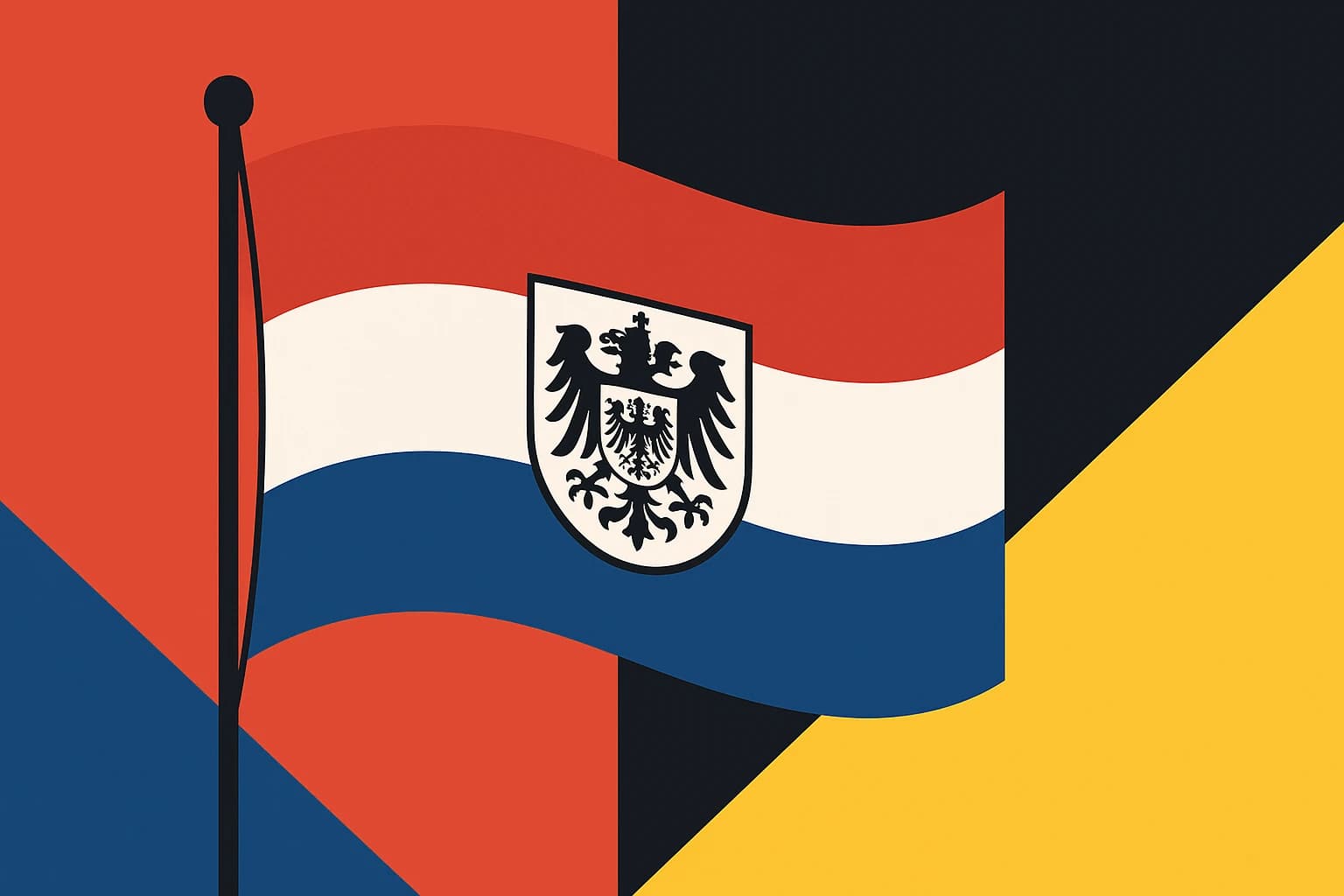
Picture a schoolchild asked to draw the flag of Moldova. She gets the three vertical stripes right: blue, yellow, red. Then she freezes. In the centre sits a coat of arms containing a shield, inside which is another shield, inside which is an auroch's head with a star between its horns, a rose, and a crescent moon. She draws a wobbly blob and moves on.
This is not a failure of the child. This is a failure of design.
It happens across dozens of countries. National flags exist at once as legal instruments, where every heraldic detail is codified in law, and as visual communication tools, where simplicity and recognisability are everything. For a small group of flags, those two roles are in unresolved conflict. Moldova, Portugal, Andorra, and the Dominican Republic show the tension most clearly, and they raise a question worth asking: if a flag cannot be accurately reproduced by an ordinary person, is it functioning as a flag at all?
Two flags for the price of one
Every nation with a complex coat of arms on its flag has two versions in circulation. There is the legally defined official flag, precise in every heraldic detail, and there is the simplified or botched version that appears on merchandise, in classrooms, on digital platforms, and at street markets.
This split is not accidental. National flags acquire legal status through constitutional provisions, flag laws, and official specifications. Moldova's Law on the State Flag of 1990 mandates the coat of arms as part of the flag. The Dominican Republic's constitution defines the emblem in explicit detail. In both cases, the coat of arms is not optional. It is the flag.
Now contrast that with the vexillological principle of simplicity. The North American Vexillological Association (NAVA) published guidelines in 2001 that warn against seals, coats of arms, and lettering on flags. The reason is straightforward: these elements fail at scale and distance. A flag should be identifiable from 30 metres away. A coat of arms with nested shields and tiny text is not.
Practice bears this out. Major mapping services, emoji standards bodies, and sporting event organisers routinely render these flags without a coat of arms, or with a heavily simplified one. It isn't disrespect. The detail cannot survive reproduction at small sizes.
The split runs deeper than pedantry. Flags as heraldic legal documents inherited from medieval tradition and flags as modern visual signals are pulling in opposite directions.
Moldova's shield within a shield
A golden eagle sits on a blue-yellow-red tricolour shield. The eagle holds an olive branch in one talon and a sceptre in the other. On its breast sits a smaller inset shield depicting a golden auroch's head, an eight-pointed star between its horns, a rose to the right, and a crescent moon to the left. All of these elements trace back to medieval Moldavian heraldry from the 14th-century reign of Dragoș.
The auroch itself is the extinct ancestor of domestic cattle. The last one recorded in the wild died in Poland in 1627. So the central symbol of Moldova's flag is an animal most people alive today have never heard of, rendered at a size most people will never be able to see.
The reproduction problem is easy to quantify. When the flag flies at a standard 90 × 135 cm size from a school flagpole, the coat of arms occupies roughly a 30 cm square. The inset shield with the auroch's head is about 4 to 5 cm across, which leaves the star, the rose, and the crescent inside it invisible from the ground.
Many commercial flag manufacturers, particularly those producing cheap polyester flags, print a vague golden eagle silhouette and omit or smear the inset shield entirely. That isn't illegal in most commercial contexts, but it does mean the flag being flown does not meet the legal definition of Moldova's state flag.
Moldova shows what happens when a flag inherits the full weight of medieval heraldic tradition without anyone asking whether that tradition survives the jump from illuminated manuscript to nylon ripstop.
Portugal and Andorra
Portugal's flag works on two levels. The vertical green-red bicolour is instantly recognisable. The central emblem packs five centuries of imperial and medieval history into a space roughly the size of a dinner plate on a full-size flag.
That emblem contains a white armillary sphere overlaid on a red-and-white shield. The shield holds five blue escutcheons arranged in a quincunx, each bearing five white bezants. Surrounding the whole arrangement are seven yellow castles. If you're already lost, you're in good company. The armillary sphere was the personal device of King Manuel I, who reigned from 1495 to 1521, and it was adopted to represent Portugal's Age of Discovery-era global navigation. Its presence on the modern flag, formalised in the 1911 republican redesign, is an act of historical nostalgia that chose symbolism over legibility.
Andorra has a different complexity problem.
Andorra's blue-yellow-red vertical tricolour contains a quarterly shield bearing four separate heraldic traditions: the crooks of the Bishop of Urgell, the red and yellow stripes of the Count of Foix, the red and yellow bars of Catalonia, and the red cows of Béarn. Beneath the shield, a ribbon carries the Latin motto "Virtus Unita Fortior." Four coats of arms, squeezed into one emblem, on a flag belonging to a country of roughly 77,000 people.
The oddity is that a tiny co-principality carries arms of a complexity more typical of major European monarchies with centuries of territorial accumulation. The emblem explains why Andorra exists, caught between two feudal lords, but explains it in a visual language most modern viewers cannot read.
Portugal and Andorra share a failure mode: the flag as compressed historical archive. Every element means something to a historian and almost none of it is legible to a passer-by.
The Dominican Republic
If Moldova's coat of arms is a nesting doll and Portugal's a history lecture, the Dominican Republic's is a library crammed into a rectangle.
Consider what the official specification requires: a quartered shield in the national colours (blue and red), surrounded by six Dominican and Cuban palm fronds and laurel branches, topped by a blue ribbon reading "Dios, Patria, Libertad," surmounted by a golden cross, flanked by two flags and two spears with cannons at the base. And within the shield itself, an open Bible showing the Gospel of John 8:32: "Y la verdad os hará libres" ("And the truth shall set you free").
The Bible detail is the striking one. The official specification requires the text of a specific verse to be legible on the flag, and at any practical flag size that text is between 1 and 3 mm tall. It cannot be read, and it is legally required.
The coat of arms dates in its essential form to the declaration of independence from Haiti in 1844 under Juan Pablo Duarte, Francisco del Rosario Sánchez, and Ramón Matías Mella. The founding Trinitarian movement embedded its motto and religious symbolism into the national emblem from the very beginning.
In practice the country runs several versions. Official government documents use a high-resolution rendering. The national football team's kit simplifies the design to stripes. Digital flag emoji, as standardised by the Unicode Consortium's emoji subcommittee, show the colour field and a vague blob. A 2019 study on national symbol recognition in Caribbean primary schools found that fewer than 12% of Dominican schoolchildren could accurately reproduce more than two elements of the coat of arms.
The Dominican flag's problem is not design but purpose. It was built as a legal and ideological document rather than a visual signal. It asks to be read, not seen.
The medieval inheritance
Most coats of arms on national flags are not originally flag designs. They are heraldic devices inherited from royal houses, colonial charters, or civic seals, retrofitted onto the flag when the modern nation-state was formalised in the 18th or 19th century. The flag came to the coat of arms. The coat of arms did not come to the flag.
Medieval coats of arms were designed to be read by heralds at close range, painted on shields, embroidered on surcoats, or reproduced in manuscript illuminations. Detail was an asset in those contexts, not a liability. When the same logic was applied to flags meant to be identified at distance, on ships, over battlefields, above government buildings, the mismatch was structural from the start.
Compare this with flags designed from scratch for flag purposes. Japan's Hinomaru, formalised in 1999 but used since 1870, is a red circle on a white field. The Swiss cross was formalised in 1889. Canada's Maple Leaf was designed in 1965 by George Stanley and John Matheson specifically to be reproducible by anyone.
These flags are famously simple because they were designed with the medium in mind. They work at 100 metres. They work at 72 pixels. They work drawn by a child with a crayon.
There's a colonial dimension too. Many of the most complex flag emblems belong to nations in Latin America, parts of Africa, and Asia where independence movements in the 19th and 20th centuries adopted European heraldic complexity as a marker of sovereign legitimacy. Complexity was a form of political assertion: we are a real nation, with a real history and real institutions.
Does it matter?
The counterargument to everything above is that flags do not need to be legible to be effective. Scholars working in the tradition of Michael Billig's "Banal Nationalism" argue that the mere presence of a flag, any flag, does the work of national identity. You see the colours, you register the nation, you move on.
The digital shift complicates it further. In 2026, flags are encountered more often as emoji, social media profile frames, and app icons than as physical objects on poles. At 72×72 pixels, the standard emoji render size, every coat of arms on every flag is indistinguishable. Moldova, the Dominican Republic, and Portugal are equally unreadable at that scale, and none of them has redesigned anything because of it.
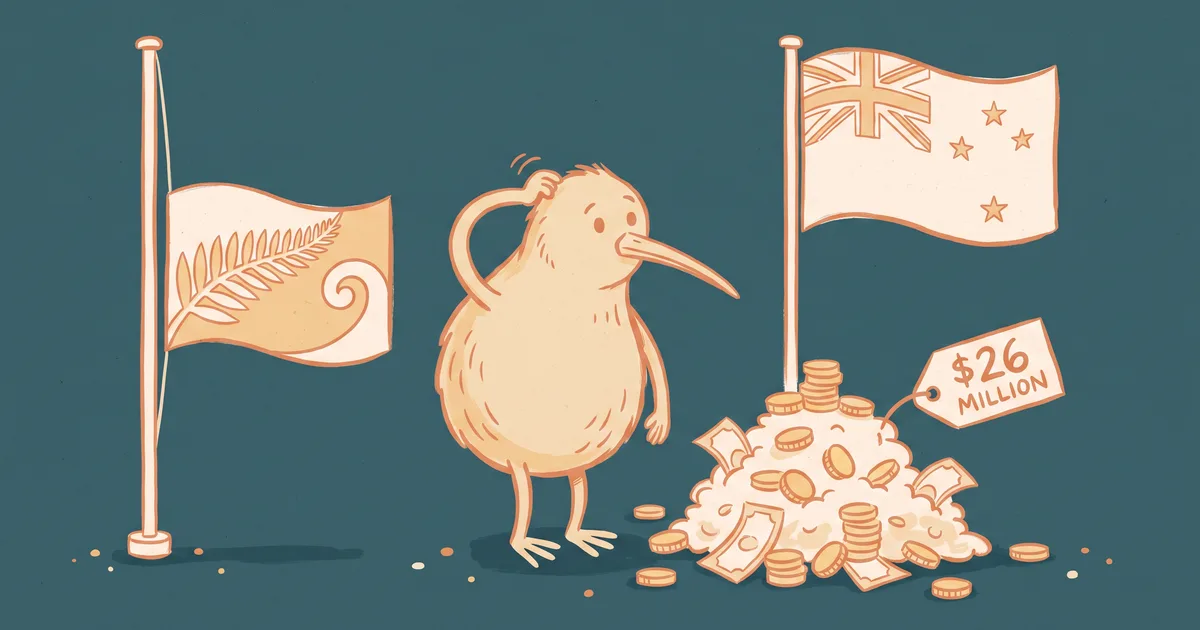
Some countries have revisited the question. New Zealand held referendums in 2015 and 2016 on whether to replace its flag (which includes a Union Jack and four stars, though no coat of arms) with something simpler. Voters chose to keep the old one. Tradition won, even when simplicity was on the ballot.
At international sporting events, flags must be identifiable at a glance on scoreboards, broadcast graphics, and stadium displays. Countries with complex coat-of-arms flags are routinely represented by their colour fields alone. The international community has quietly agreed to recognise simplified versions as sufficient.
The tension is not between legibility and complexity. It is between two definitions of what a flag is for. Some flags are for flying. Some flags are for filing.
The drawing test
Back to the schoolchild. She has now looked up the official specification for Moldova's flag. She sees the auroch's head, the eight-pointed star, the rose, the crescent, and she understands what each element means. She still cannot draw it.
That is the real test of a flag as a flag: not whether its symbols are meaningful, but whether a person with no training and no tools can reproduce a recognisable version from memory. By that test, Moldova, the Dominican Republic, Andorra, and Portugal all partly fail, though only as flags. As legal instruments, historical documents, and expressions of national identity they do fine.
The coat of arms nobody can draw is not a scandal. It is a design problem most nations chose not to solve because they were building monuments rather than signals. Whether that was the right trade-off is for those 77,000 Andorrans, 10 million Dominicans, and 2.5 million Moldovans to decide, probably without being able to draw the thing they are deciding about.
Julio Song
Writer
Julio is a staff writer at FlagDB. He studied Mathematics at the University of Madrid and has a passion for vexillology.
More from Julio Song →