Picture a room. A long room, walls lined with the flags of every nation on earth. You scan left to right: eagles, stars, crescents, suns, a dragon, an AK-47, a machete, coats of arms bristling with heraldic animals. And then, at the end of the row, you stop. Because there, on a clean white band between blue and green, sits a hat. Not a crown. Not a helmet. A woven straw hat.
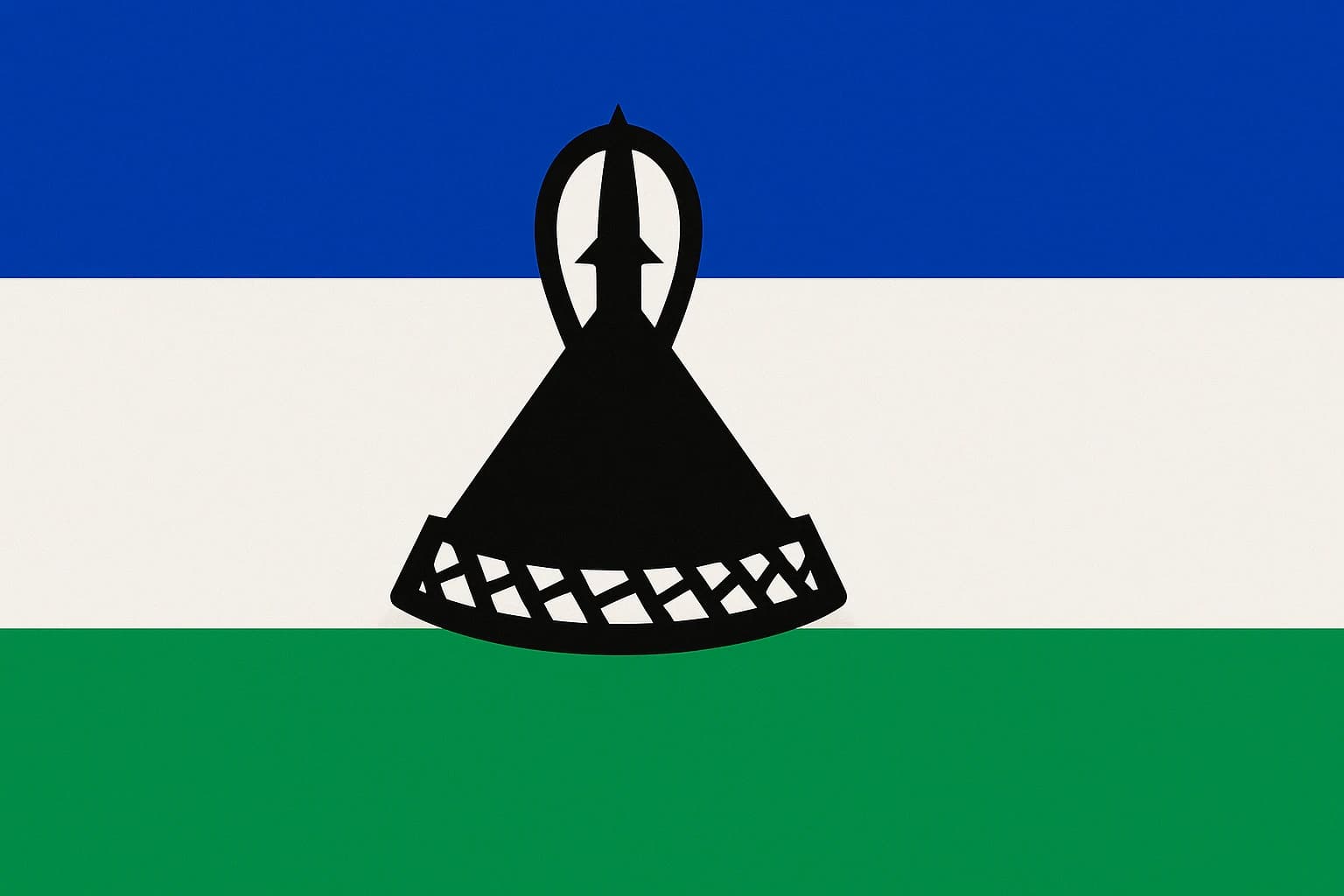
This is Lesotho's flag.
In 2006, the Basotho government did something nations almost never do. They stripped their flag down to a single cultural object, a conical woven hat called the mokorotlo, and declared it sufficient to represent an entire country. No weapons, no animals, no celestial bodies. The question worth asking is why a hat, an object tied to craft and daily life, carries more symbolic weight than the spear it replaced.
What the old flag was saying
From 1987 to 2006, Lesotho flew a flag with three horizontal bands of blue, white, and green. At its center sat a Basotho shield in black, flanked by a crossed assegai (a long-bladed spear) and a knobkierie (a wooden club). It was a martial composition, rooted in the visual language of resistance and defense.
That made historical sense. Lesotho, formerly Basutoland, was a nation forged in conflict. King Moshoeshoe I unified the Basotho people in the early 19th century through military strategy and hard diplomacy. He held off both Boer expansion and British colonial pressure, eventually securing British protection in 1868 as the lesser evil compared with absorption by the Orange Free State. The shield and spear were a tribute to that survival.
By the early 2000s, though, those symbols had aged into inherited belligerence. Lesotho is one of the least militarily assertive nations in Africa, entirely surrounded by South Africa, with no territorial disputes to signal. The old flag performed a history rather than describing a present: a siege-mentality banner for a country at peace.
There's a wrinkle. Lesotho's first independence flag, adopted in 1966, had featured a Basotho hat in brown and orange tones. The hat wasn't new, so the 2006 redesign was partly a return rather than an invention.
The 2006 redesign
October 4, 2006, marked the 40th anniversary of Lesotho's independence from Britain, and the government commissioned a new flag timed explicitly to the milestone.
The result was three equal horizontal bands, blue on top, white in the middle, green on the bottom, with a single black mokorotlo centered on the white. No shield, no weapons, no animals, no sun, no stars.
The official color symbolism is direct. Blue represents rain, which matters enormously in a drought-prone highland nation. White stands for peace and green for prosperity. Putting the hat on the white band equates the mokorotlo with peace.
Removing weapons from a national flag is close to unheard of. Most nations add symbols over time, layering on more elements and more claims. Lesotho subtracted, reducing its national identity to one woven object.
The redesign was government-led, aligned with the independence celebrations, and framed publicly not as a retreat from history but as an embrace of Basotho cultural heritage. That framing let the country tell itself a story: we aren't abandoning our past, we're choosing a different part of it.
What a mokorotlo is
The mokorotlo is a conical hat woven from Juncus lomatophyllus grass (sometimes called Qiloane grass). It has been worn by Basotho men and women for centuries. Its distinctive pointed silhouette is said to echo the shape of Qiloane Hill, a sandstone pinnacle near Thaba Bosiu, the mountain fortress where Moshoeshoe I established his stronghold.
The geographic connection does a lot of work. The hat doesn't depict a weapon or a battle, it encodes the landscape of resistance itself. Qiloane Hill, Thaba Bosiu, Moshoeshoe I, and the founding of the Basotho nation are all folded into a conical shape made of woven grass.
The mokorotlo isn't a museum artifact. Highland herders wear it, urban professionals display it, and it crosses social class and region within Lesotho. It's also an export: mokorotlo hats sell throughout Southern Africa and internationally as craft products, which puts Basotho identity in markets in a way a shield or a spear never did.
That combination is what makes it work on a flag. It's an ordinary object that is also ancient, economically active and culturally loaded, worn and made and sold and recognized, and it's something Basotho people hold in their hands.
Why so few flags trust a single object
Most of the world's flags use abstract geometry: stripes, stars, crescents, crosses. When they do include a specific object, they usually wrap it in a multi-element composition, a coat of arms surrounded by ribbons, animals flanking a shield, a sun rising over mountains. Single-object flags are rare.
The reason is that flags are designed by committee, under political pressure, needing to represent multiple constituencies, ethnic groups, regions, and ideologies. A single object risks looking too narrow, too ethnic, or too mundane. The safe default is legible abstraction.
Uganda's flag, adopted in 1962, places a grey crowned crane at its center, a specific living bird standing for the country's gentle character and its natural heritage. But Uganda frames the crane inside a white disc, which buffers it visually. Lesotho's design does without that framing.
Angola's flag, adopted in 1975 and still in use, has a machete and gear wheel, a Marxist-Leninist vocabulary encoding the MPLA's revolutionary ideology. Angola's central object is political where Lesotho's is cultural.
Mozambique's flag has an AK-47 crossed with a hoe over an open book. It is the only national flag in the world depicting a modern assault rifle, and it stands for armed liberation. Lesotho's mokorotlo is almost its photographic negative: the same southern African geography, the opposite symbolic philosophy.
Where Lesotho sits among African flags
Patterns emerge once you group them. Ethiopia's green, gold, and red palette has been adopted across dozens of post-independence flags as a statement of shared liberation heritage. In Ghana, Cameroon, Mali, Senegal, and Guinea, the color palette itself is the message.
Another group anchors identity in the natural world or in the material culture of a specific ethnic tradition. Uganda has its crane, Kenya a Maasai shield and crossed spears, Zambia an eagle in the upper corner.
Angola and Mozambique, as above, encode armed struggle with tools and weapons from liberation-era iconography. And among Saharan and North African nations, stars and crescents tie national identity to Islamic heritage or a broader cultural community.
Lesotho fits none of these comfortably. Its symbol is not a heroic animal, an ideological emblem, or a pan-movement color palette but a specific artifact of daily Basotho life, made by hand, worn on the head, sold in markets.
The choice follows from Lesotho's situation. The Basotho never fought a violent anti-colonial war. Basutoland became Lesotho through negotiation in 1966, a peaceful transition that denied the new nation the raw material of armed liberation. Lesotho's national pride rests on cultural continuity with the pre-colonial Basotho nation, not on the story of who they fought.
The flag doesn't say "we fought for this land." It says "we are this culture," which is a different claim entirely.
The geopolitics of a hat
Lesotho is one of only three enclaved nations in the world, along with San Marino and Vatican City, entirely surrounded by a single country. South Africa wraps around it on every side. There is no coastline, no shared border with a second neighbor, no geographic feature marking where Lesotho ends.
That makes cultural identity a practical necessity rather than a nicety. The mokorotlo does the work a coastline or a mountain range does for other nations, defining where Lesotho ends and South Africa begins in the mind rather than on the map.
The hat also works as a diaspora marker. Hundreds of thousands of Basotho workers have migrated to South African mines and cities, and in Johannesburg, Bloemfontein, and Durban the mokorotlo has served as a recognition symbol among dispersed Basotho communities. It travels in a way the flag itself, pinned to a pole or printed on a government document, does not.
In 2026, with global arguments running about indigeneity, heritage preservation, and the decolonization of national symbols, Lesotho's 2006 decision looks well timed. Countries across Africa, Asia, and the Pacific are wrestling publicly with what to keep and what to remove from their flags and emblems. Lesotho settled the question twenty years ago by choosing a symbol that predates colonialism, survives it, and requires no explanation to the people it represents.
The redesign has not sparked a wave of imitations, but vexillologists and design scholars have pointed to it as a case study in how cultural confidence produces radical simplicity.
Look at the hat again
Go back to that room full of flags and find Lesotho's. What looks like quirky minimalism is an argument about nationhood: that the claim worth making is not what you fought against but what you have always been.
The mokorotlo on a white ground doesn't say "we survived colonialism," though Lesotho did. It doesn't say "we are free," though Lesotho is. It says the Basotho have always worn this hat, and that placing one woven straw object at the center of a national identity was enough.