Iran's Flag Has a Date Written Along Its Edges: The 22 Takbirs and the Lion They Replaced
Julio Song · · 10 min read
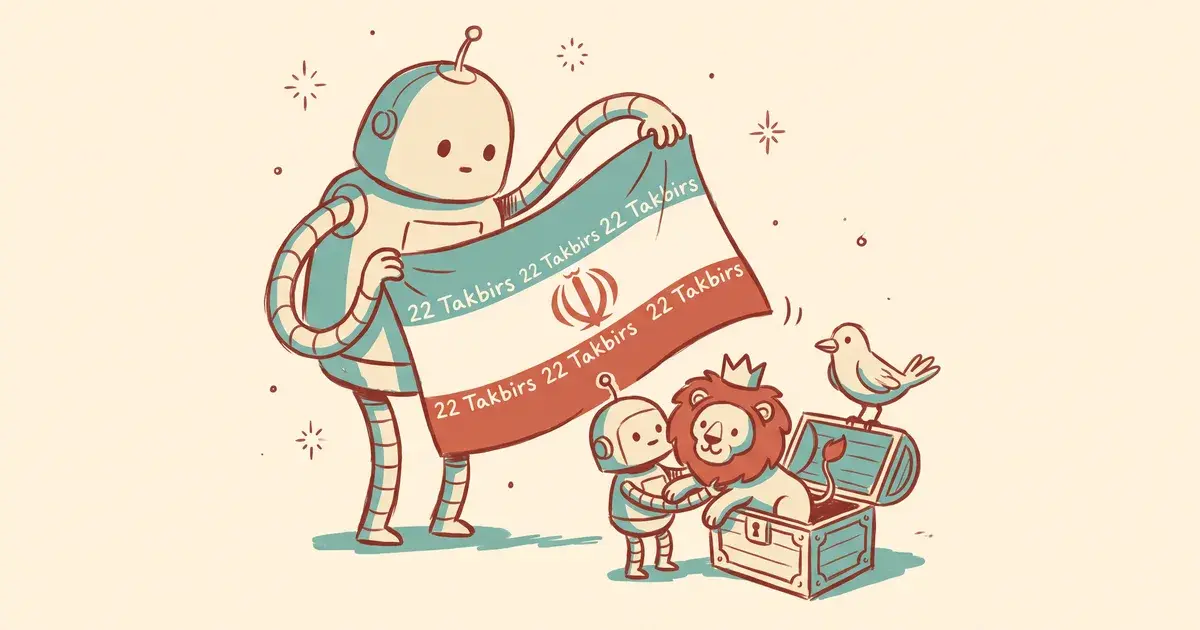
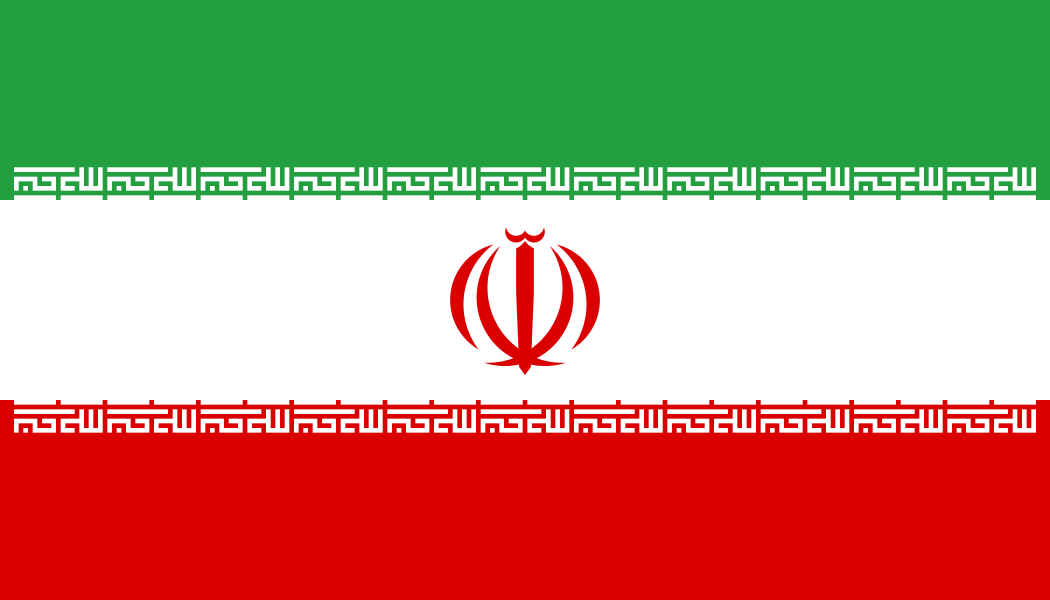
Look closely at the flag of Iran and count the white lettering. Eleven small blocks run along the bottom of the green band. Eleven more run along the top of the red. Each one says the same thing, Allahu Akbar, "God is greater."
Twenty-two repetitions is a strange number for a prayer. It's a normal number for a date. The flag of the Islamic Republic carries its own birthday stitched along the edges of its middle stripe, and you'd never know unless someone told you.
 IranView flag →
The story of how that date got there runs through a lion with a sword, a rejected design full of clenched fists, an architect who called the job "divine," and a quiet note to a treaty office in Switzerland.
A lion that sat in the middle for seventy years
The green, white and red didn't arrive with the revolution. They're much older. When Iran wrote its first constitution, the Supplementary Fundamental Laws ratified on 7 October 1907 put the flag into law in a single line. Article 5 reads: "The official colours of the Persian flag are green, white and red, with the emblem of the Lion and the Sun."
That emblem was already centuries old by then. The Lion and Sun began as an astrological image, the sun in the house of Leo. The Safavid dynasty took it up as a royal badge, partly to stand apart from the Ottomans, who had claimed the crescent. Later rulers kept adding to it. Under Fath-Ali Shah the lion picked up a sword, Zulfiqar, the blade associated with Ali. An 1836 decree from Mohammad Shah required the lion to stand and carry a saber. A decree of 1846 went further and claimed the emblem was close to 3,000 years old, a claim the scholar Piemontese later criticised as politics mixed with anachronism.
The design kept shifting in the twentieth century too. According to the history on Wikipedia's Flag of Iran page, the sun lost its face in 1933. In 1964 the proportions changed from 1:3 to 4:7, the ratio Iran still uses. Reza Shah added the Pahlavi crown on top, mostly in military versions.
So by 1979 you had a tricolour with seventy years of legal standing and a central emblem with a royal pedigree going back to the 1500s. The revolution liked the first part. It had a problem with the second.
What do you do with a king's lion after the king leaves?
The answer, at first, was nothing much. Flags of the World's record of the transition notes that the imperial crown vanished from the war flag and naval ensign almost at once. The lion and sun itself stayed put. As of April 1979, observers reported no change to the national flag or the state arms.
That couldn't last. Ruhollah Khomeini called for the removal of the old regime's symbols, which he described, per an account of the flag's design published by Ajam Media Collective, as "remnants of a tyrannical regime." A national competition for a new emblem opened in the spring of 1979.
The first winner was not the design you see today. Sadegh Tabrizi, a painter from the Saqqa-khaneh school, won the first round. His emblem, as FOTW describes it, put a sun ringed by 22 stars at the center, with eight clenched fists around it. The 22 stars already pointed at the date of the revolution's victory. It was adopted on 30 January 1980 and appeared on banknotes and government paper.
It lasted barely three months. FOTW records its replacement on 9 May 1980. Ajam's account says nobody has given a firm reason for the switch, and floats one theory: the fists-and-spears arrangement looked a bit too much like a pentagram.
Notice what carried over, though. Tabrizi's emblem was gone. His number stayed.
The architect and the tulip
The emblem that replaced it came from Hamid Nadimi, an architect. When Ajam's writer interviewed him in 2009 he was on the architecture faculty at Shahid Beheshti University in Tehran, and he rarely spoke about the flag. When he did, he got emotional. He called the design "a more divine and spiritual act for me" and said he was speechless trying to describe it.
His explanation of the shape is precise. Nadimi said the idea came from Surah al-Hadid, the chapter of the Quran named for iron, which he read as naming three pillars of Islamic government: scripture, balance and iron. The central upright is a rod drawn from those last two ideas. Above it sits a tashdid, the Arabic doubling mark, there to double the strength of the shaft.
Around that rod curve four crescents. Together with the sword they spell the word Allah in stylized form. The emblem has five parts in all, which the official reading links to the principles of Shia Islam.
Then there's the outline. Step back and the whole thing looks like a flower. Nadimi told Ajam he meant the lettering to evoke a tulip and a lotus, both old Persian symbols. The tulip carries extra weight in Iran. An old belief holds that a red tulip grows on the grave of a young soldier who dies for his country, and Wikipedia's emblem article notes it has come to stand for martyrdom. The Iran-Iraq War began within months of the emblem's approval, and Ajam points out that this flag went on to drape the coffins of soldiers killed in the Iran-Iraq War.
Nadimi sent his sketches to Khomeini's office. Approval came by phone, through Akbar Hashemi Rafsanjani. One small source conflict worth flagging: Ajam gives the approval date as 9 June 1980, while FOTW and Wikipedia give 9 May 1980 (19 Ordibehesht 1359 in the Iranian calendar). The Persian date FOTW cites lines up with May.
One more detail from the interview shows how close the flag came to an awkward accident. In an early sketch of the border lettering, the Kufic letters looked like a lowercase "usa." For a republic whose chief foreign enemy was the United States, that wasn't going to work. The lettering was redrawn.
Twenty-two times, in a script from Islam's first centuries
The border text is the part most people miss, and it's the part with the date in it.
The lettering is Kufic, an angular Arabic script that FOTW dates to the first centuries of Islam. Ajam identifies the specific style as Kufic ma'qeli, a square, blocky variant that packs neatly into a narrow band.
There are eleven takbirs on the green side and eleven on the red. The total, 22, stands for 22 Bahman, the 22nd day of the 11th month of the Iranian calendar. In 1357 by that calendar, which is 11 February 1979, the Imperial Iranian Army declared itself neutral and the monarchy fell. Ajam calls it the date of the revolution's victory.
Think about how unusual that is. Plenty of flags encode numbers. Stars count states, stripes count founding colonies. Almost none hide a calendar date inside repeated religious text, written so small that a flag at a distance shows only a thin white fringe.
The constitution keeps it all in place. Article 18 of the Constitution of the Islamic Republic, adopted in 1979 and revised in 1989, says: "The official flag of Iran is composed of green, white and red colours with the special emblem of the Islamic Republic, together with the motto (Allahu Akbar)." The detailed drawing, including the 4:7 ratio, lives in the national standard ISIRI 1.
If you set that next to Article 5 of 1907, the colours survived word for word. The emblem is new. The motto is new. Even the ratio dates from the Shah.
The lion's other job
The Lion and Sun wasn't only a royal badge. It was also a protective emblem under international humanitarian law, sitting alongside the Red Cross and the Red Crescent.
Iran's Red Lion and Sun Society joined the international Red Cross and Red Crescent Movement in 1929, according to Wikipedia's Lion and Sun article. The Geneva Conventions of 1949 listed the red lion and sun as one of three recognized emblems. Iran signed those conventions in December 1949 and ratified them in February 1957.
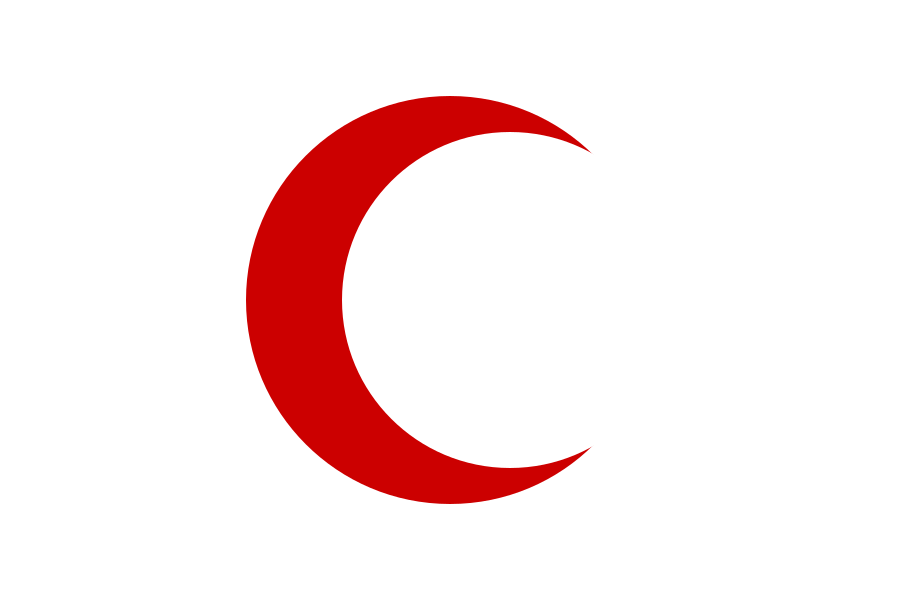
Once the lion came off the national flag, it had to come off the ambulances too. In a note dated 3 September 1980, recorded by WIPO in Iran's treaty declarations, Iran told the treaty depositary it "would not practice its right of using the 'Red Lion and Sun' as one of the three official emblems." From then on its society used the red crescent.
 Red CrescentView flag →
The wording is careful. Iran didn't give the emblem up. It stopped using it, and reserved the right to "maintain its right of using the Red Lion and Sun emblem once again" if new distinctive emblems were approved. On paper, the red lion and sun is still a recognized emblem.
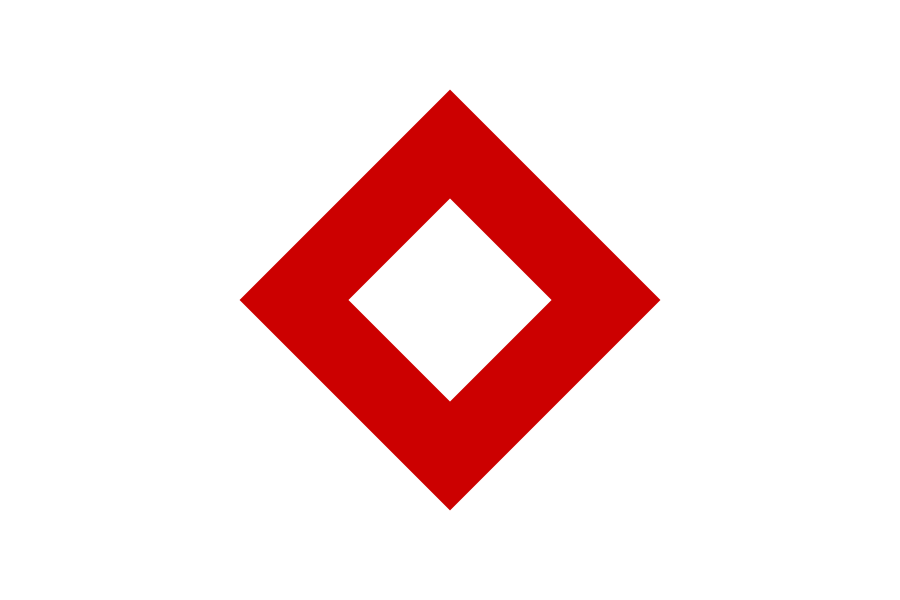
That reservation matters because new emblems did arrive. In 2005, Additional Protocol III created the red crystal, the neutral diamond meant for societies that wanted neither cross nor crescent. The Lion and Sun article notes the protocol confirmed the lion and sun's status at the same time.
 Red CrystalView flag →
So the lion sits in a strange legal limbo. Banned from Iran's state flag, still valid under the Geneva Conventions, and held in reserve by the same government that removed it.
Two flags flying for one country
Off the treaty page, the lion has had a busy second life. A segment of the Iranian diaspora flies the Lion and Sun tricolour as a sign of opposition to the Islamic Republic. Monarchists use it. So does the MEK. Wikipedia's Lion and Sun article says that in Los Angeles and other cities with large Iranian communities, the emblem now turns up on flags, mugs and souvenirs far more than it did when the Shah was in power.
During the 2022 protests that followed the death of Mahsa Amini, some people went further and proposed fresh variants of the Lion and Sun, designs meant to signal a "new Iran" without simply restoring the old monarchy's badge.
The argument has reached inside the government, too. In 2014, Ali Younesi, an adviser to President Hassan Rouhani, argued that the lion and sun had Islamic meanings of its own and suggested bringing it back, according to Ajam. It didn't happen.
What you end up with is a country with two tricolours that share every stripe and every colour, written into law in 1907, and differ only in the middle and along the edges. One center holds a lion with Ali's sword. The other holds a tulip that spells God's name. The edges of the official one count to 22, so the day the monarchy fell is written into the flag itself.
Next time you see Iran's flag on a news broadcast, try counting the white marks along the stripes. You're reading a date.
Julio Song
Writer
Julio is a staff writer at FlagDB. He studied Mathematics at the University of Madrid and has a passion for vexillology.
More from Julio Song →