Vexillology is the study of flags, and a fair amount of it consists of noticing what a design is actually made of once you stop treating it as decoration. The flags below are not the ones that come up in quizzes. Each of them puts something specific on the cloth, and in every case the specific thing is doing work.
Anguilla's three dolphins
Anguilla is a British Overseas Territory in the Caribbean, and its flag carries three dolphins.
The dolphins are read locally as continuity and strength, which for a small island is less a boast than a description. It is an unusual choice for a flag: an animal that belongs to the water around the territory rather than to any coat of arms.
Bhutan's Druk
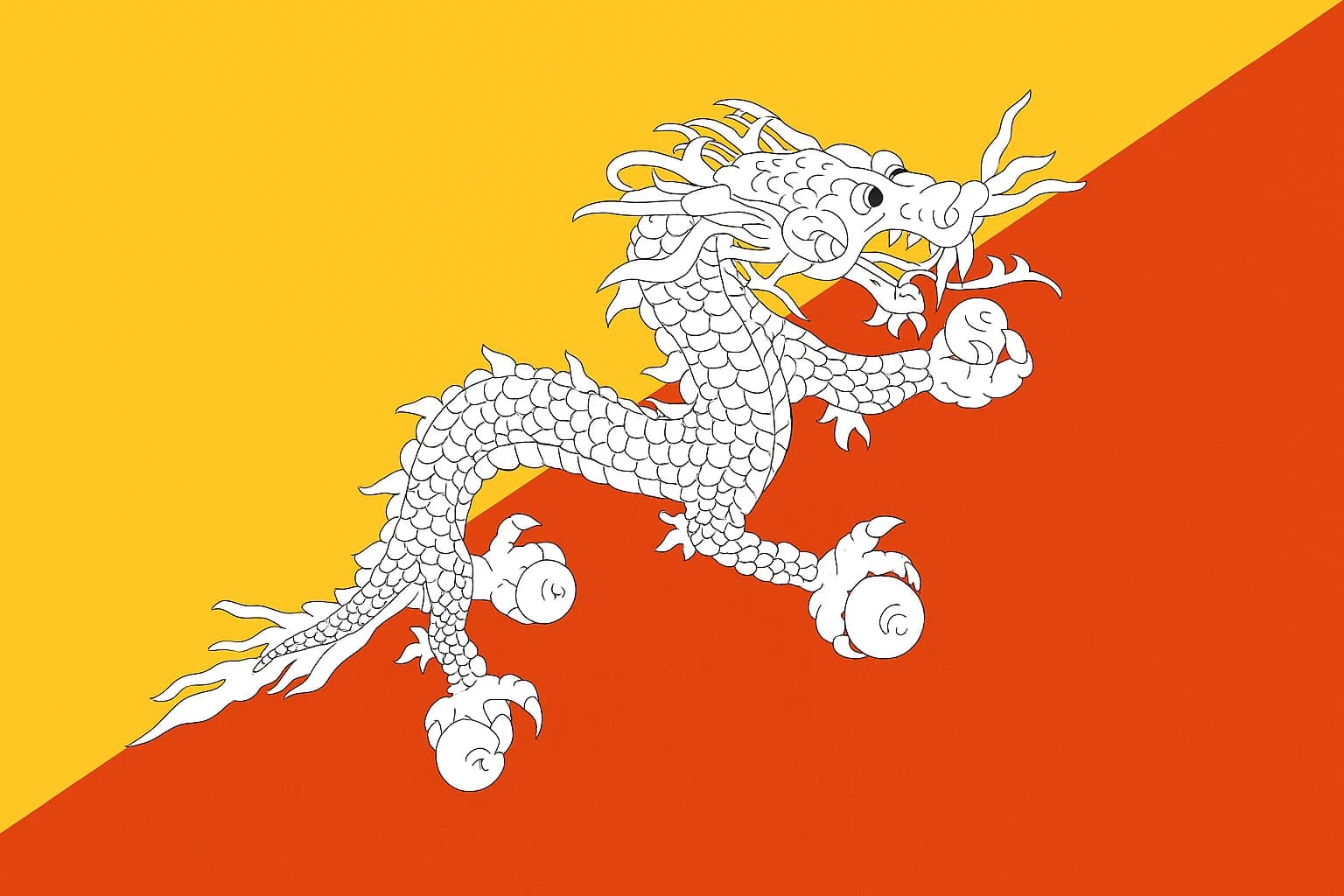
The dragon on Bhutan's flag is Druk, the Thunder Dragon, and it comes from the country's Buddhist tradition rather than from heraldry.
Druk stands for protection and for the purity of the land. That framing sits close to Bhutan's policy of measuring itself by Gross National Happiness, which is one of the rare cases where a national symbol and a government's stated priorities point in the same direction.
Malawi's colors
Malawi's flag has a straightforward key. Black is the indigenous population, red is what the struggle for independence cost, and green is the land.
Above them sits a rising sun, which is about as direct as independence symbolism gets: the country starts here.
Belize and its mahogany tree
Belize puts its national coat of arms on the flag, and inside it a mahogany tree.
The tree points at the forestry industry the territory was built around and at the labor that industry demanded. Not many flags name an economy that plainly.
Moldova's eagle
Moldova's flag has an eagle holding a cross in its beak and an olive branch in its claws.
Faith in one part of the bird and peace in the other. It is a compact statement for a country whose borders and allegiances have been rearranged more than once.
None of these flags come up much outside their own countries. What each one gives you is a legible record of what a place decided to say about itself at the moment it got to choose.