Three Flags That Aged Differently: Afghanistan, Albania and Argentina
Julio Song · · 2 min read
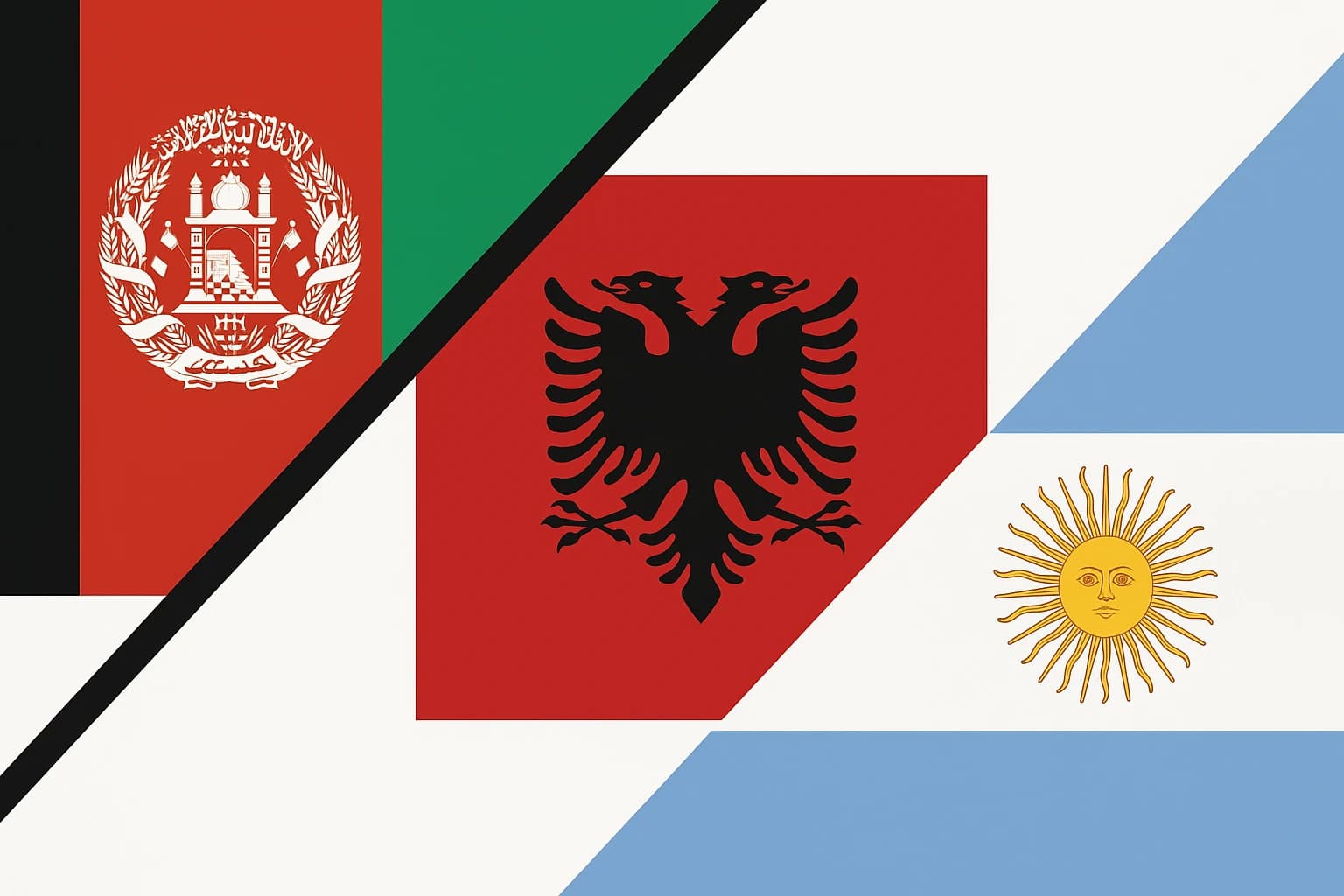
Afghanistan, Albania and Argentina make a useful trio because their flags have aged in completely different ways. One has been rewritten with almost every change of government, one has kept the same emblem for centuries, and one grew out of a war of independence and then settled.
Vexillology, briefly
Vexillology is the study of flags. The reason it repays attention is that flags change with the political weather. They record independence and struggle, unity and division, and they get redesigned when the people in charge want to signal that something has ended or begun.
Afghanistan
Afghanistan's flag has gone through several redesigns, each one attached to a political turning point.
It moved from an early Islamic green flag to the black, red and green tricolor in use today. The changes usually came with upheaval: a new republic declared, a regime replaced. The current design keeps Islamic symbols for faith and a central emblem that gestures at the country's history.
Albania
Albania's flag is the opposite case. It has barely moved.
The red field with the black double-headed eagle goes back to Skanderbeg, the medieval commander who fought the Ottoman Empire. Later events, including the fall of communism, changed details around it without touching the eagle. For Albanians it reads as an emblem of resistance and of national identity, and the two are hard to separate.
Argentina
Argentina's flag came out of the break with Spain.
The early designs took their light blue and white from the sky and the clouds, and were shaped by the independence struggle against Spanish rule. The Sun of May was added later and stands for revolution and freedom. The colors are now read as serenity and prosperity, which is a long way from where they started.
What the three have in common
Each flag records its country's particular struggles rather than a shared template. Afghanistan's shows how completely a flag can be rewritten when regimes turn over. Albania's shows how long a single emblem can survive if it is old enough and specific enough. Argentina's shows a revolutionary symbol softening into a national one.
As for what comes next, modern flag design tends toward simplicity while holding on to whatever the core cultural element is, and political change still prompts redesigns. That much is predictable. Which flags actually change, and when, is not.
Julio Song
Writer
Julio is a staff writer at FlagDB. He studied Mathematics at the University of Madrid and has a passion for vexillology.
More from Julio Song →