The Dragon on the Flag of Bhutan and Wales: Two Ancient Creatures, Two Completely Different Meanings
Julio Song · · 8 min read
Lay every national and territorial flag in the world across a gymnasium floor and you would need a large gym. Over 200 flags, full of lions, eagles, condors, and one parrot (Dominica, and it is wonderful).
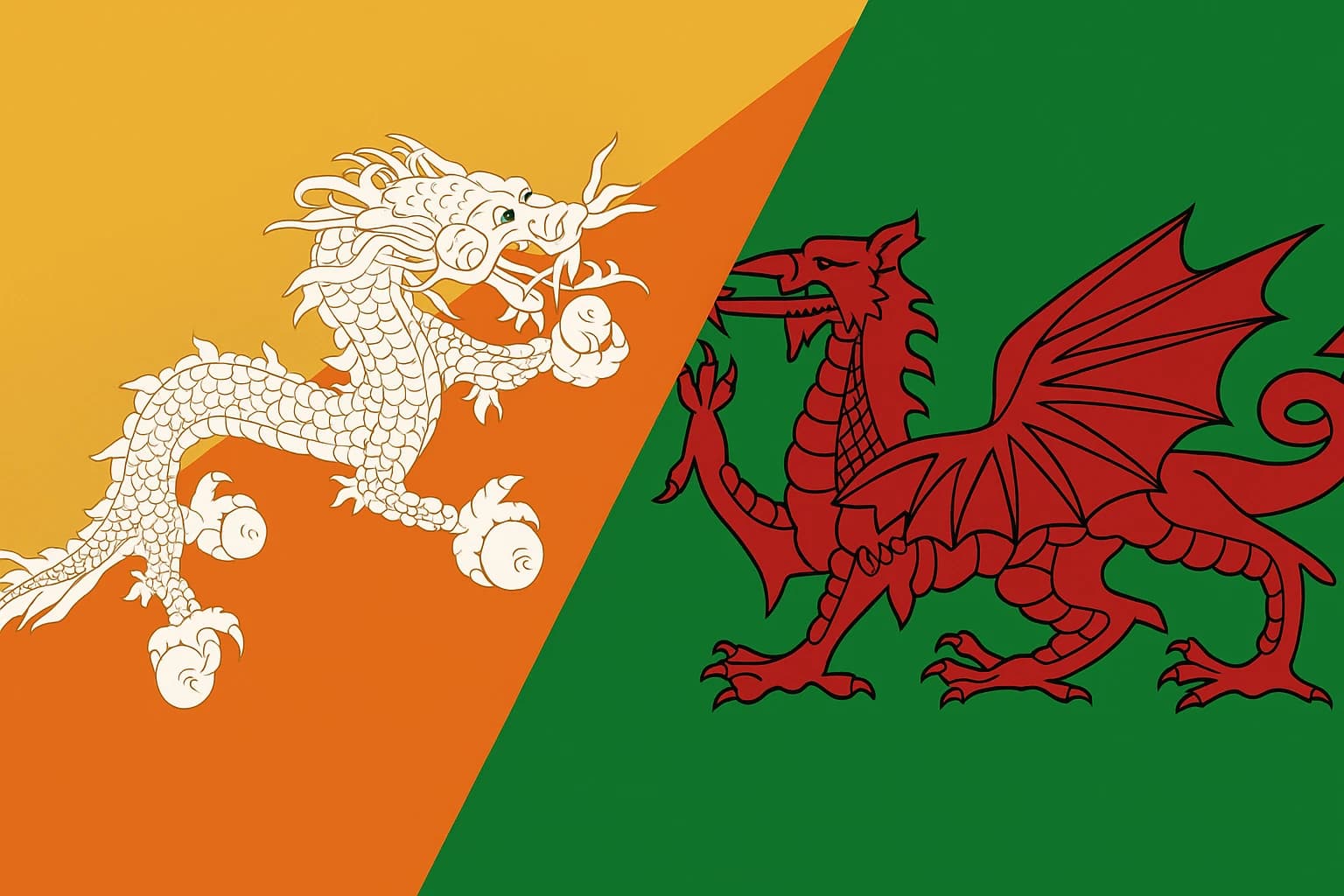
Scan all of them and you will find exactly two carrying the most famous mythical creature humans have ever invented. Wales and Bhutan, roughly 5,000 miles apart, with almost no shared cultural history, both put a dragon at the center of their flag.
The dragons could hardly be less alike. One is a battle standard born from prophecy and centuries of political defiance. The other is a guardian of Buddhist dharma whose voice is the thunder rolling through Himalayan valleys.
The rarest mythical beast in vexillology
Dragons appear in the mythology of nearly every civilization on Earth. The Chinese lóng, the Mesoamerican Quetzalcoatl, the Norse Níðhöggr, the Greek drakōn. Humanity has been telling dragon stories for millennia on every continent.
They are almost entirely absent from national flags. Lions show up on over a dozen. Eagles appear on more than twenty. Dragons manage two.
There are two main reasons. The first is that the European Christian tradition cast the dragon as evil. Revelation 12:9 identifies Satan as "that ancient serpent, who is called the devil and Satan," and dragon-as-devil imagery saturated medieval European culture. When Christian kingdoms started building heraldic identities the dragon was politically toxic, so they used lions, eagles, and crosses instead.
The second is that in East Asia the dragon sat at the opposite extreme. It was imperial. China's five-clawed dragon was guarded so closely by the throne that it never became a popular symbol capable of surviving into the republican age. When the Qing dynasty fell in 1912 its yellow dragon flag, flown since 1889, fell with it, because the emblem was fused to a single political order.
There is one notable edge case. Malta's flag carries the George Cross, which shows St. George slaying a dragon, but there the dragon is the villain.
So how did two small nations at opposite ends of the world, a Celtic nation inside the United Kingdom and a Buddhist kingdom in the Himalayas, both end up flying the creature everyone else rejected?
Y Ddraig Goch: prophecy and defiance
The Welsh dragon's story starts underground.
The oldest literary source is the Historia Brittonum of around 829 CE, attributed to the monk Nennius. In it, the British king Vortigern tries to build a fortress at Dinas Emrys in Snowdonia and the walls keep collapsing. A boy-prophet named Ambrosius, later merged with Merlin in Geoffrey of Monmouth's Historia Regum Britanniae of 1136, explains why: two dragons, one red and one white, lie buried in a pool beneath the foundations, locked in combat. The red is the Britons, the white the Saxon invaders, and the prophecy says the red will win.
That made the Welsh dragon political from its first appearance. It was never decorative and never purely spiritual. It stood for resistance to Anglo-Saxon and later English domination, carrying the weight of a people who understood themselves as the original Britons pushed to the margins of their own island.
Follow it forward and it keeps turning up at moments of political assertion. Henry VII, of Welsh Tudor lineage, flew the red dragon standard at Bosworth Field in 1485 on his way to seizing the English crown, then folded it into the Tudor royal arms as a supporter, tying his legitimacy to ancient British prophecy.
Then the irony. When the Union Jack was created in 1606 and updated in 1801, Wales got no representation at all. No green and white, no dragon, nothing. Wales had been legally annexed to England under the Laws in Wales Acts of 1535 to 1542, and the union flag treated it as a non-entity.
The red dragon was not officially adopted as the Welsh flag until 1959, and that adoption was partly an act of reassertion: a statement that Wales existed, was not a region of England, and had a symbol older and fiercer than any cross on the union flag.
This is a dragon that fights.
Druk: the thunder dragon that became a country's name
Five thousand miles east, in the eastern Himalayas, the dragon tells an entirely different story.
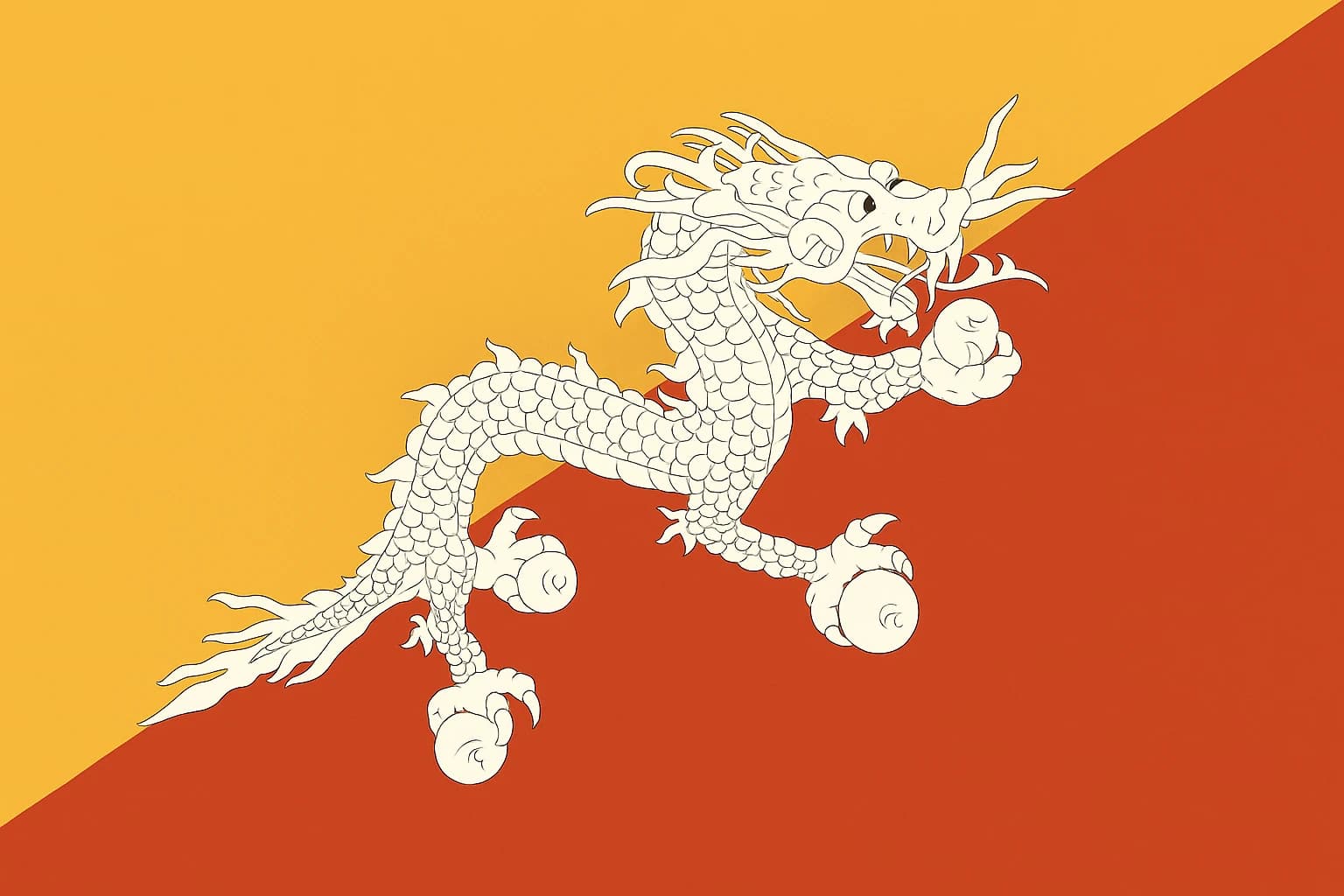
Bhutan's name in Dzongkha, the national language, is Druk Yul, Land of the Thunder Dragon. In Wales the dragon is a symbol placed on a flag. In Bhutan the dragon is the country: it lives in the name, in governance, since the king is the Druk Gyalpo or Dragon King, and in ordinary speech.
The Druk comes out of Tibetan Buddhist tradition, where thunder rolling across Himalayan valleys was understood as the dragon's roar, the voice of the dharma. The link to Bhutanese identity crystallized around the 12th century, when Tsangpa Gyare founded the Drukpa Kagyu school of Buddhism, having seen dragons in the thunder during the construction of Ralung Monastery in Tibet according to tradition. When the Drukpa lineage became dominant in Bhutan under Zhabdrung Ngawang Namgyal in the 17th century, the dragon became inseparable from being Bhutanese.
The flag, in its modern form since 1969, is divided diagonally: saffron-yellow above for secular royal authority, orange-red below for Buddhist spiritual tradition. A white Druk sits across the middle, clutching jewels, norbu, in its claws. White for purity, jewels for the nation's wealth and the perfection of the dharma. Every element is theological as much as political.
This is a dragon that guards.
The two weapons make the difference concrete. The Welsh dragon breathes fire. The Bhutanese dragon speaks thunder. One is martial, the other is sacred sound.
Same creature, different worlds
Put the flags side by side and the contrasts sharpen. Y Ddraig Goch stands passant, the heraldic term for walking with one forepaw raised, red and aggressive in posture with tongue and claws extended, a European heraldic beast built to intimidate. Bhutan's Druk appears in profile, white, holding jewels, its open mouth reading more as chant than attack, and it resembles a Tibetan temple guardian far more than a battlefield emblem.
The origin stories pull apart in the same direction. The Welsh dragon comes from ethnic conflict and a prophesied victory in war, born underground in a pool between collapsing walls. The Bhutanese dragon comes from spiritual revelation, appearing in the sky in the voice of thunder. One rises from beneath the earth, the other descends.
Their relationships to the state differ too. In Wales the dragon was adopted and re-adopted across centuries by different political actors, Cadwaladr, Henry VII, the modern Welsh assembly, picked up and set down as needs shifted. In Bhutan it was never adopted in that strategic sense, because it was already there, woven through the country's name, religion, and monarchy at once.
For all that, both dragons do the same job. They assert an identity against erasure. The Welsh dragon says Wales is not England. The Bhutanese dragon says Bhutan is not Tibet or India or anyone else. Both belong to small nations flanked by much larger neighbors, and the most powerful creature available makes a compact case for being distinct.
The third option: the dragon as villain
Malta is worth more than a passing mention, because it shows the other way a dragon can reach a flag.
From 1943 to 1964, and in modified form since, Malta's flag has carried the George Cross in its canton. King George VI awarded the George Cross to the entire island on April 15, 1942, for civilian heroism during the Axis siege, and the cross itself depicts St. George slaying a dragon.
Here the beast is the thing overcome: the chaos of war personified and then defeated by endurance. It is still a story about national survival, told from the other end.
Dragons on flags never function as decoration. Whether the dragon is the hero, as in Wales and Bhutan, or the enemy, as on the George Cross, it demands a story about battle, faith, or identity, and that may be exactly why they are so rare. A symbol carrying that much meaning is hard to use casually, and it binds tightly to whatever it represents. The Qing dynasty demonstrated the risk: a dragon fused to one political order does not survive into the next.
Why these two endure
The survival of these dragons is structural rather than accidental. Both belong to small, culturally distinct nations that have kept their identity beside much larger neighbors, England in the Welsh case, China and India in Bhutan's. A country without geopolitical weight has to get its distinctiveness across some other way.
Both have become more prominent in modern national branding, not less. Wales uses the dragon in tourism, in sport, where the rugby dragon is recognized worldwide, and across its cultural exports. Bhutan's Druk appears on the national airline, Drukair, on the currency, and at the center of the country's carefully managed image as a land of Gross National Happiness and Buddhist wisdom.
Which is the part worth sitting with. The dragon has no single meaning. The European tradition of chaos and evil to be slain and the Asian tradition of wisdom, protection, and cosmic power live inside the same creature, and these two flags are the clearest evidence anyone could ask for that both readings have survived intact.
Julio Song
Writer
Julio is a staff writer at FlagDB. He studied Mathematics at the University of Madrid and has a passion for vexillology.
More from Julio Song →