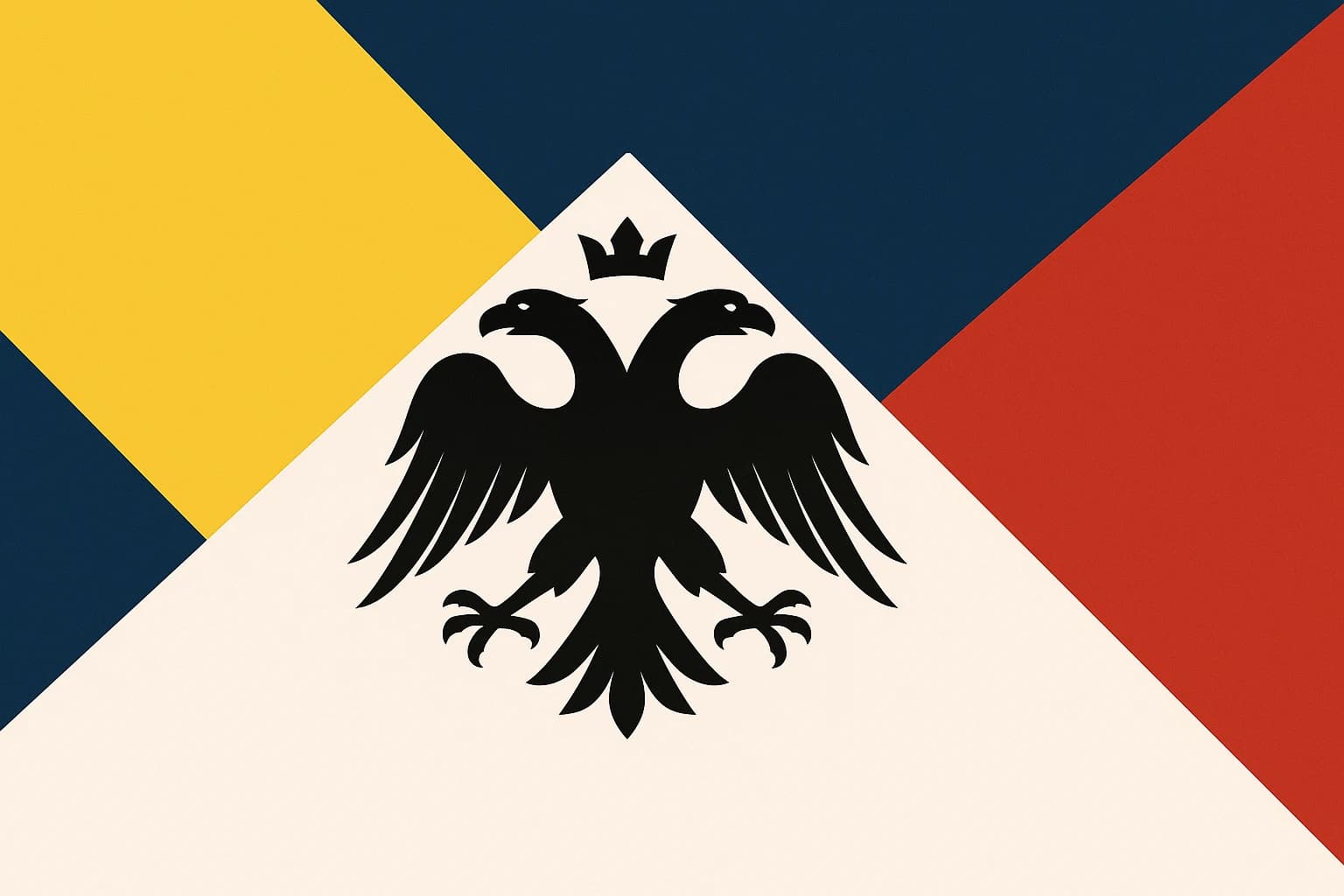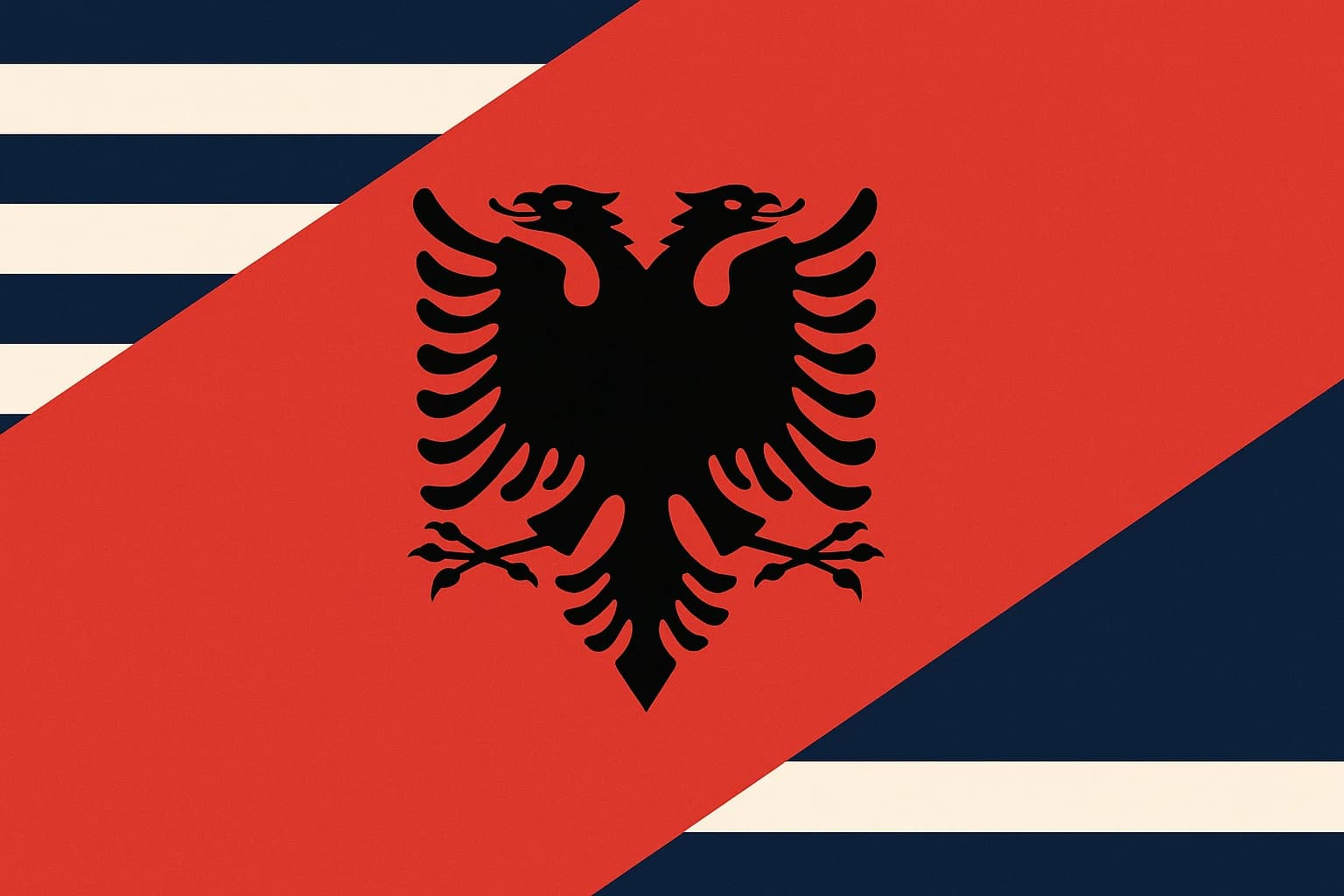
In 1912 a small Balkan nation declared independence from the Ottoman Empire and chose, as the centerpiece of its flag, a symbol older than Christianity: a black double-headed eagle on a blood-red field. The nation was Albania, majority-Muslim and freshly liberated, reaching back millennia rather than decades for its founding emblem. Why would a country whose population was roughly 70 percent Muslim at independence fly a flag borrowed from Christian imperial heraldry?
The answer runs from Hittite rock carvings in Bronze Age Anatolia to a 15th-century guerrilla commander named Skanderbeg to a room full of nationalists in the port city of Vlorë on November 28, 1912. It also explains why the same eagle appears on the arms of Russia, Serbia, and Montenegro but dominates only Albania's flag, and why neighboring North Macedonia passed it over in favor of a sun.
Two heads, three thousand years
The earliest known double-headed eagles appear in Hittite rock carvings at Yazılıkaya and Alaca Höyük in central Anatolia, dating to roughly 1400 to 1200 BCE, over a millennium before Rome adopted its single-headed eagle as a legionary standard. The Hittites were not thinking about flags. They were thinking about gods and kings and the space between them.
The symbol probably represented divine kingship and vigilance in all directions, two heads looking east and west, or heaven and earth, depending on which reading you prefer. Either way it suited any empire claiming universal sovereignty, which is a claim one head struggles to make.
The motif went quiet for centuries, then resurfaced in the Byzantine Empire around the 10th or 11th century. Scholars still argue about the exact adoption date. What is not in dispute is that the Palaiologos dynasty, from 1261 to 1453, made it the definitive imperial emblem, putting it on coins, silk textiles, church decorations, and manuscript illustrations. Two eagle heads in Constantinople told you who was in charge.
The eagle was never owned by a single dynasty or faith, which is the part that matters here. It migrated through the Seljuk Turks, the Holy Roman Empire, and Orthodox Slavic kingdoms with very little friction, traveling farther than almost any other emblem in history.
Skanderbeg's banner
Albania's founding hero is Gjergj Kastrioti, known as Skanderbeg. Born around 1405, he was an Albanian nobleman taken as a hostage to the Ottoman court as a child, converted to Islam, and given a military command, which he handled well enough that the Ottomans trusted him with soldiers and territory.
Then he defected. In 1443 he returned to Albania, reclaimed his family's fortress at Krujë, reconverted to Christianity, and launched a 25-year rebellion against the empire that had raised him. His personal seal and battle standard carried the black double-headed eagle on red, borrowed directly from Byzantine heraldic tradition, presenting him as a Christian prince holding European Christendom's southeastern flank.
Europe took note. Pope Callixtus III called him Athleta Christi, the Champion of Christ, and his story was retold in Italian, French, and German chronicles for centuries. He is still the most famous Albanian who ever lived.
Skanderbeg died in 1468 and Albania fell fully under Ottoman control soon after, but the eagle outlasted him. It survived in diaspora memory, especially among the Arbëreshë, the Catholic Albanian communities scattered across southern Italy who had fled the Ottoman advance, and it persisted in folk art and oral tradition among people who had lost their state but not their emblem.
So when 19th-century Albanian nationalists needed a unifying symbol, they did not have to invent one. Skanderbeg had fused the Byzantine eagle with Albanian identity four centuries earlier.
The Rilindja: why a Muslim-majority nation chose a Christian symbol
The Albanian National Awakening, the Rilindja Kombëtare, ran roughly from 1870 to 1912, and it faced a problem unique in the Balkans. Albanians were divided among Muslim communities, both Sunni and Bektashi, Orthodox Christians, and Roman Catholics. The Ottoman millet system organized people by religion rather than ethnicity, so there was no administrative category called Albanian at all. You were Muslim or Orthodox or Catholic first.
Nationalist intellectuals understood that a nation would need a story running deeper than confession. Pashko Vasa, a Catholic Albanian writer, put it in a line from his 1878 poem: "The religion of Albanians is Albanianism." Slogan, provocation, and political program in one sentence.
They went looking for pre-Ottoman symbols that predated the religious divisions, and Skanderbeg's eagle was the strongest candidate available. It pointed back to an era when the word Albanian meant something undivided.
On November 28, 1912, Ismail Qemali raised the red and black double-headed eagle flag at Vlorë to declare independence, consciously echoing Skanderbeg's banner and anchoring the new state in the medieval resistance rather than the Ottoman centuries.
The design itself makes the argument. No coat of arms, no text, no crescent, no cross, nothing confessional anywhere on the cloth. A Muslim from Shkodër, a Catholic from the highlands, and an Orthodox Christian from the south could look at the same flag and find a shared past rather than a dividing line. The strategy worked because the symbol was old enough to predate the thing it needed to overcome.
The eagle elsewhere: Russia, Serbia, Montenegro
Albania is not the only country with a double-headed eagle, but it uses one differently from everyone else, and the difference is instructive.
Russia adopted the eagle under Ivan III after his 1472 marriage to Sophia Palaiologina, niece of the last Byzantine emperor, making an explicit claim on Moscow as the Third Rome, heir to a fallen Constantinople. But Russia put the eagle on its coat of arms. The white, blue, and red tricolor stayed eagle-free.
Serbia's Nemanjić dynasty used the double-headed eagle from the 13th century. It was revived on the coat of arms after independence from the Ottomans in the 19th century and remains on the state flag, though it sits inside the arms as one element among a crown, a cross, and a shield.
Montenegro uses a golden double-headed eagle on its coat of arms against a blue field, again inside a heraldic shield, sharing space with a lion and a crown.
For all three, the eagle is one claim in a layered heraldic program that also asserts dynasty, religion, and territory. For Albania the eagle is the flag. It had to carry the whole weight of defining nationhood by itself, and the stripped-down design is what that job required.
The road not taken: North Macedonia's Vergina Sun
When North Macedonia declared independence from Yugoslavia in 1991 it faced a version of the same problem: how to anchor a new state in a history that predates the most recent imperial overlord.
It chose the Vergina Sun, the star-sunburst from the golden larnax found in what is believed to be Philip II of Macedon's tomb at Vergina in 1977. The symbol reached back to ancient Macedon and skipped the Byzantine, Ottoman, and Yugoslav eras entirely, on exactly the logic the Albanian nationalists had used.
Greece objected furiously, arguing that the Vergina Sun was Greek heritage, and a trade embargo followed. The 1995 interim agreement forced a redesign, producing the current stylized yellow sun on a red field.
Both countries reached into pre-Ottoman antiquity, and both picked up a symbol other nations also used. The difference is that nobody in Moscow or Belgrade ever filed a diplomatic protest over Tirana's flag. The eagle was shared, but the specific version, black on red, Skanderbeg's, was unmistakably Albanian. North Macedonia's chosen emblem was claimed by a neighbor with more leverage and a fierce attachment to the ancient Macedonian legacy.
The principle underneath is that the emblems that work are old enough to feel timeless and specific enough that no neighbor can credibly claim them. Albania threaded that needle. North Macedonia, with its first flag, did not.
From state emblem to stadium gesture
At the 2018 FIFA World Cup, the Albanian eagle went viral without an Albanian team on the pitch. During the Switzerland versus Serbia match, Swiss players Xherdan Shaqiri and Granit Xhaka, both of Albanian heritage, celebrated goals with the double-headed eagle hand gesture: two hands interlocked, thumbs extended, forming the shape of the bird. The stadium erupted, social media followed, and FIFA fined both players.
That a 3,000-year-old motif can travel from stone carvings to imperial seals to battle standards to national flags and end up as a hand sign in a football stadium is unusual. Most symbols get lost somewhere along that route, replaced or forgotten when the empires carrying them collapse.
Inside Albania the eagle stays politically charged. It appears on government buildings, tattoo parlors, car bumpers, and Instagram bios, and arguments about its correct form, how many feathers, how angular, how stylized, have accompanied every change of regime. King Zog modified it. Enver Hoxha's communist government added a red star above it. The post-1992 democratic restoration removed the star and went back to something close to the 1912 original.
Flag scholars consistently rank the result among the world's most distinctive designs, for the same reason it worked in 1912. Two colors, one figure, no text and no secondary charges, carrying an argument about which past a country decided mattered most.