Walk into any tattoo parlor in Chicago on a Saturday afternoon and flip through the flash book. Somewhere between the roses and the skulls, you'll find the city flag. Two blue stripes, four red stars, clean white field. It's one of the most-requested designs in the city, a distinction no state flag and precious few national flags will ever claim.
Most city flags, meanwhile, are terrible: clip-art disasters stuffed with illegible seals, committee-approved blandness, and palettes that could put you to sleep. A small number have gone the other way and become more recognizable and more genuinely loved than the national banners flying above them.
Chicago, Amsterdam, and the City of London are the clearest cases, and what they have in common is not a mandate from above. It's a design simple enough that people adopted it on their own.
A sea of forgettable seals
Roman Mars's 2015 TED talk, "Why city flags may be the worst-designed thing you've never noticed," has been viewed over 7 million times, and the examples he showed were brutal. Milwaukee's old flag crammed a gear, a ship, a Native American chief, a church, a barley sheaf, and a lake scene into a single frame, all surrounded by a circular seal. Pocatello, Idaho, was voted the worst city flag in North America by the North American Vexillological Association (NAVA); its old design included a trademark symbol. On a flag. San Francisco, a city synonymous with visual culture, flew a seal on a bedsheet for decades.
This keeps happening because flags get designed by committees, approved by bureaucrats, and burdened with the impulse to cram in every possible symbol of local identity. The library board wants a book. The port authority wants a ship. The historical society wants a date. The result tries to say everything and says nothing.
Ted Kaye's guide "Good Flag, Bad Flag," published by NAVA, lays out five principles:
- Simplicity. A child should be able to draw it from memory.
- Meaningful symbolism. The elements should relate to what the flag represents.
- Two to three basic colors, drawn from standard flag colors.
- No lettering or seals, ever.
- Distinctiveness. It shouldn't be confusable with anything else.
Most city flags violate all five.
Chicago: the flag that became a tattoo
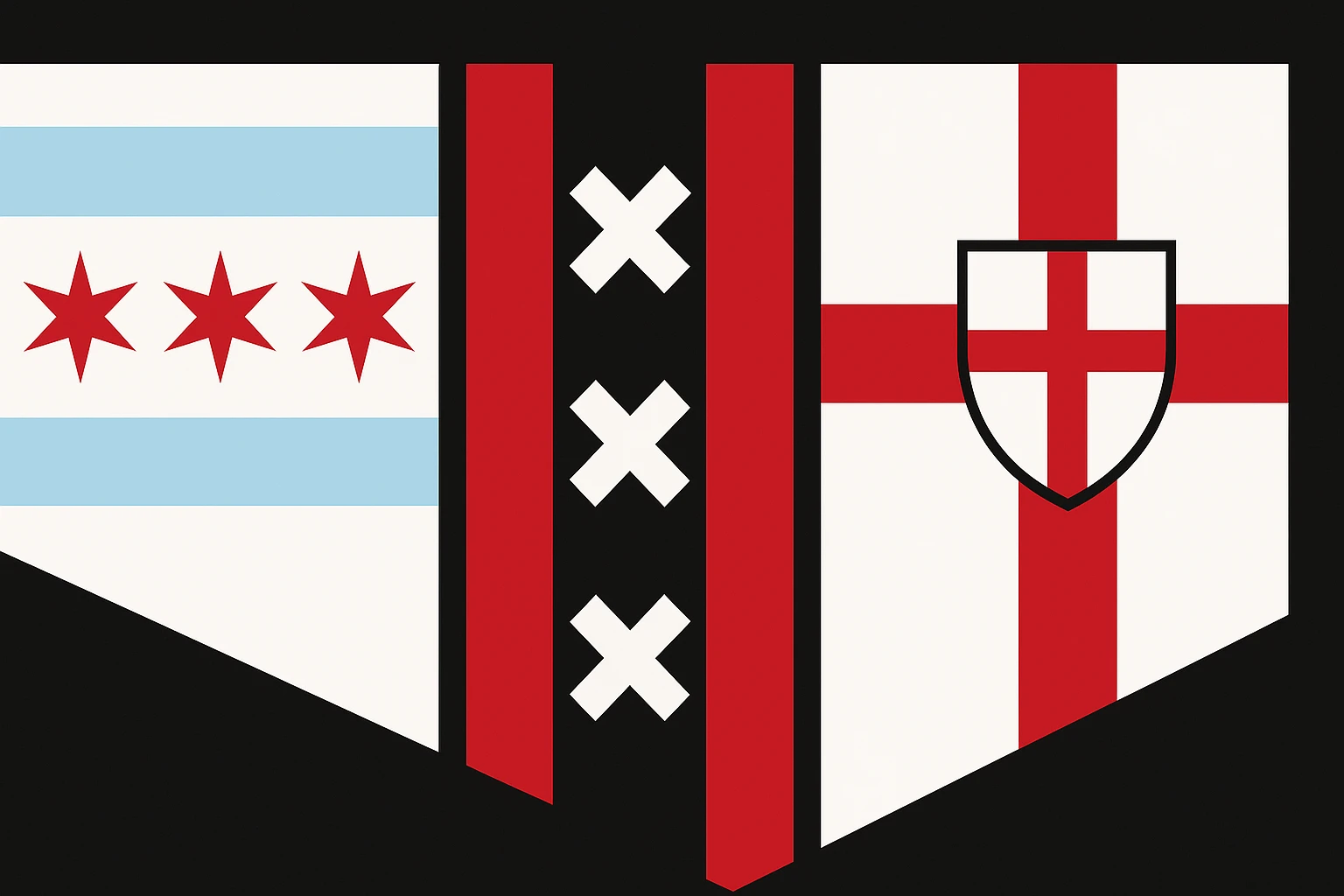
Two pale blue horizontal stripes represent Lake Michigan and the Chicago River. Between them, on a white field, sit four six-pointed red stars, each commemorating a defining event in the city's history: Fort Dearborn, the Great Chicago Fire of 1871, the 1893 World's Columbian Exposition, and the 1933 Century of Progress Exposition. Three colors, two types of element, and a story you could tell a stranger on the L in thirty seconds.
The flag was created in 1917 by Wallace Rice, a poet and municipal design advocate who won a competition judged by the Municipal Flag Commission. Rice explicitly rejected the seal-on-a-bedsheet approach, arguing for simplicity and symbolism over encyclopedic inclusion, and the commission listened.
A century later his design is on coffee mugs, bar signs, murals, album covers, laptop stickers, jacket patches, and a great many forearms. No other American city flag comes close to that level of citizen-driven adoption.
Score it against the five NAVA principles and it hits all five. A child could draw it from memory. Each element carries specific meaning. The palette is distinctive without being garish. No lettering, no seal, no fine print. And you will never confuse it with another city's flag.
Nobody mandated that Chicagoans put their flag on everything. During sports championships, during moments of community solidarity, during crisis, it became shorthand for "this is my city," which is not something a branding exercise can manufacture.
Amsterdam: three crosses that became a brand
Amsterdam's flag has three white Saint Andrew's crosses arranged vertically on a black stripe, flanked by red panels. The design derives from the coat of arms of the noble Persijn family and dates to at least the 16th century, though the triple-cross motif may be older.
Those three crosses, rendered as XXX, have long since escaped their heraldic origins. They're on the Amsterdammertje, the reddish-brown bollards that line the city's streets. They're on the official city logo. They were on the giant "I amsterdam" sculptures at Museumplein. They turn up on government letterhead and nightclub flyers alike.
There's also the obvious double meaning: three X's, the red-light district, the old adult content ratings. Amsterdam hasn't run from it. Leaning into the ambiguity has, if anything, made the symbol harder to forget.
Compare the Dutch national flag.
The red-white-blue tricolor is respected but generic. Squint and you could confuse it with Luxembourg, Paraguay, or a sideways France. Amsterdam's flag has no such problem.
The other advantage is adaptability. Amsterdam's crosses work on a bollard, a website favicon, a 50-foot banner, and a beer coaster, and that versatility comes directly from the simplicity of the original.
The City of London: heraldry older than the nation
A distinction that trips up almost everyone: the City of London is not London. It's the historic Square Mile, the ancient financial district at the heart of the metropolis, with its own government (the City of London Corporation), its own police force, its own Lord Mayor, and its own ancient flag. Greater London, the sprawling city of 9 million people, is something else.
The City's flag has a St George's Cross, red on white, with the sword of Saint Paul, a red upward-pointing dagger, in the upper-left canton. The design dates to at least the 14th century and possibly earlier.
That sword does two jobs. It represents Saint Paul, the patron saint of London, whose cathedral has dominated the Square Mile's skyline for centuries. It also commemorates Sir William Walworth, the Lord Mayor who stabbed the rebel leader Wat Tyler during the Peasants' Revolt of 1381. One symbol, a specific saint and a specific killing, which is about as far from vague corporate symbolism as a flag can get.
The City of London's arms are among the oldest continuously used civic arms in the world, predating the formal establishment of England's own heraldic traditions. Nearly 800 years of unbroken use gives the flag a weight no redesign committee could manufacture.
Compare the Union Jack.
The UK's national flag is itself a fine piece of design, a layered composite of three crosses representing England, Scotland, and Ireland. But the City of London's flag arguably carries more concentrated history per square inch, representing a political entity that has governed itself continuously since before the Magna Carta.
What the three have in common
They come from different continents, centuries, and design traditions, and they still overlap almost completely.
All three could be drawn accurately from memory by someone with no artistic training, which is the single biggest factor in adoption. A flag people can't reproduce informally never gets adopted informally. Consider how rarely anyone doodles a state flag on a napkin.
Their symbolism is specific rather than abstract. Chicago's stars mark particular historical events. Amsterdam's crosses trace to a particular noble family. London's sword points to a particular saint and a particular killing. That is a long way from the usual municipal formula where the blue represents our commitment to water and the green symbolizes growth and opportunity.
They're also restrained. Chicago uses three colors and two types of element. Amsterdam uses three colors and one repeating motif. London uses two colors and two elements. None of them tries to be everything to everyone, which is the hardest decision in the whole process.
None of them can be confused with another city's or country's flag, so each one works as an identity marker on sight.
And civilians display all three voluntarily. They get worn, tattooed, merchandised, and hung from apartment windows by people who feel real ownership over them. Nobody told them to.
What other cities are learning
Other cities have been paying attention. Inspired by Roman Mars and the NAVA principles, a wave of municipal flag redesigns swept across North America in the 2010s and 2020s. Pocatello replaced its infamous flag in 2017 with a clean mountain-and-compass design. Provo, Utah swapped out its outdated banner in 2015. Milwaukee, home of that cluttered collage, adopted a much better flag in 2022 after a public design competition: a single golden geometric sun over a blue field.
The stakes are not only aesthetic. A good city flag gives residents a visual shorthand for belonging, which matters most in diverse cities where other identity markers can be divisive. It's one of the few things everyone in a city shares regardless of neighborhood, background, or politics.
The reform process has its own failure mode, though. Well-intentioned redesigns collapse when they prioritize including every stakeholder's pet symbol over coherent design. What Chicago, Amsterdam, and London demonstrate is that leaving things out is most of the work, and that a flag simple enough to remember, specific enough to mean something, and distinctive enough to stand alone stops being government-issued fabric and starts being something citizens claim.