In the summer of 1964, the Canadian Parliament descended into what one senator later called "the most bitter debate in Canadian legislative history." It wasn't about war, taxes, or territory. It was about a piece of cloth. For six months, elected officials screamed, wept, filibustered, and nearly brought down a government over what should go on Canada's national flag. The country had existed for 97 years without an official one, flying instead a colonial holdover with the British Union Jack in the corner. When Prime Minister Lester B. Pearson forced the issue, he set off an identity crisis that split the country along linguistic, cultural, and generational lines.
The design that won was nobody's first choice. Not Pearson's, not the opposition's. It came out of a last-ditch parliamentary committee as a compromise candidate and was adopted through procedural maneuver at 2:15 in the morning. More than 60 years after it was first raised on Parliament Hill on February 15, 1965, the Maple Leaf is one of the most recognizable national symbols in the world.
A country without a flag: why Canada waited 97 years
When Canada confederated in 1867, nobody bothered to design a flag. The new dominion simply continued flying the British Union Jack and various versions of the Canadian Red Ensign, a red flag with the Union Jack in the canton and a Canadian coat of arms on the fly. No legislation. No official adoption. The Red Ensign evolved informally over the decades, with updated coats of arms swapped in as provinces joined Confederation, but it was only authorized for limited official use (government buildings abroad) by an order-in-council in 1945, never by an Act of Parliament.
Several attempts to settle the question failed before what became known as the Great Flag Debate of 1964. A 1925 committee established by Prime Minister Mackenzie King dissolved without agreement. A 1946 joint committee of the Senate and House of Commons reviewed over 2,600 designs before disbanding in deadlock. The country kept kicking the can down the road.
The reason was a standing tension between English Canadians, many of whom felt deep loyalty to the British crown and the Union Jack, and French Canadians, who saw British symbols as relics of colonial conquest and cultural marginalization. The flag question was never really about aesthetics. It was a proxy fight over national identity, and nobody wanted to be the one to light that particular fuse.
Pearson's gamble
Lester B. Pearson did it anyway.
On May 17, 1964, the Nobel Peace Prize laureate and Liberal Prime Minister, leading a fragile minority government, stood before a Royal Canadian Legion convention in Winnipeg. The venue was a deliberate provocation: the room was packed with pro-British veterans. Pearson announced that Canada would have a new distinctive flag within two years. He was booed off the stage.
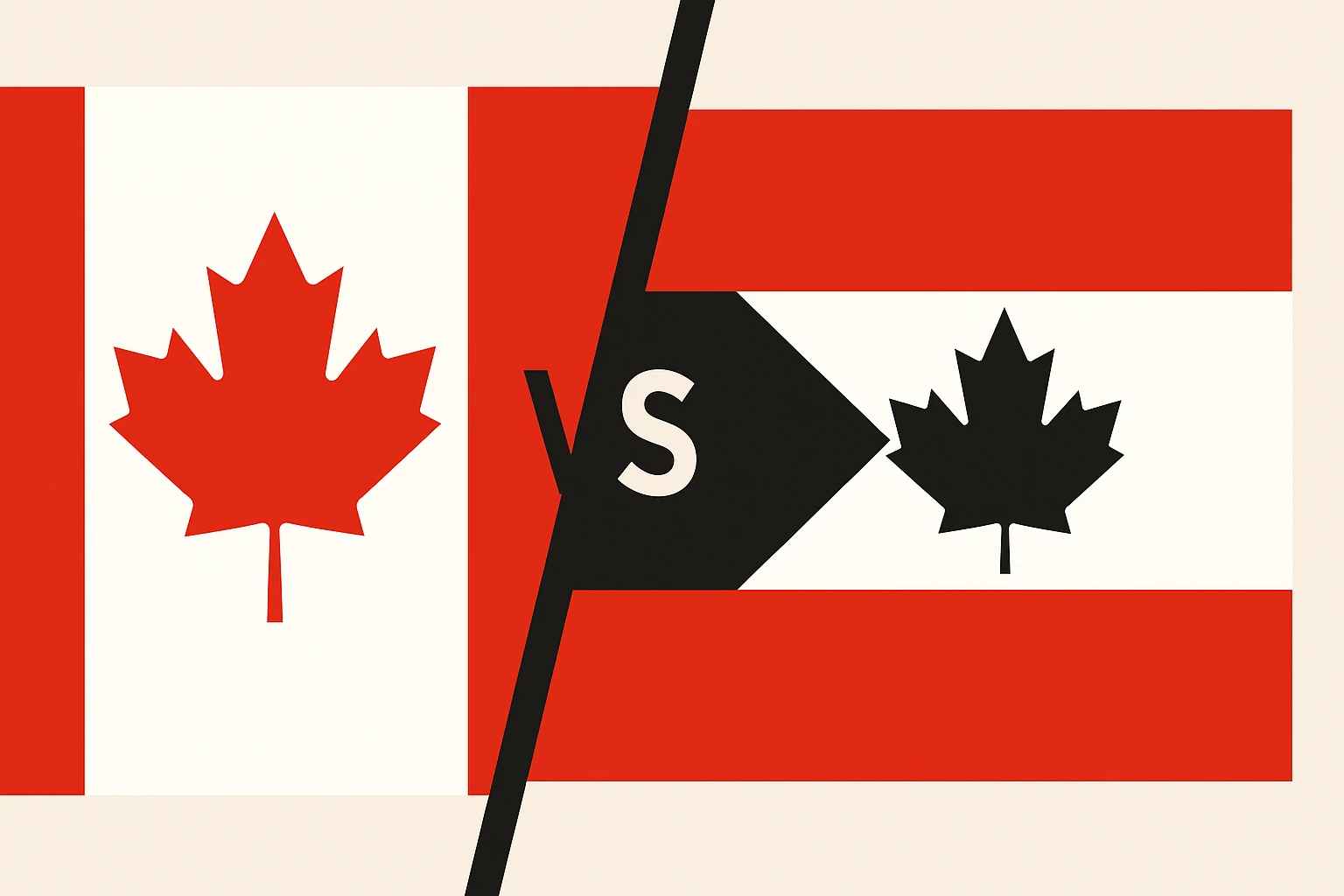
His own preferred design, quickly dubbed the "Pearson Pennant," had three red maple leaves conjoined on a single stem against a white background with blue borders on each side, the blue standing for Canada's position between the Atlantic and Pacific. It was immediately polarizing. Critics mocked it as "Pearson's turkey gobbler" and "the grocery store emblem." Supporters argued it represented Canada's bicultural identity without British imperial symbols.
Pearson's motives were both principled and political. He had seen Canadian and South African troops unable to distinguish themselves from British forces under similar flags during the 1956 Suez Crisis. He also wanted to appeal to Quebec during the rising tide of the Quiet Revolution and separatist sentiment. Many in his own party thought gambling a minority government on a culture war was reckless. He believed it was necessary.
Diefenbaker's last stand
John Diefenbaker, the fiery Progressive Conservative opposition leader and former Prime Minister, became the debate's most passionate combatant. He viewed removing the Union Jack as a betrayal of the country's British heritage and of the veterans who had fought under the Red Ensign.
Diefenbaker used every parliamentary tactic available. His caucus filibustered for weeks, delivering marathon speeches and introducing amendment after amendment, stretching the House of Commons debate from June through December 1964.
It got intensely personal. Diefenbaker reportedly wept in the House while holding a Red Ensign. MPs received death threats. The proceedings grew so acrimonious that Speaker Alan Macnaughton struggled to maintain order.
His position had real support, too. Polls at the time showed the country genuinely divided, with a significant share of Canadians preferring to retain the Red Ensign or at least keep the Union Jack somewhere in a new design. The fractures were regional and generational: Western Canada and the Maritimes, with strong British-heritage populations, largely sided with Diefenbaker, while Quebec and urban Ontario leaned toward Pearson.
The committee, the compromise, and the 2 a.m. vote
To break the impasse, the House voted in September 1964 to refer the flag question to a 15-member all-party committee chaired by Liberal MP Herman Batten. The committee reviewed thousands of public submissions, including designs featuring beavers, fleurs-de-lis, and even a map of Canada.
The two people who mattered most were John Matheson, a Liberal MP and war veteran who had long championed a single maple leaf design, and historian George Stanley, dean of arts at the Royal Military College of Canada. Stanley had written to Matheson proposing a design based on the college's own flag: a single red maple leaf on a white background between two red borders.
Plenty of people initially dismissed it as too simple. But when the committee held its final vote, the single maple leaf performed decisively better than both the Pearson Pennant and the Red Ensign, winning support across party lines for a reason that sounds backwards: it was nobody's passionate first choice, so it offended the fewest people.
On December 15, 1964, after Pearson invoked closure to end the filibuster (a controversial procedural move that infuriated the Conservatives), the House of Commons voted 163 to 78 to adopt the single maple leaf design. The final vote came at approximately 2:15 a.m., with Diefenbaker and many Conservatives sitting in bitter silence.
The new flag was officially inaugurated on February 15, 1965, in a ceremony on Parliament Hill attended by 10,000 people. Pearson declared, "May the land over which this new flag flies remain united in freedom and justice." Diefenbaker was reportedly seen with tears streaming down his face.
The designs that almost were
The committee and the public together generated over 5,900 proposed designs, and the archive of rejects is worth a look.
Among the serious contenders was a design with a Union Jack and a fleur-de-lis flanking a maple leaf, an attempt to satisfy both English and French Canada that satisfied neither. The Pearson Pennant came close to becoming reality: Pearson pushed it hard in the initial House debate, and had the matter not gone to committee, his government might have forced it through. Most vexillologists consider the three-leaf design aesthetically inferior and harder to reproduce.
George Stanley's original sketch was refined by graphic designer Jacques Saint-Cyr of the Canadian Government's Expositions Branch, who modified the proportions and stylized the maple leaf into its 11-pointed form. A natural maple leaf has far more points and would have looked cluttered at a distance. That refinement is easy to overlook and it made the difference.
One of the more telling rejected concepts was a Red Ensign variant with a gold maple leaf replacing the coat of arms, a split-the-difference approach that would have preserved the Union Jack while adding a Canadian element. It pleased almost nobody in committee.
What the record shows is that national symbols often get chosen by elimination rather than inspiration. The Maple Leaf won because it was the only option that could survive the gauntlet of competing identities, regional loyalties, and political grievances.
Canada's agony against Liberia's simplicity
Liberia's flag, adopted in 1847 when the nation declared independence, was modeled directly on the American Stars and Stripes: eleven red and white stripes for the signers of its Declaration of Independence, and a single white star on a blue field for Liberia's status as the first independent republic in Africa.
Unlike Canada's ordeal, Liberia's flag adoption was straightforward. The country was founded by freed American slaves under the auspices of the American Colonization Society, and the founders' identification with American political ideals made an American-inspired design an uncontested choice.
That simplicity masked its own tensions. The Americo-Liberian settlers who chose the flag were a small elite that would dominate the indigenous population for over a century. The flag meant unity to some and exclusion to others, which complicates any easy reading of the contrast.
Canada's long argument, on the other hand, forced the country to publicly reckon with its dual colonial heritage, its Indigenous erasure, and its aspiration to be something other than a British dominion. Painful, but arguably a healthier process, and one that gave the resulting flag deeper legitimacy. Both cases suggest the same thing: the difficulty of a flag debate tracks the unresolved tensions inside the nation having it.
From compromise to icon
Public opinion on the Maple Leaf shifted sharply in the decades after adoption. By 1995, polls showed over 80% of Canadians supported the flag. By its 60th anniversary in February 2025, it had become inseparable from Canadian identity: sewn onto backpackers' bags worldwide, flown at Olympic ceremonies, recognized as one of the most distinctive national flags anywhere.
The design works because it is simple. It is one of only a handful of national flags a child can draw from memory, and its red-and-white scheme is identifiable at any size or distance. The busier Pearson Pennant would have lacked both qualities.
The flag also did quiet work in differentiating Canada from both Britain and the United States during the late 20th century. It became associated with peacekeeping, multiculturalism, and polite independence in a way the Red Ensign never could have.
Diefenbaker never reconciled with it. He requested that his coffin be draped with the Red Ensign when he died in 1979, a last act of defiance that showed how personally the debate had wounded the people in it, even as the country moved on.