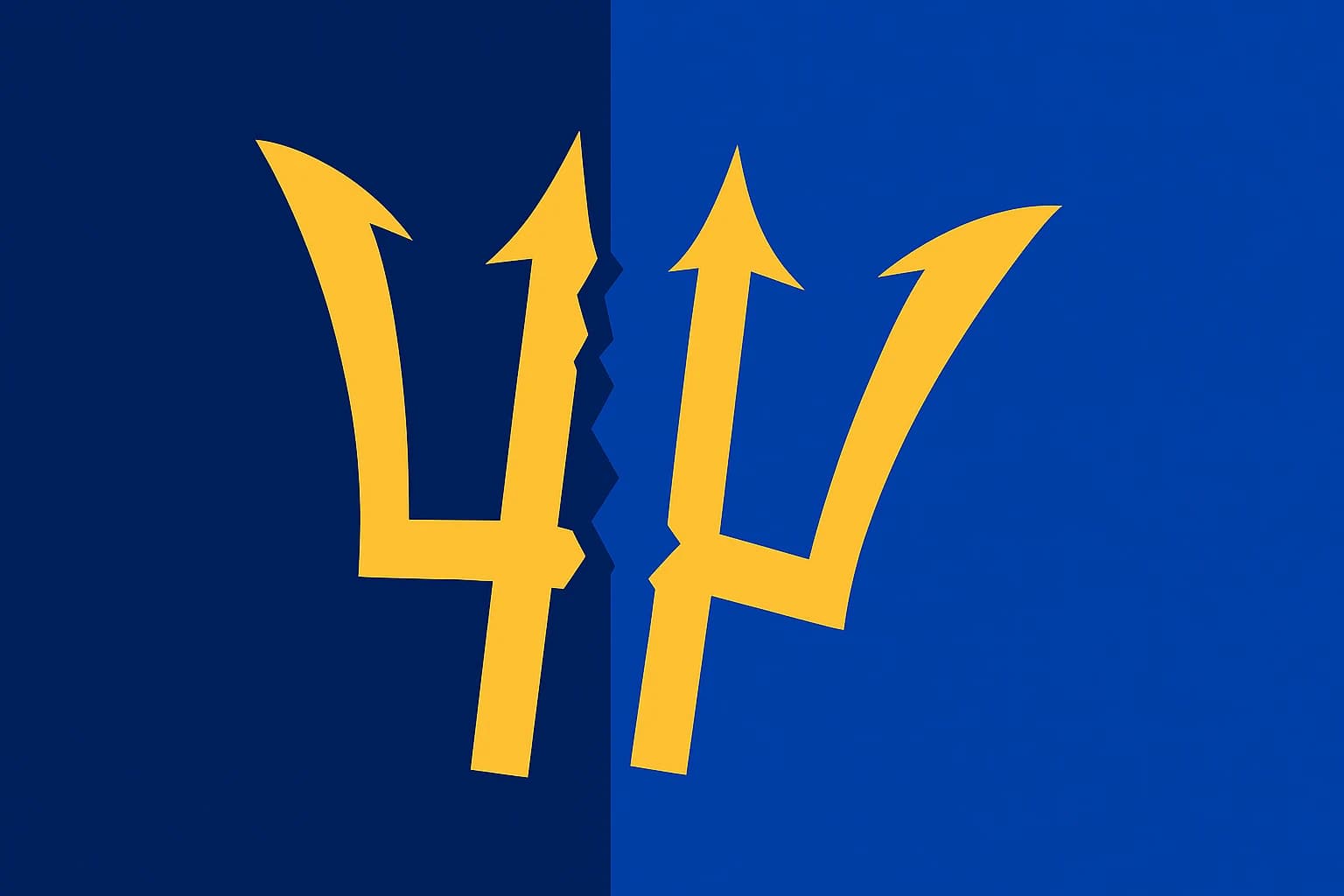
When Barbados unveiled its national flag on November 30, 1966, the very day it gained independence from Britain, the design contained an act of defiance so subtle that most onlookers missed it entirely. At the center of the flag's ultramarine and gold bands sat a black trident head, its shaft deliberately broken off. That trident had been lifted directly from the colonial seal of Barbados, where it appeared clutched in the hand of Britannia, the embodiment of British imperial power. Designer Grantley Prescod didn't reject the trident. He didn't replace it with something new. He kept it, but he snapped it free from the hand that held it.
In one gesture, Prescod told the story of a country that had taken its identity back from colonial control without pretending the colonial history had not happened. It is among the most subversive decisions anyone has made in flag design, and hardly anyone outside Barbados knows the story.
The trident's route from a colonial seal through Prescod's redesign to the republic Barbados became in 2021 raises a question that most post-colonial nations answer differently: what does it mean to build a national identity by breaking the past apart and keeping the pieces, rather than by erasing it?
Britannia's grip: the colonial seal and the trident's original meaning
The colonial seal of Barbados dates back to the 17th century. It featured Britannia holding a trident, a symbol of British naval supremacy and dominion over the seas. The imagery echoed the mythology of Neptune and Poseidon. The message was blunt: Britain ruled the waves, and these islands belonged to the Crown.
Barbados was one of England's oldest Caribbean colonies, settled in 1627. It bore the nickname "Little England" due to its deep cultural and institutional ties to Britain. The Anglican church, the parliamentary system, the plantation economy, even the cricket. Everything pointed back to London. The trident on the seal reinforced this possessive relationship. It said: you are ours.
The trident on colonial seals was never decorative. It signified ownership, maritime control, and the projection of imperial power across the Atlantic. You'd find similar imagery across British Caribbean colonial insignia, a visual language of domination repeated from Jamaica to Trinidad to the smallest island territories. The trident was shorthand for an empire that stretched its reach through saltwater.
By the middle of the 20th century, as independence movements gathered pace across the Caribbean, these colonial symbols had become politically charged. They stood for the authority nationalist leaders were trying to dismantle, and the trident, an unquestioned emblem of order for three centuries, turned into a provocation. It was going to be dealt with somehow. The only question was how.
Grantley Prescod and the competition that changed everything
In 1966, as Barbados prepared for independence, the government held a public competition to design a national flag. More than a thousand entries came in. That is a thousand Barbadians sitting down with pencils and paint, each answering the same question: what does this country look like when it belongs to itself?
Grantley W. Prescod, an art teacher, won the competition with a design that was deceptively simple. Two bands of ultramarine, representing sea and sky, flanked a gold band representing the sand of the island's beaches. At the center sat a black broken trident head.
What Prescod chose not to do is the interesting part. Instead of inventing a new symbol, he took the trident out of the colonial seal, removed Britannia's hand, and broke the shaft, turning an emblem of subjugation into one of liberation. The three prongs were given a new reading: government of the people, government for the people, government by the people. Principles of democracy carried on a weapon that had stood for somebody else's authority.
The broken shaft is the break with colonial rule. It admits that Barbadian history is entangled with Britain's while declaring the relationship of dominance over. The shaft was not removed from the design, it was snapped, and Prescod understood that the distinction was the whole point.
Why breaking is more powerful than replacing
Erasing a symbol lets a country pretend the past did not happen. Keeping it intact suggests the past still has a hold. Prescod took a third route and broke the thing, which achieves what neither erasure nor preservation can.
In semiotics, the study of signs and meaning, there is a distinction between erasure (removing a colonial symbol entirely) and subversion (repurposing it). Prescod chose subversion, which carries a more complex and more powerful political message. By keeping the trident, Barbados refused to pretend that 339 years of colonial history hadn't happened. By breaking it, the nation asserted that it had taken control of the narrative. This is an act of agency, not amnesia.
Compare this to iconoclasm movements throughout history. During the French Revolution, crowds destroyed royal symbols, melted down statues, renamed streets. After the fall of the Berlin Wall, Soviet statues were pulled from their pedestals across Eastern Europe. The dominant approach was total removal. Out with the old, in with something clean.
Prescod's approach parallels what postcolonial theorists like Homi Bhabha have described as "mimicry with a difference," adopting the colonizer's symbols but altering them in ways that undermine the original authority. The colonized subject speaks back in the colonizer's own language, but the words mean something new. That's what the broken trident does. It speaks the visual language of the British Empire, but the sentence it forms is one of independence.
The broken trident also functions as a permanent visual reminder to future generations. It tells them not only that Barbados is independent, but how and from what it became independent. The flag encodes its own origin story. Every time a Barbadian child looks at that flag and asks, "Why is the trident broken?" the answer is the history of the nation itself.
Caribbean comparisons: different flags, different answers
Barbados wasn't the first Caribbean nation to face this design challenge, and it wasn't the last. Looking at how its neighbors handled their colonial visual inheritance puts Prescod's decision into sharper relief.
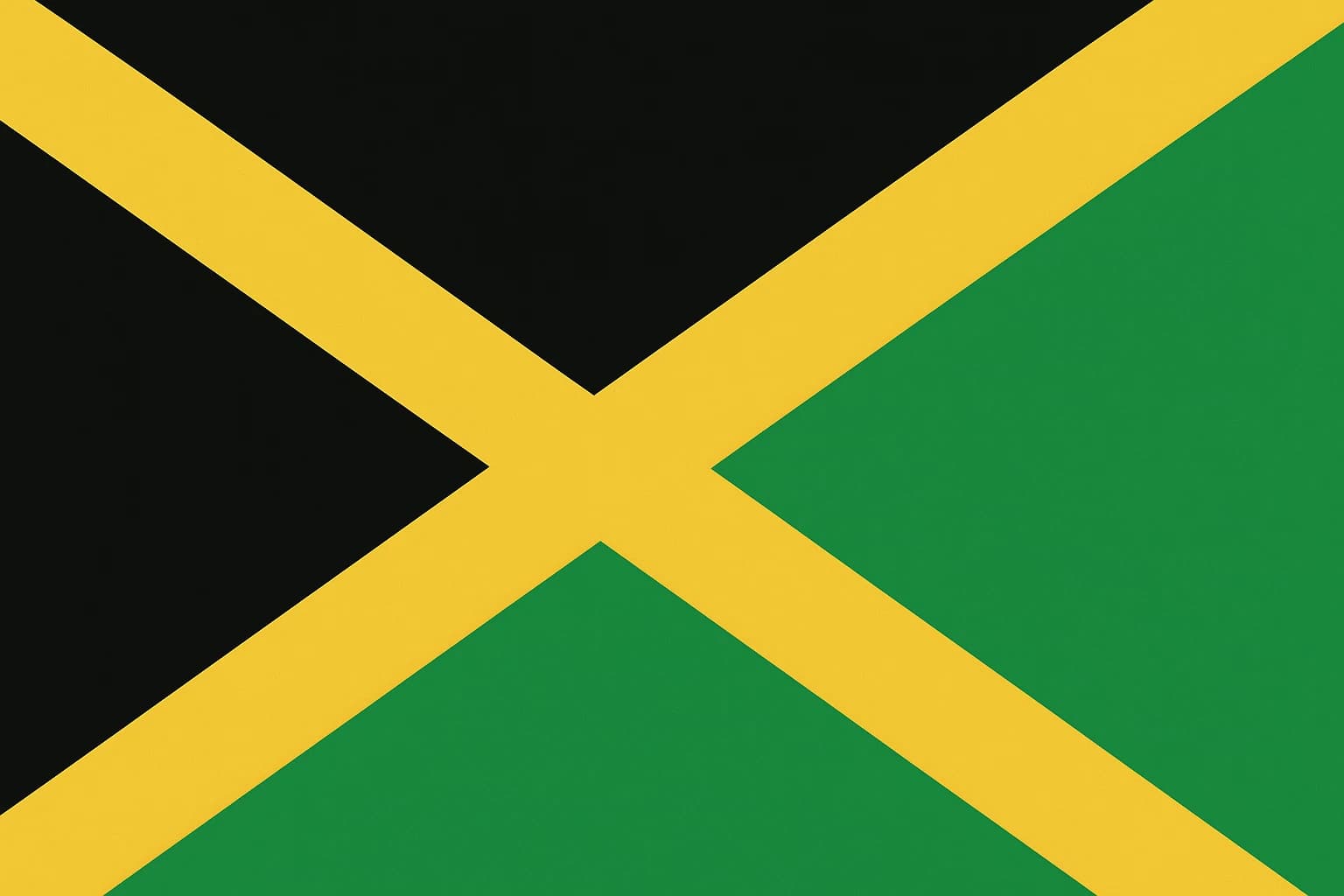
Jamaica, independent since 1962, chose a completely original flag design. Black, green, and gold with no reference to colonial symbols. The colors represent hardship, agriculture, and sunshine. A clean aesthetic break.
Trinidad and Tobago, also independent from 1962, adopted a red field with a black diagonal stripe edged in white, designed by Carlisle Chang. Another original composition that avoided engaging with colonial imagery.
Dominica, independent since 1978, took a different path entirely. It incorporated the Sisserou parrot, an endemic species found nowhere else on Earth, as a symbol of uniqueness and ecological identity. Nature, rather than political history, sits at the center of national identity.
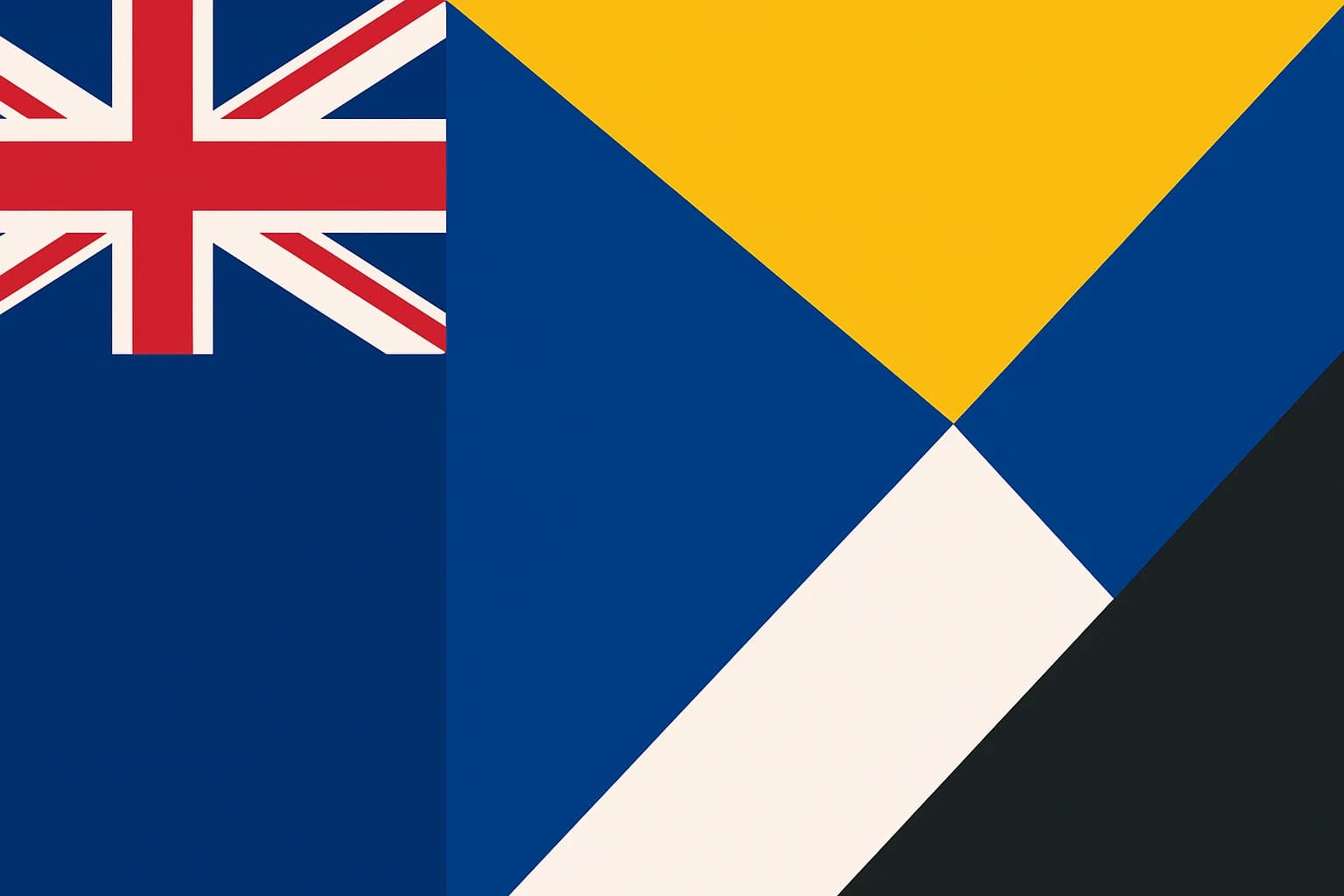
Then there's Montserrat, still a British Overseas Territory as of 2026. Its flag retains the British Blue Ensign with a colonial coat of arms showing a woman (Erin, symbolizing Irish heritage) embracing a harp and cross. It's an example of colonial visual continuity where independence hasn't occurred.
Barbados is the only one of these that argues with its inheritance. Jamaica and Trinidad erased theirs, Montserrat preserved its, and Barbados took the colonial symbol and altered it. The flag is a historical argument stitched into fabric as much as it is a national emblem.
November 30, 2021: the republic and the trident's second life
On November 30, 2021, exactly 55 years after independence, Barbados officially became a republic. It removed Queen Elizabeth II as head of state and installed Dame Sandra Mason as its first president. Prince Charles himself attended the ceremony, standing in the warm Bridgetown night as the country severed its last formal link to the Crown.
Unlike independence in 1966, the republican transition produced no new flag. Barbados kept the broken trident, which is to say that Prescod's 1966 design had already encoded the full trajectory of decolonization. It needed no updating because it had always been ahead of the politics.
The decision to retain the flag sparked discussion among vexillologists and political commentators. Was the broken trident now even more meaningful, since the last formal link to the Crown had been severed? Or had the flag's symbolism been fully realized and therefore completed its work? It's a genuine debate, and both sides have merit.
Prime Minister Mia Mottley's government framed the republican transition as a completion of the independence process. In this reading, the broken trident's shaft wasn't broken in 1966 alone. It was a break that took 55 years to become fully real. The snap happened in slow motion, and the flag was always depicting the endpoint, not just the beginning.
The 2021 transition restarted conversations across the Caribbean about colonial legacies. Jamaica's Prime Minister Andrew Holness signaled interest in a similar republican move, and Barbados's flag came up repeatedly in regional discussions about what post-colonial identity looks like, which turned a Barbadian symbol into a Caribbean talking point.
What a broken trident teaches about designing identity after empire
Flag design in a post-colonial context is a political act rather than an aesthetic one. It forces a new country to decide whether it defines itself by what it was, what it rejected, or what it hopes to become.
Barbados found a fourth option and defined itself by the act of transformation. The flag points at neither a utopian future nor an idealized past but at the specific moment of rupture that made the country.
This approach has relevance far beyond the Caribbean. As countries and communities around the world in 2026 continue to grapple with colonial monuments, statues, and symbols, Barbados's model suggests that subversion is sometimes more historically honest than demolition. You don't have to tear down a statue to change its meaning. You can break it, reframe it, put it in a new context, and let it tell a different story.
The broken trident also complicates a common assumption in vexillology, that the best flags are clean and free of historical baggage. The rules of good flag design popularized by the North American Vexillological Association favor simplicity and originality. Prescod's design is simple, but simple in the way a haiku is simple, and it works partly because it carries the weight of history rather than avoiding it.
The flag that told the future
Prescod could have picked a flying fish, a sugar cane stalk, or an abstract geometric pattern, none of which carry a trace of British rule. He went into the colonizer's own iconography instead, pulled out a weapon of imperial authority, and broke it.
That decision produced a flag that acknowledges colonial history and declares liberation from it in the same image, and it has needed no revision in sixty years of a country that has changed a great deal.