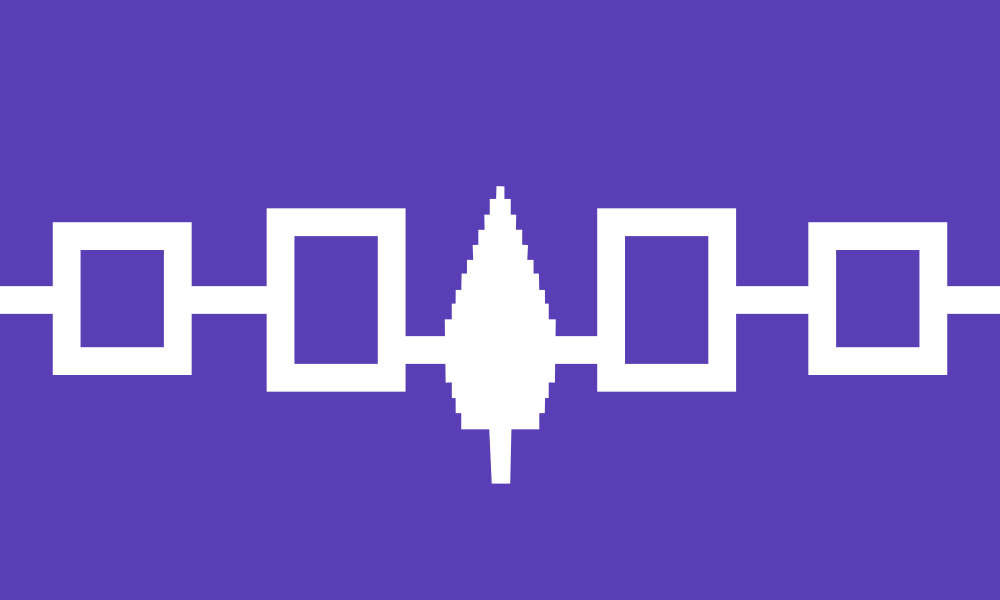
The Haudenosaunee Flag
Haudenosaunee Confederacy
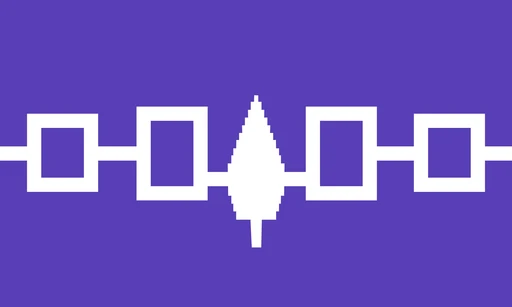
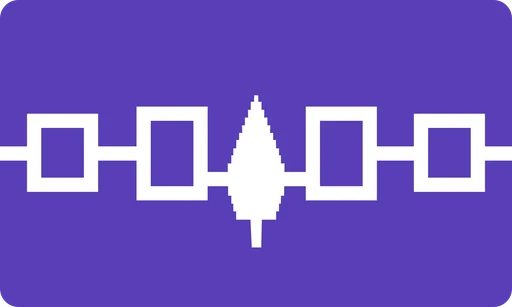
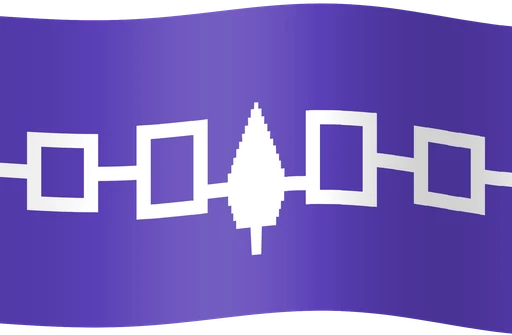
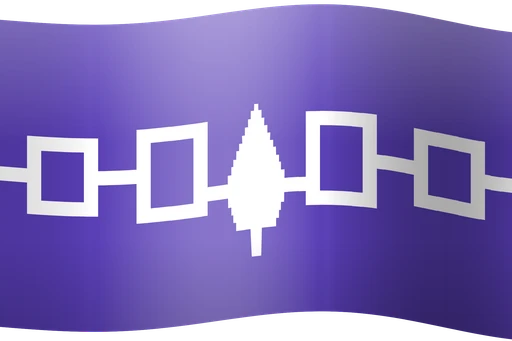
The Haudenosaunee flag is purple with a row of five white symbols across the middle: two open squares, a pine tree and two more open squares, all joined by a white line that runs to both edges. The design copies the Hiawatha Belt, the wampum belt that records the founding of the Haudenosaunee Confederacy, also known as the Iroquois or Six Nations. Each symbol is one of the five founding nations. From left to right they are the Seneca, Cayuga, Onondaga, Oneida and Mohawk. The tree in the centre is the Tree of Peace, and it stands for the Onondaga, who keep the confederacy's council fire. Purple and white are the colours of wampum beads.
The Haudenosaunee flag is a wampum belt turned into cloth. Four open white squares and a white pine tree sit in a row on a purple field, joined by a white line that runs off both edges. The pattern is centuries old. The flag was put together around 1990 for a lacrosse team, by a teacher, a student and the student's father, who ran a T-shirt shop.
Five nations in a row
The Haudenosaunee are the people often called the Iroquois or the Six Nations. Their confederacy began when five nations made peace with each other, and the Hiawatha Belt is the record of that agreement. The Onondaga Nation calls it "a national belt of the Haudenosaunee" and says it was "created at the beginning of our confederacy of peace." It is named after Hiawatha, the Onondaga man who helped the Peacemaker carry the message from nation to nation.
Each symbol on the belt is one nation, and the flag keeps them in the same order. Hold the flag like a map, with west on the left:
- The outer left square is the Seneca, the western doorkeepers and the People of the Great Hill.
- The next square is the Cayuga.
- The tree is the Onondaga.
- The next square is the Oneida, the People of the Standing Stone.
- The outer right square is the Mohawk, the eastern doorkeepers and the first nation to accept the peace.
The tree is a white pine. In the Onondaga telling, the Peacemaker uprooted the tallest white pine, and it became the Tree of Peace. The Onondaga sit in the middle because they are the firekeepers of the confederacy. They keep "the fire that never dies." When the Grand Council meets, the belt is present, the nation says, "to remind the leaders to maintain the peace."
The line that ties the symbols together is the union itself. The Peacemaker told the nations to live "together under one longhouse" with "one common law, one heart, and one mind."
Count the symbols and you get five. The Tuscarora joined the confederacy in 1722 as the sixth nation, after the belt was made, so the flag of the Six Nations shows only five of them.
Why it is purple
Wampum beads come in two colours. The Onondaga Nation describes them as cut from "the white and purple parts of the shell" of a clam. The Hiawatha Belt is purple with the symbols worked in white, and the flag follows it.
The exact purple is another matter. No Haudenosaunee government has published a specification, and the flags in use vary. Flags of the World describes the field as blue or purple. The image on this page uses a mid purple and a height-to-width ratio of 3:5, which is the usual shape. Neither is official.
Tim Johnson and his father saw this problem coming. In 2003 they told Indian Country Today that the first flag was accurate to the symbol on the belt, but that the design is in the public domain and later copies do not always keep the proportions. Harold Johnson's advice was that "all our Six Nations governments adopt technical standards and requirements for the faithful production of the flag."
A team with passports and no flag
The flag exists because of lacrosse. The Grand Council of the Haudenosaunee sanctioned a national team, the Iroquois Nationals, in 1983. The International Lacrosse Federation turned the team away from the 1986 world championship, then admitted it as a full member in 1988. Its first world championship was the 1990 tournament in Perth, Australia.
The players intended to travel on Haudenosaunee passports. A team that enters a stadium as a nation needs something to carry, and the confederacy had no flag. According to a history piece published by Buffalo Toronto Public Media, Rick Hill took on the job. Hill is Tuscarora, was born in Buffalo and was teaching at the University at Buffalo. He contacted Tim Johnson, a Mohawk undergraduate from North Tonawanda. Oren Lyons, an Onondaga faithkeeper who taught at the same university, had suggested the Hiawatha Belt as the model.
Johnson told Indian Country Today how he did it. He traced a photograph of the belt so the proportions stayed true, then prepared the design with red contact film and high-contrast photography. His father Harold, known as Jack, had spent years as a chemical worker and ran a business printing Native designs on clothing. He used the negative to print a dozen flags. They "sold immediately," and Hill bought a couple for the Nationals.
The two accounts differ on the date. The 2003 article says the flag was created "in the late 1980s." The 2026 piece, which Johnson and Hill helped write, says 1990. Either way, the team carried it in Australia.
Whose flag is it?
Nobody voted on it. There is no adopting resolution to cite, which is why this page gives no adoption date. Johnson's own explanation is that the symbol was already everyone's: "It belongs to all of our families and clans and nations."
The uptake was quick and wide. Contributors to Flags of the World have recorded it in official use by the Mohawks of Kahnawake and flying at Tuscarora in New York and at Six Nations of the Grand River in Ontario. Buffalo Toronto Public Media lists appearances at the Smithsonian's National Museum of the American Indian in Washington and at the Standing Rock protests against the Dakota Access Pipeline. Before the team's games, a traditional song, the "Bean Song," is played alongside the American and Canadian anthems.
The flag has also been kept at home on principle. In July 2010 the United Kingdom refused to accept Haudenosaunee passports for the world championship in Manchester. The players would not travel on American or Canadian ones, and the team forfeited its three opening games. In June 2022 the team dropped "Iroquois" and became the Haudenosaunee Nationals.
The Olympic question
Lacrosse was last an Olympic sport in 1908. In October 2023 the International Olympic Committee added it to the 2028 Games in Los Angeles, in the six-a-side format. That raised an obvious question about the people who invented the game.
On 17 January 2025 the United States and Canada issued a joint statement urging the committee to "allow the Haudenosaunee Confederacy" to compete as its own team. It argued that "a narrowly scoped exception is appropriate."
The committee has not agreed. Windspeaker reported in March 2026 that it "has said it will not allow the Haudenosaunee to participate under its own flag," because only countries with a National Olympic Committee are eligible. Claudia Jimerson, the Nationals' director of lacrosse operations, told a conference in Las Vegas on 23 March 2026 that she hoped officials would "have a change of heart." Qualifying begins with continental championships late in 2026.
References
[1] "Hiawatha Belt," Onondaga Nation. https://www.onondaganation.org/culture/wampum/hiawatha-belt/
[2] "Wampum," Onondaga Nation. https://onondaganation.org/culture/wampum
[3] "Joint Statement from the United States and Canada on Haudenosaunee Participation in the 2028 Los Angeles Olympics," The White House, January 17, 2025. https://bidenwhitehouse.archives.gov/briefing-room/statements-releases/2025/01/17/joint-statement-from-the-united-states-and-canada-on-haudenosaunee-participation-in-the-2028-los-angeles-olympics
[4] Tom Wanamaker, "From beads to banner," Indian Country Today, November 25, 2003. https://ictnews.org/archive/from-beads-to-banner/
[5] Jeff Z. Klein, "Heritage Moments at UB: A flag is born for the Six Nations," Buffalo Toronto Public Media, March 20, 2026. https://www.btpm.org/2026-03-20/heritage-moments-at-ub-a-flag-is-born-for-the-six-nations
[6] Sam Laskaris, "Haudenosaunee Nationals Lacrosse Teams Still Pushing For IOC Recognition," Windspeaker, republished by SNI News, 2026. https://sninews.org/?p=41373
[7] "Iroquois Confederacy (U.S. and Canada)," Flags of the World. https://www.crwflags.com/fotw/flags/xa-iroqu.html
[8] "Flag of the Haudenosaunee Confederacy," Wikipedia. https://en.wikipedia.org/wiki/Flag_of_the_Haudenosaunee_Confederacy
[9] "Haudenosaunee men's national lacrosse team," Wikipedia. https://en.wikipedia.org/wiki/Haudenosaunee_men%27s_national_lacrosse_team
Common questions
- What does the Haudenosaunee flag mean?
- The flag reproduces the Hiawatha Belt, the wampum belt made when five nations agreed to live in peace under one law. Each of the five white symbols is a nation: Seneca, Cayuga, Onondaga, Oneida and Mohawk. The line joining them shows their union. The tree in the middle is the Tree of Peace, the white pine the Peacemaker uprooted so the nations had a place to bury their weapons. Tim Johnson, one of the flag's makers, called it a symbol of "peace, unity and prosperity."
- Who designed the Haudenosaunee flag?
- Three people share the credit. Rick Hill, a Tuscarora artist and teacher linked to the Iroquois Nationals lacrosse team, started the project. Tim Johnson, a Mohawk student at the University at Buffalo, drew the artwork from a photograph of the Hiawatha Belt. His father, Harold "Jack" Johnson, printed the first flags. The idea of using the belt came from Oren Lyons, an Onondaga faithkeeper. The design itself is far older than any of them. It belongs to the belt.
- Why is the Haudenosaunee flag purple and white?
- Those are the two colours of wampum. The Onondaga Nation describes wampum as beads cut from the white and purple parts of a clam shell. The Hiawatha Belt is a field of purple beads with the five symbols picked out in white, and the flag keeps the same scheme. No Haudenosaunee government has published a colour standard, and Flags of the World records the field as blue or purple.
- Which nations do the symbols on the Haudenosaunee flag represent?
- Read the flag like a map, with west on the left. The first square is the Seneca, keepers of the western door. Next come the Cayuga. The tree is the Onondaga, at the centre of the confederacy. Then come the Oneida, and last the Mohawk, keepers of the eastern door. The sixth nation, the Tuscarora, joined in 1722, after the belt was made, so it has no symbol of its own.
- When was the Haudenosaunee flag first flown?
- Sources disagree on the year it was made. Tim Johnson dated it to the late 1980s in a 2003 interview with Indian Country Today. A 2026 history piece he co-wrote for Buffalo Toronto Public Media puts the design work at the University at Buffalo in 1990. Both accounts agree on the occasion: the Iroquois Nationals took the flag to the world lacrosse championship in Australia, which was held in Perth in 1990.
- Will the Haudenosaunee flag fly at the 2028 Olympics?
- As of March 2026, no. Lacrosse returns to the Games in Los Angeles, and the Haudenosaunee Nationals want to compete as their own team. The United States and Canada backed them in a joint statement on 17 January 2025. The International Olympic Committee has said only countries with a National Olympic Committee are eligible, and the Haudenosaunee do not have one. The team was still pressing its case in March 2026.
Download this flag
Free in 12 styles, from 32px icons up to 2000px, as SVG, PNG, WebP and JPG.