The Navajo Nation Flag
Navajo Nation
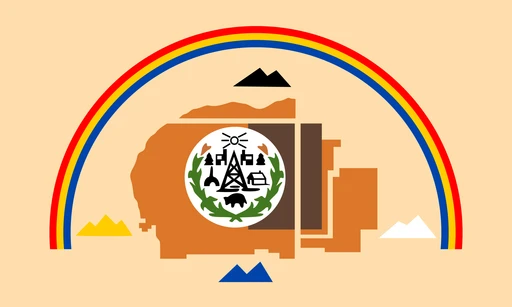
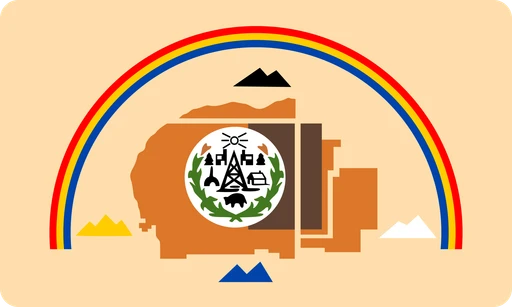
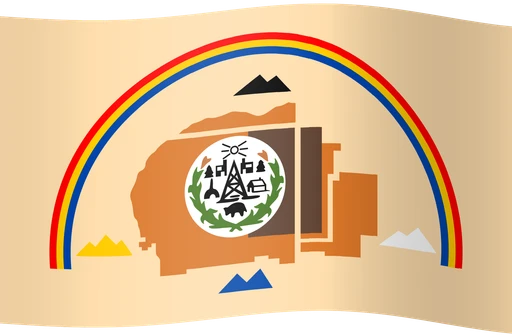
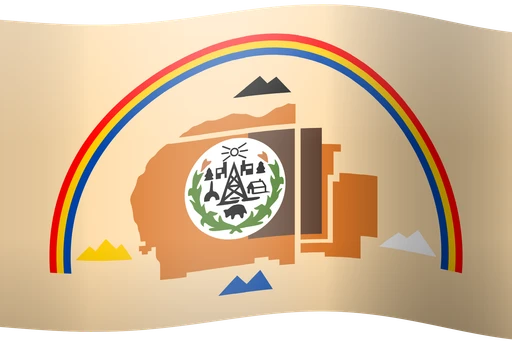
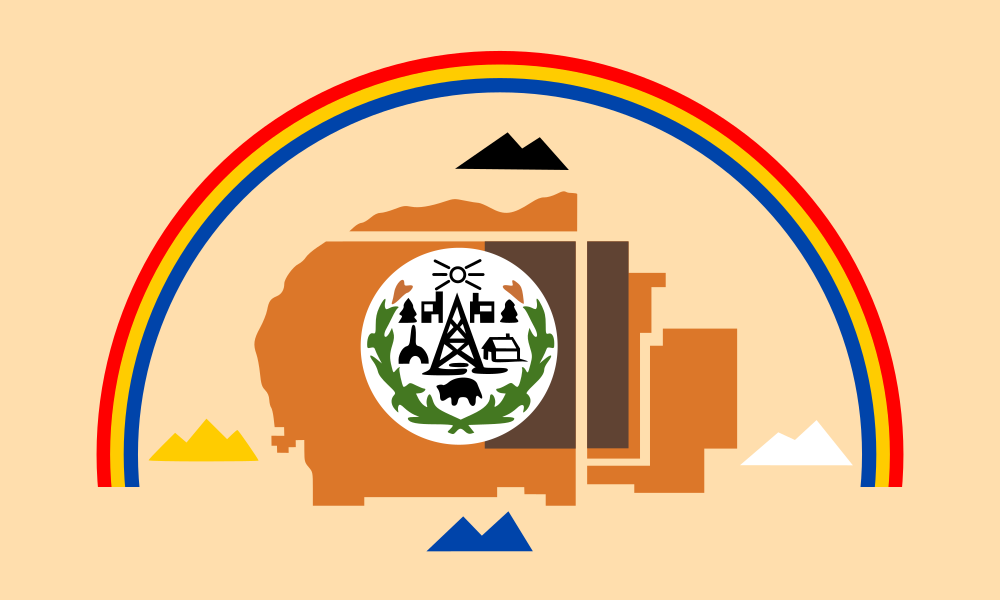
The Navajo Nation flag sets a copper map of the Nation on a tan field, with the smaller 1868 treaty reservation marked inside it in dark brown. Four mountains stand at the cardinal points: white for Blanca Peak in the east, blue for Mount Taylor in the south, yellow for the San Francisco Peaks in the west, black for Hesperus Peak in the north. A rainbow of red, yellow and blue arches over the land and stops short of closing, a sign of Navajo sovereignty. At the center, a white disc carries the sun, corn, livestock, a hogan, a modern house, an oil derrick and a sawmill.
Most flags simplify. The Navajo Nation flag does the opposite. It holds a map, four mountains, a rainbow, a sun, two cornstalks, livestock, a hogan, a modern house, an oil derrick and a sawmill on one piece of cloth, and it asks you to read every part. Flag designers tend to wince at that. The Navajo Nation has flown it for more than fifty years over a territory larger than West Virginia, because the design was never meant to work as a logo. It works as a sandpainting, which is a picture of a world with the people standing in the middle of it.
140 designs and one from Mariano Lake
The Nation's own account of the flag is short. A design by Jay R. Degroat, a Navajo from Mariano Lake, New Mexico, was selected from 140 entries and adopted by the council at Window Rock on 21 May 1968. Degroat worked from sandpainting, the healing art made in colored sand on the floor of a hogan and swept away the same day. That choice explains the density. A sandpainting is a map of creation, and nothing inside one is decoration.
The paperwork disagrees with itself on a small point. The Navajo Nation's history page credits Resolution CMY-55-68. The Navajo Nation Code, which carries the flag at Title 1, Section 302, lists the adopting resolution as CMY-75-68. Both agree on the date.
Timing is worth noticing. In May 1968 the body voting was still the Navajo Tribal Council, and the land was still officially the Navajo Indian Reservation. The switch to "Navajo Nation" came less than a year later, on 15 April 1969, by a separate resolution that also fixed the spelling of Navajo with a j. The flag got there first and the name caught up.
Section 302 has been edited once. In October 2006 the council rewrote it so the flag symbolizes "the tradition, sovereignty and heritage of the Navajo People." The word the 2006 amendment added was sovereignty.
A map with a smaller map inside it
The center of the flag is a map doing two jobs at once. The copper outline is the Navajo Nation as it exists now, roughly 27,000 square miles spread across northeastern Arizona, northwestern New Mexico and southeastern Utah, the largest Indian reservation in the United States. Tucked inside it is a smaller shape in dark brown.
That smaller shape is the reservation granted by the Treaty of Bosque Redondo on 1 June 1868. The treaty ended four years of captivity at Fort Sumner, where the US Army had marched thousands of Navajo hundreds of miles from their homeland and held them in conditions that killed them by the thousand. The land they were allowed back to was a fraction of what they had held. Everything between the brown shape and the copper line is what the Nation has regained since.
Not many flags carry their own border history. This one puts the worst year and the current borders on the same field and leaves you to measure the distance between them.
Four mountains and a rainbow left open
Around the map stand four mountains, each a color and a direction. White is Blanca Peak in Colorado, the east, where the day starts. Blue is Mount Taylor in New Mexico, the south. Yellow is the San Francisco Peaks in Arizona, the west, where the sun sets. Black is Hesperus Peak, the north, keeper of night. Together they bound Diné Bikéyah, the Navajo homeland, and on the flag they sit at top, bottom, left and right, holding the map inside a frame older than any survey.
Above them arches a rainbow in three bands, red on the outside, then yellow, then blue. It stops before the ends meet. The Office of the Navajo Nation President treats the gap as the point: the open arch stands for sovereignty, protection and balance, and shields the people while restoring hózhó, the harmony between land, spirit and life.
The orientation shifts between the Nation's two emblems. On the Great Seal the white eastern mountain sits at the top. On the flag, north is up and east moves to the right, which is how a map behaves.
The disc in the middle, and the people who find it too much
The white circle at the center borrows from the Great Seal. A sun sits above two green cornstalks, their tips showing pollen used in prayer. Below is livestock for the herding economy, a traditional hogan beside a modern house, an oil derrick between them for the Nation's resource potential, wildlife above, and a sawmill for industry. The seal itself came from an entry by John Claw, Jr. and was adopted on 18 January 1952. The council amended it in May 1988, adding two arrowheads to the surrounding ring so it signified protection within all fifty states, and replacing the word Tribe with Nation.
Vexillologists have opinions. NAVA's booklet "Good" Flag, "Bad" Flag, compiled by Ted Kaye, puts the Navajo Nation flag in its "no" column, with the caption "Over 20 graphic elements overwhelm the viewer and none are large enough to be seen easily." The flag it is paired against, in the "yes" column, is the Iroquois Confederacy's.
The criticism is fair on its own terms and beside the point on the Nation's. Kaye's rules are written for flags read at a distance, flapping, from the wrong side. A sandpainting is read close up, on the ground, by people who already know what the figures are.
A flag with its own body of law
In January 1970 the council gave the flag five sections of statute, and they are specific. It flies at or near the main entrance of every Navajo Nation facility except in bad weather, and at or near every school house on school days. Outdoors it flies only from sunrise to sunset. It goes above every other flag on a single staff except the flag of the United States, and sits immediately to the left of the US flag when the two are shown together. It is hoisted briskly and lowered with ceremony. The President of the Navajo Nation orders it to half staff.
The prohibitions are equally exact. No drapery, no advertising, no costumes or athletic uniforms, nothing printed on it, nothing allowed to touch the ground. A flag too worn to fly is burned by the Department of Navajo Veterans Affairs or a veterans organization. Publicly mutilating, defacing, burning or trampling it is an offense under Section 306, and Section 307 sets the penalty at up to 500 dollars, 30 days in jail, or both.
The flag has traveled further than most tribal emblems. In February 1995 Bernard A. Harris Jr., a NASA physician who spent part of his childhood on the reservation, asked the Navajo for something to take aboard the shuttle Discovery, and President Albert Hale handed him the flag. Medicine men checked first that the orbit would run clockwise. Ross Nez blessed the cloth with corn pollen, which NASA staff queried as an unidentified yellow powder until Hale explained what it was for. "The flag is a symbol of our nation and reminds us of how we must live in balance with our Mother Earth to survive," Hale said. Eight days later it came back down, bound for a flagpole at the Navajo Nation Capitol in Window Rock, which is the only place on the flag's whole itinerary that was ever the point.
References
[1] Navajo Nation, "History," official government site. https://www.navajo-nsn.gov/history
[2] Navajo Nation Code, Title 1, Chapter 3, "Great Seal and Flag," §§ 301-307. https://dinelanduse.org/wp-content/uploads/2023/04/Title1.pdf
[3] Office of the Navajo Nation President and Vice President, "A Flag That Remembers: Creation, Place, and Responsibility in Diné Bikéyah," 7 January 2026. https://opvp.navajo-nsn.gov/260107-a-flag-that-remembers/
[4] Flags of the World (FOTW), "Navajo Nation (U.S.)." https://crwflags.com/fotw/Flags/xa-navaj.html
[5] "Shuttle Crewman Takes Navajo Flag Into Space," The Spokesman-Review, 9 February 1995. https://www.spokesman.com/stories/1995/feb/09/shuttle-crewman-takes-navajo-flag-into-space-i
[6] Ted Kaye (comp.), "Good" Flag, "Bad" Flag: How to Design a Great Flag, North American Vexillological Association, 2006 and 2020, ISBN 978-0-9747728-1-3.
[7] Wikipedia, "Flag of the Navajo Nation." https://en.wikipedia.org/wiki/Flag_of_the_Navajo_Nation
[8] Wikipedia, "Navajo Nation." https://en.wikipedia.org/wiki/Navajo_Nation
Common questions
- What do the four mountains on the Navajo Nation flag mean?
- They are the four sacred mountains that bound Diné Bikéyah, the Navajo homeland, each with its own color and direction. White marks Blanca Peak in the east, blue marks Mount Taylor in the south, yellow marks the San Francisco Peaks in the west, and black marks Hesperus Peak in the north. Set around the map, they show the land held inside the order of the cardinal directions rather than inside a state line.
- Who designed the Navajo Nation flag?
- Jay R. Degroat, a Navajo from Mariano Lake, New Mexico. His entry was picked from 140 submitted to a flag competition, and the Navajo Tribal Council adopted it on 21 May 1968 at Window Rock. Degroat drew on sandpainting, the ceremonial art made in colored sand and destroyed the same day, which is why the flag reads as a scene rather than an emblem.
- Why is the rainbow on the Navajo Nation flag left open?
- The arch deliberately stops before it closes. The Office of the Navajo Nation President describes the opening as a sign of sovereignty, protection and balance, with the rainbow shielding the people and restoring hózhó, the harmony between land, spirit and life. A closed ring would read as an enclosure. An open one reads as a nation that answers to nobody above it.
- What is the dark brown shape inside the map on the flag?
- It is the reservation created by the Treaty of Bosque Redondo, signed on 1 June 1868, which let the Navajo return home after four years of imprisonment at Fort Sumner. The copper outline around it is the Navajo Nation as it stands now, roughly 27,000 square miles across Arizona, New Mexico and Utah. The flag carries both borders at once, the loss and the recovery.
- Are there rules for flying the Navajo Nation flag?
- Yes, and they run to five sections of the Navajo Nation Code, adopted in January 1970. The flag flies at every Navajo Nation facility and at schools on school days, outdoors only between sunrise and sunset. It ranks above every other flag on a staff except the flag of the United States. Treating it with contempt in public is an offense punishable by a fine of up to 500 dollars or 30 days in jail.
- Has the Navajo Nation flag been to space?
- In February 1995 the astronaut Bernard A. Harris Jr. carried it aboard the shuttle Discovery, the first Navajo item to fly in orbit. Medicine men confirmed first that the shuttle's path ran clockwise, and Ross Nez blessed the cloth with corn pollen. The eight-day flight ended with the flag bound for the Navajo Nation Capitol in Window Rock.
Download this flag
Free in 12 styles, from 32px icons up to 2000px, as SVG, PNG, WebP and JPG.