The Crimean Tatar Flag
Kök Bayraq
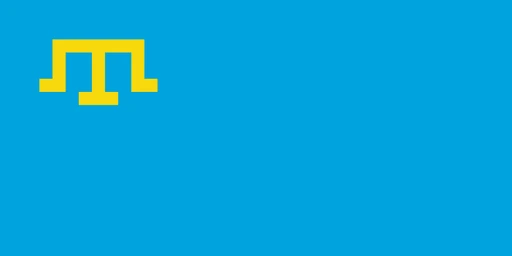
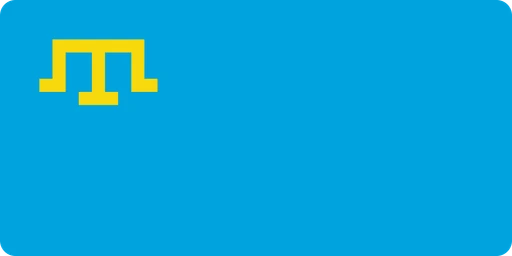
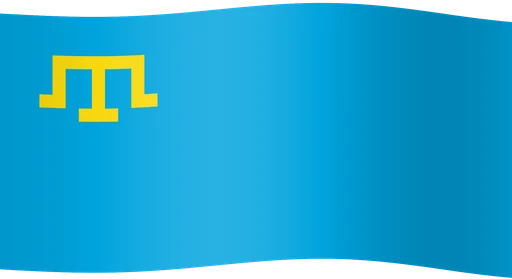
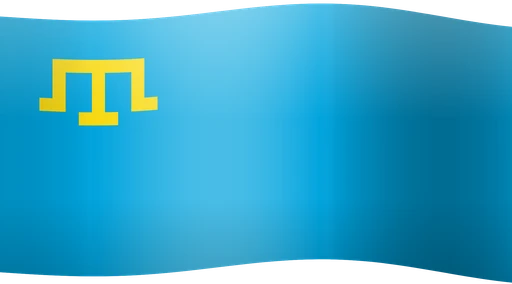
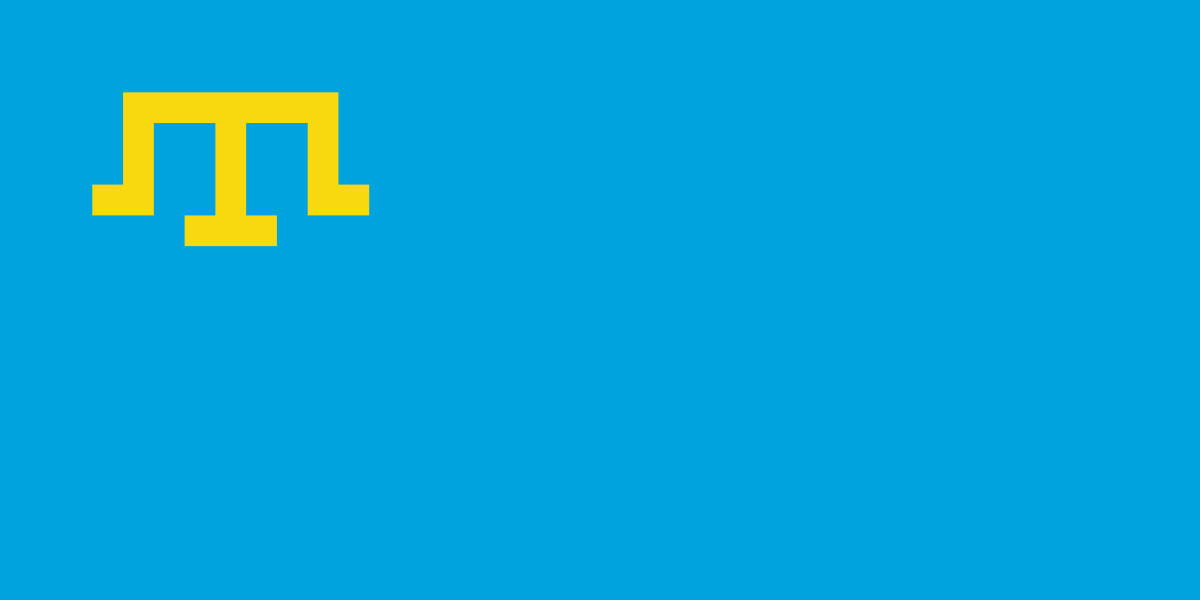
The Crimean Tatar flag is a sky-blue field with a golden tamga in the upper corner next to the staff, in proportions of 1:2. The tamga is the tarak tamga, the family sign of the Giray dynasty, which ruled the Crimean Khanate from the fifteenth century to the eighteenth. It appeared on the khans' coins, seals and palace walls. Readings of its shape vary: scales of fair rule, a comb, or a falcon in flight. Blue is a traditional colour of the Turkic peoples and stands for a clear sky and peace. The single-colour field is read as the unity of the people.
The Crimean Tatar flag is about as plain as a flag gets: a sky-blue rectangle with a small golden mark near the staff. That mark is the tarak tamga, the family sign of the khans who ruled Crimea for three centuries. The flag was banned for most of the twentieth century, carried into exile by a deported nation, and restored in 1991. Today, flying it in Crimea draws a fine again.
A khan's seal on a blue cloth
The Crimean Tatars are a Turkic people native to the Crimean peninsula. From the fifteenth century to the eighteenth, the Giray dynasty ruled the Crimean Khanate there, and the tarak tamga was its clan sign. A tamga is a mark of ownership and lineage. Turkic peoples put them on banners, coins and livestock, and the Girays put theirs on seals, coins and the walls of their palace in Bakhchysarai.
Nobody agrees on what the shape shows. You will read that it is a set of scales, standing for balance and fair rule. You will read that it is a comb, which is what tarak means. Others see a falcon with its wings spread. All three readings circulate, and no official text picks one.
The colour is easier. Blue is a traditional colour of the Turkic peoples, and the flag is often called Kök Bayraq, the blue banner. Ukraine's Institute of National Memory describes the blue as a clear sky and peace, and the single-colour field as the unity of the people.
Revolution, then a ban
The flag's modern story starts in 1917. After the February Revolution, Crimean Tatar political groups organised under a blue banner. In late 1917 the First Qurultay, a national assembly, met in the Khan's Palace in Bakhchysarai. It formed a national government. At its head was Noman Çelebicihan, the mufti of Crimea, who also wrote the poem "Ant Etkenmen" ("I Have Sworn"). That poem is now the Crimean Tatar anthem.
The records are thin on how formal the flag was. The Fundamental Laws adopted by the Qurultay on 26 December 1917 did not define it. The first written description comes from a 1919 document, which describes a grey-blue flag with the national emblem near the hoist. Flag historians also record green and red variants with the tamga from 1917 and 1918. Of these, only the blue one survived.
The government did not last. The Bolsheviks dispersed the Qurultay in 1918 and shot Çelebicihan in Sevastopol on 23 February 1918. In 1929 Soviet authorities declared the blue flag bourgeois-nationalist and banned it.
Exile and return
On 11 May 1944 Stalin signed the State Defence Committee order to expel every Crimean Tatar from Crimea. The deportation began on 18 May and lasted three days. More than 191,000 people were sent to special settlements in Central Asia and Siberia, most of them women, children and the elderly. Estimates of the death rate in those settlements run from 20 to 46 percent.
In exile, even keeping the national symbols counted as a crime against Soviet power. Activists secretly hung black mourning cloths on 18 May instead. Children born in the settlements grew up without knowing a national flag had ever existed.
Mass return to Crimea began in 1989. Two years later, on 26 June 1991, the Second Qurultay opened in Simferopol, more than 73 years after the first. On 30 June it passed a resolution "On the national flag and national anthem of the Crimean Tatar people." It describes a cloth of sky-blue colour with the golden tamga, the sign of authority, in the upper corner next to the staff, with a width to length ratio of 1:2. By September 1991 a version with a central tamga was flying outside the Verkhovna Rada in Kyiv, carried by protesters demanding restored statehood and recognition of the Mejlis.
A session of the Fifth Qurultay on 21 and 22 July 2012 passed a fresh resolution on the flag and anthem. It repeated the 1991 design: sky blue, golden tamga near the staff, 1:2. The resolution said the symbols express the people's unity, their continuity across generations and their long struggle for freedom.
Reading the design
The specification is short. It fixes three things: the colour of the field, the colour and position of the tamga, and the proportions. It does not fix the exact size of the tamga or its distance from the edges, so flags made by different makers vary a little. The shades vary too, because the resolution names colours rather than codes. The version shown here uses a bright sky blue and a deep yellow for the gold.
If you are trying to tell it apart from a similar flag, look at the tamga. Kazakhstan's flag also puts a golden device on sky blue, but it has a sun and an eagle in the centre and an ornamental band along the hoist. The Crimean Tatar flag has one small emblem in the canton and nothing else.
A flag on a contested peninsula
The Fifth Qurultay decided on 29 August 2010 to mark 26 June each year as Crimean Tatar Flag Day, after a proposal from youth organisations. It is an unofficial holiday, set by Crimean Tatar self-government, but Ukraine's government takes part. In 2021 the Ministry of Foreign Affairs used the day to condemn Russian restrictions on Crimean Tatar symbols, the flag included. The same statement called the Qurultay the highest national institution of Crimea's Indigenous people. Ukraine's Law "On Indigenous Peoples of Ukraine" followed on 1 July 2021.
Inside Russian-occupied Crimea the picture is different. Russia annexed the peninsula in 2014, and in 2016 its Crimean court declared the Mejlis an extremist organisation and banned it. Displaying the flag there now draws fines and administrative arrest. Glavcom reports that the authorities photograph homes where it hangs, to pressure the owners.
Outside Crimea the flag has turned up at big moments. When Jamala won Eurovision in Stockholm in 2016 with "1944," a song about the deportation, the organisers had put Crimean Tatar flags on a list of banned non-state flags. Someone brought one into the hall anyway. In June 2018 Mejlis chairman Refat Chubarov led a 40-metre Crimean Tatar flag down Khreshchatyk, Kyiv's main street. Each 26 June the blue cloth goes up again.
References
[1] Ukrinform, "В Україні відзначають День кримськотатарського прапора" (26 June 2025). https://www.ukrinform.ua/rubric-society/4008319-v-ukraini-vidznacaut-den-krimskotatarskogo-prapora.html
[2] ZN.ua, "Кримські татари затвердили національні прапор і гімн" (22 July 2012). https://zn.ua/ukr/POLITICS/krimski_tatari_zatverdili_natsionalni_prapor_i_gimn.html
[3] Ministry of Foreign Affairs of Ukraine, "Заява МЗС України до Дня кримськотатарського прапора" (26 June 2021). https://www.kmu.gov.ua/news/zayava-mzs-ukrayini-do-dnya-krimskotatarskogo-prapora
[4] Verkhovna Rada of Ukraine, Law of Ukraine No. 1616-IX "On Indigenous Peoples of Ukraine" (1 July 2021). https://zakon.rada.gov.ua/laws/show/1616-20
[5] Glavcom, "Сталін заборонив, Курултай відновив: Україна відзначає День кримськотатарського прапора." https://glavcom.ua/country/society/stalin-zaboroniv-kurultaj-vidnoviv-ukrajina-vidznachaje-den-krimskotatarskoho-prapora-1127992.html
[6] Radio Svoboda, "Прапор кримських татар: від появи до наших днів" (26 June 2020). https://www.radiosvoboda.org/a/photo-prapor-krymskykh-tatar-vid-poiavy-do-nashykh-dniv/30692326.html
[7] Flags of the World (FOTW), "Crimean Tatars (Ukraine)." https://www.fotw.info/flags/ua_krtat.html
[8] "Flag of Crimea," Wikipedia (section on the Crimean Tatar flag). https://en.wikipedia.org/wiki/Crimean_Tatar_flag
Common questions
- What does the symbol on the Crimean Tatar flag mean?
- The golden symbol is the tarak tamga, the clan sign of the Giray dynasty, the rulers of the Crimean Khanate. Tamgas were marks used by Turkic peoples on banners, coins and livestock. There is no single accepted reading of this one. It is described as a set of scales for balance and fair rule, as a comb (the literal meaning of tarak), and as a falcon soaring in the sky.
- Why is the Crimean Tatar flag blue?
- Sky blue is a traditional colour of the Turkic peoples, and the Crimean Tatars are a Turkic people. Ukraine's Institute of National Memory describes the blue as a clear sky and peace, and the plain single-colour field as the unity of the people. Crimean Tatar political groups used a blue banner from 1917, and the 1991 resolution kept the colour.
- When was the Crimean Tatar flag adopted?
- Twice. A blue banner with the tamga was used during the national revival of 1917 and the First Qurultay in Bakhchysarai. Soviet authorities banned it in 1929. The Second Qurultay restored it as the national flag by a resolution passed in Simferopol on 30 June 1991, and a later Qurultay session in July 2012 confirmed the design and its 1:2 proportions.
- What is Crimean Tatar Flag Day?
- Crimean Tatar Flag Day falls on 26 June, the date in 1991 when the Second Qurultay opened its first session in Simferopol. The Fifth Qurultay chose the date on 29 August 2010, at the suggestion of youth organisations. It is an unofficial holiday set by Crimean Tatar self-government, but Ukraine's government takes part. In 2021 the Ministry of Foreign Affairs used the day to condemn Russian restrictions on the flag in occupied Crimea.
- Is the Crimean Tatar tamga the same as the Ukrainian trident?
- No. Both are bold golden emblems on blue, and the two flags often fly side by side, so people compare them. Historians say the two symbols have different origins. The tarak tamga is the clan sign of the Giray dynasty, which ruled the Crimean Khanate from the fifteenth century to the eighteenth. Its own meaning is debated: scales, a comb or a falcon.
Download this flag
Free in 12 styles, from 32px icons up to 2000px, as SVG, PNG, WebP and JPG.