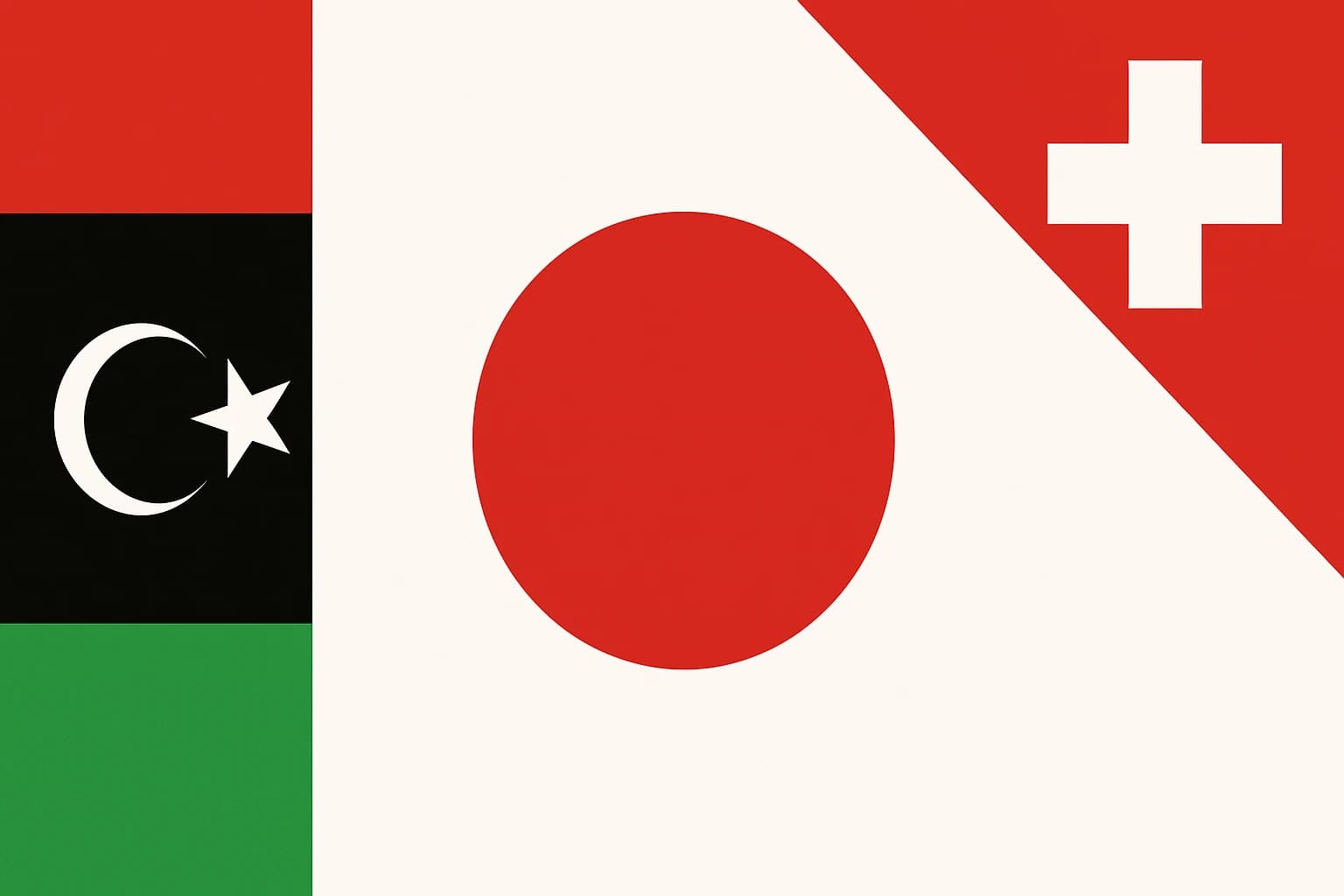
Somewhere in Belgium in 1815, a French soldier raises a white cloth above a trench. He is done fighting, and the gesture is unmistakable. In Rome, in the same decade, a pope stands beneath a white-and-gold banner blessing a crowd of thousands, and his gesture is unmistakable too. One man is saying "I give up." The other is saying "I speak with the authority of God."
How did one color end up carrying meanings as incompatible as surrender and divine authority? Purity and mourning? Peace and political erasure?
White is the most ideologically unstable color in vexillology, not because it lacks meaning but because it works as a blank screen onto which different civilizations, institutions, and political moments have projected whatever they needed. It appears on roughly 75% of the world's national flags, second only to red. But red clusters reliably around blood, courage, and revolution. White scatters.
The blankness problem
Start with physics. White is the presence of all visible wavelengths of light, and yet cultures treat it as the absence of color. That contradiction sits under everything else.
Compare white with red on flags. Red almost always points at a narrow band of meanings: blood, sacrifice, revolution, courage. You see red, you think intensity. White resists that kind of clustering. In the medieval language of heraldic tinctures, argent (white or silver) stood for sincerity and peace, but that turned out to be one interpretation among many that came later.
Call it symbolic instability. Some symbols gain power precisely because they absorb local meaning, and white is the clearest example in flag design. Flags use white not because cultures agree on what it means but because each culture pours its own meaning into it.
The Vatican flag: white as sacred authority
The flag of Vatican City, adopted in its current form on June 7, 1929 under the Lateran Treaty, is a vertical bicolor of gold (or yellow) and white, with the crossed keys of Saint Peter and the papal tiara on the white band.
White here means divine light, papal holiness, and spiritual purity. It is not passive or empty. It claims ultimate moral authority. In the Catholic liturgical color system, white vestments are worn at Easter, at Christmas, and on the feast days of saints who were not martyred. White marks the presence of God rather than the absence of anything.
The Vatican flag is also one of only two sovereign-state flags that are square, Switzerland being the other. The unusual shape reinforces the claim to stand outside normal political categories, and the white is doing the same work.
Set that against the common Western secular reading of white as neutral or blank. On the Vatican flag white is the opposite of neutral. It is the most doctrinally loaded color on the banner. When the pope stands under it he is not standing under blankness. He is standing under a claim about the nature of the universe.
When a plain white flag ruled France
From the late 16th century through 1790, and again briefly during the Restoration of 1815 to 1830, the French Bourbon monarchy flew a plain white flag as its royal standard. Completely white: no emblem, no device, no coat of arms. Just white fabric.
White was the personal color of the House of Bourbon, and the blankness was the point. The king needed no symbol because he was the symbol.
Then came the Revolution. The Tricolore added blue and red, the colors of Paris, to white in 1794, representing a new and shared sovereignty. The white stayed, but bracketed by the people's colors.
By the 18th century white was also being codified as the international battlefield signal of surrender and truce. A French soldier waving a white cloth in defeat was, in a strange sense, waving his king's color.
After the Revolution the Bourbon white flag became politically radioactive, and flying it was a counter-revolutionary act. Charles X's insistence on the white flag over the Tricolore during the Restoration was one of the grievances behind the July Revolution of 1830. White had gone from absolute power to reactionary nostalgia, another meaning layered onto the same cloth.
Bangladesh and the politics of leaving white out
The flag of Bangladesh, adopted on January 17, 1972, is a red disc on a dark green field. There is no white anywhere on it.
That was intentional. Bangladesh declared independence from Pakistan in 1971 after the Liberation War, and Pakistan's flag leans heavily on white: a white crescent and star on a green field, plus a white vertical stripe representing minority religious communities and peace.
Leaving white out was a visual break from Pakistani identity. The original 1971 war flag included a yellow map of Bangladesh inside the red disc, which the designers removed for the final version. Keeping only red and green tied the flag to land, green for the lush Bengal landscape, and to blood, red for the martyrs of the Liberation War.
The designers were not rejecting white in the abstract. They were rejecting the specific meanings white had accumulated on the Pakistani flag. White is never just white. It arrives carrying the luggage of its previous uses.
The Red Cross and the rules of war
The Red Cross emblem, a red cross on a white background, was adopted at the First Geneva Convention of 1864. It inverts the Swiss flag, white cross on red, to honor Switzerland's role as neutral host of the convention.
White is doing something very specific here: encoding legal neutrality under international humanitarian law. A Red Cross flag on a battlefield is not a surrender flag. It is a do-not-shoot flag with treaty law behind it, and white means protected status rather than capitulation.
The distinction has caused real, lethal confusion. Soldiers in several conflicts, including the First World War and the Vietnam War, reported difficulty telling white surrender flags from Red Cross markers at a distance. Two of white's meanings, surrender and protected neutrality, look alike and mean opposite things.
There is a further complication. In some Muslim-majority countries the Red Cross emblem was perceived as a Christian symbol, which led to the Red Crescent in 1876 and eventually the Red Crystal in 2005. All three kept the white background. White's meaning as neutral ground survived the change of central symbol, though it took treaties, conventions, and decades of legal enforcement to pin white to a single meaning.
The Olympic flag's supposedly blank canvas
Pierre de Coubertin designed the Olympic flag in 1913, and it first flew at the 1920 Antwerp Games. Five interlocking rings of blue, yellow, black, green, and red sit on a white field. His stated rationale was that these six colors, counting the white background, appear on every national flag in the world, which would make the Olympic flag universal.
Whether the white background is truly blank is another matter. Coubertin's white field carries a specific ideological meaning: the Enlightenment-era European notion of universalism, the idea that there exists a neutral default human culture above and beyond national particularities. White here functions as a claim that the Olympics transcend politics, a claim contradicted by nearly every Games since Berlin 1936.
The same assumption runs through design and technology, in the white background of a web page or the blank white document. White's perceived neutrality is a cultural construction rather than a natural fact, and in vexillology every blank white field is making a silent argument.
Latvia is a useful counterpoint. Its flag, adopted in 1918 and re-adopted in 1990, is a dark red (carmine) field divided by a narrow white horizontal stripe, where white represents justice. A very specific, non-neutral meaning crammed into the thinnest possible band.
Latvia's white is the opposite of the Olympic white: small, precise, and locally defined rather than vaguely universal. Two flags, two whites, two completely different strategies.
What white teaches about how flags mean
White as divine authority in the Vatican. Absolute monarchy in Bourbon France. Political rejection in Bangladesh. Legal protection on the Red Cross. Claimed universalism at the Olympics. Civic virtue in Latvia. No other flag color covers that range.
The instability is useful. Flags work by compressing complicated political ideas into simple visual forms, and white's capacity to absorb contradictory meanings makes it the most versatile color available. It is also the most treacherous, because its meaning is never self-evident.
Reading white on a flag means reading context rather than color. A white stripe next to green means something different from a white field behind a red cross, which means something different again from an all-white banner. White depends more than any other color on its neighbors, its history, and its institutional framing to communicate anything at all.
Every flag that uses white is betting that the viewer will supply the right meaning from context. Sometimes the bet pays off, as with the Red Cross and its decades of enforced neutrality. Sometimes it fails, as when the Bourbon monarchy's white flag became indistinguishable from a gesture of defeat.