Turkmenistan's Carpet Strip: The Most Complex Flag Design in the World and What It Encodes
Julio Song · · 10 min read
Rank every national flag by how much cultural, political and geographic information it packs into a square centimetre, and one wins by a wide margin. It is not the Union Jack with its layered crosses, or Nepal with its double-pennant geometry, or Brazil with its star chart of a particular night sky.
It is Turkmenistan's.
Running down the hoist side of the green field is a vertical strip of deep claret red containing five carpet patterns called güls. Each one stands for a specific tribe, a region, and a weaving tradition. No other national flag attempts anything close to this. And yet the most detailed flag in the world rarely gets discussed beyond a passing note that it is unusual, which leaves the interesting questions untouched: what the strip actually encodes, why an authoritarian post-Soviet leader built a national identity on textiles, and what that says about how Central Asian states reassembled themselves after 1991.
A flag that doubles as a textile encyclopedia
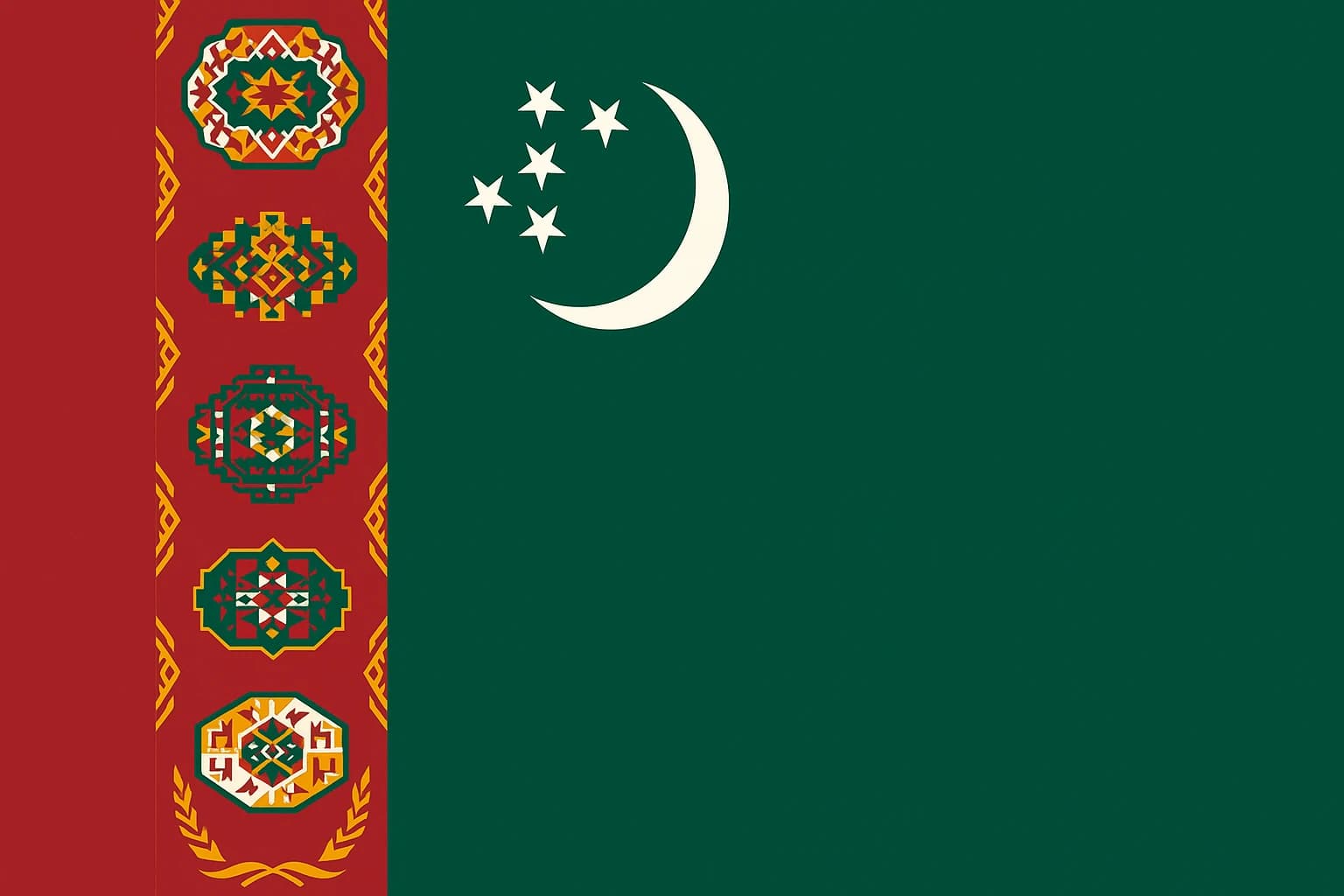
The basic layout looks simple. A green field carries a white crescent moon and five white stars in the upper left. So far, so standard for a majority-Muslim Central Asian nation. Then your eye catches the vertical strip along the entire hoist side, taking up roughly a fifth of the flag's width, filled with deep claret carpet patterns that are miniaturized reproductions of real Turkmen weaving motifs. Nothing else among sovereign flags comes close.
Most national flags work with simple geometric shapes: stars, stripes, crosses, coats of arms. Turkmenistan's carries a woven textile catalogue. The flag was adopted on February 19, 1992, less than four months after independence from the Soviet Union on October 27, 1991. That speed matters. This was not a Soviet-era flag with the hammer and sickle removed and a new emblem dropped in, the approach several other former republics took. It was designed from scratch, and its designers reached past seven decades of Soviet rule for something older.
That something was the Turkmen carpet. UNESCO inscribed Turkmen carpet-making as Intangible Cultural Heritage in 2019, though the tradition mattered for centuries before any international body noticed. For nomadic Turkmen, carpets were not decoration. They were walls hung inside yurts, floors, doors, bags for carrying goods on horseback, and sometimes a form of currency. A carpet was architecture, furniture and identity document at once. Putting carpet patterns on the flag was a claim about what Turkmen civilization actually consists of.
Decoding the five güls
A gül (plural: güller) is a medallion-like motif, the signature pattern of a specific Turkmen tribe. Female weavers passed the patterns down through generations, and each gül worked almost like a heraldic coat of arms. Look at the gül at the centre of a carpet and you could tell which tribe made it, which region it came from, and roughly when.
The flag carries five, each tied to one of Turkmenistan's major tribal groups and, by extension, one of its five modern provinces (welayatlar):
- The Teke gül sits at the top, for the Teke tribe, dominant in the Ahal and Mary provinces and historically the most politically powerful group in Turkmen society. Teke carpets are known for dense, symmetrical knotting and deep crimson reds.
- The Yomut gül comes next, for the Yomut tribe of the Balkan province along the Caspian coast. Yomut weaving runs to more angular, asymmetric patterns and a wider colour palette.
- The Saryk gül occupies the middle position, for the Saryk tribe of the Marv oasis region in the southeast, known for fine knotwork and rich burgundy tones.
- The Chowdur gül sits fourth, for the Chowdur tribe of the Dashoguz province in the north, whose carpet traditions show clear influence from neighbouring Uzbek and Karakalpak weaving.
- The Arsary gül anchors the bottom, for the Ersari tribe of the Lebap province along the Amu Darya river, the easternmost of the major tribal regions.
So the five güls are not only five tribes. They are five geographic regions, which puts a political map of the whole country into the hoist of the flag, along with five distinct weaving traditions that differ in knot density, colour and structure.
The vertical order is not random either. The Teke have dominated Turkmen politics since independence and before it, and their gül is first. That is a statement of political primacy dressed as a neutral catalogue of tribal heritage.
Niyazov's nation-building project
To understand why the flag looks this way, you need to understand the man who commissioned it. Saparmurat Niyazov, who gave himself the title "Turkmenbashi" (Father of All Turkmen), was the former Communist Party boss of the Turkmen Soviet Socialist Republic. When the USSR collapsed, he became independent Turkmenistan's first president and ruled until his death in 2006, constructing one of the world's most eccentric personality cults along the way.
The political problem was real. Turkmenistan had never existed as a unified nation-state. Soviet planners drew its borders in 1924, lumping together tribal groups whose identities as Teke, Yomut, Ersari and others ran far deeper than any sense of being Turkmen in a national sense. Tribal loyalty was not a quaint relic. It was the primary organizing principle of social and political life.
Carpet symbolism was a strategic answer to that. Putting all five tribal güls on one flag in a single strip declared that Turkmenistan was the sum of its tribes rather than the property of any one of them. We are all Turkmen, and the shared carpet heritage proves it. At the same time the state asserted authority over those identities by controlling how they were represented and in what order.
The flag was one piece of a much larger symbolic overhaul. Niyazov renamed the months and days of the week, with January becoming "Turkmenbashi." He built a gold-plated statue of himself in Ashgabat that rotated to face the sun. He wrote the Ruhnama, a spiritual guidebook that became required reading in schools, workplaces and even driving tests. He declared the Turkmen carpet a national treasure by presidential decree.
Most of that sounds absurd from outside, and much of it was. The carpet symbolism worked where the personality cult did not, because it drew on something people already had. But there is a tension in the design. The flag appears to celebrate tribal equality, and Niyazov was Teke. The Teke dominated the government, the security services and the economy, and still do. The Teke gül at the top of the strip quietly records that imbalance while the composition as a whole proclaims unity.
The 2001 amendment: olive branches and permanent neutrality
In 1995, the United Nations General Assembly formally recognized Turkmenistan's status of "permanent neutrality." This was a rare distinction. Turkmenistan became only the second country ever, after Austria in 1955, to have its neutrality endorsed by the UN.
On January 24, 2001, Turkmenistan amended its flag. Two crossed olive branches appeared beneath the five güls at the bottom of the carpet strip, a direct visual reference to the UN emblem.
One vertical strip now carried tribal identity, geographic territory, weaving heritage and a foreign policy doctrine.
Permanent neutrality suited Niyazov's domestic agenda. It justified isolationism, kept Turkmenistan out of military alliances, and reinforced the regime's control over information and borders. It was less a diplomatic posture than the ideological basis for keeping the country sealed.
The rest of the flag is loaded too. The green field references Islam, the crescent represents growth and hope, and the five stars correspond to the five provinces, echoing the five güls below them. There is almost no unallocated space on it.
Kazakhstan took a similar path
Turkmenistan was not the only Central Asian nation to reach for textile heritage when designing a post-Soviet flag. Kazakhstan's flag, adopted June 4, 1992 and designed by Shaken Niyazbekov, is the most instructive comparison.
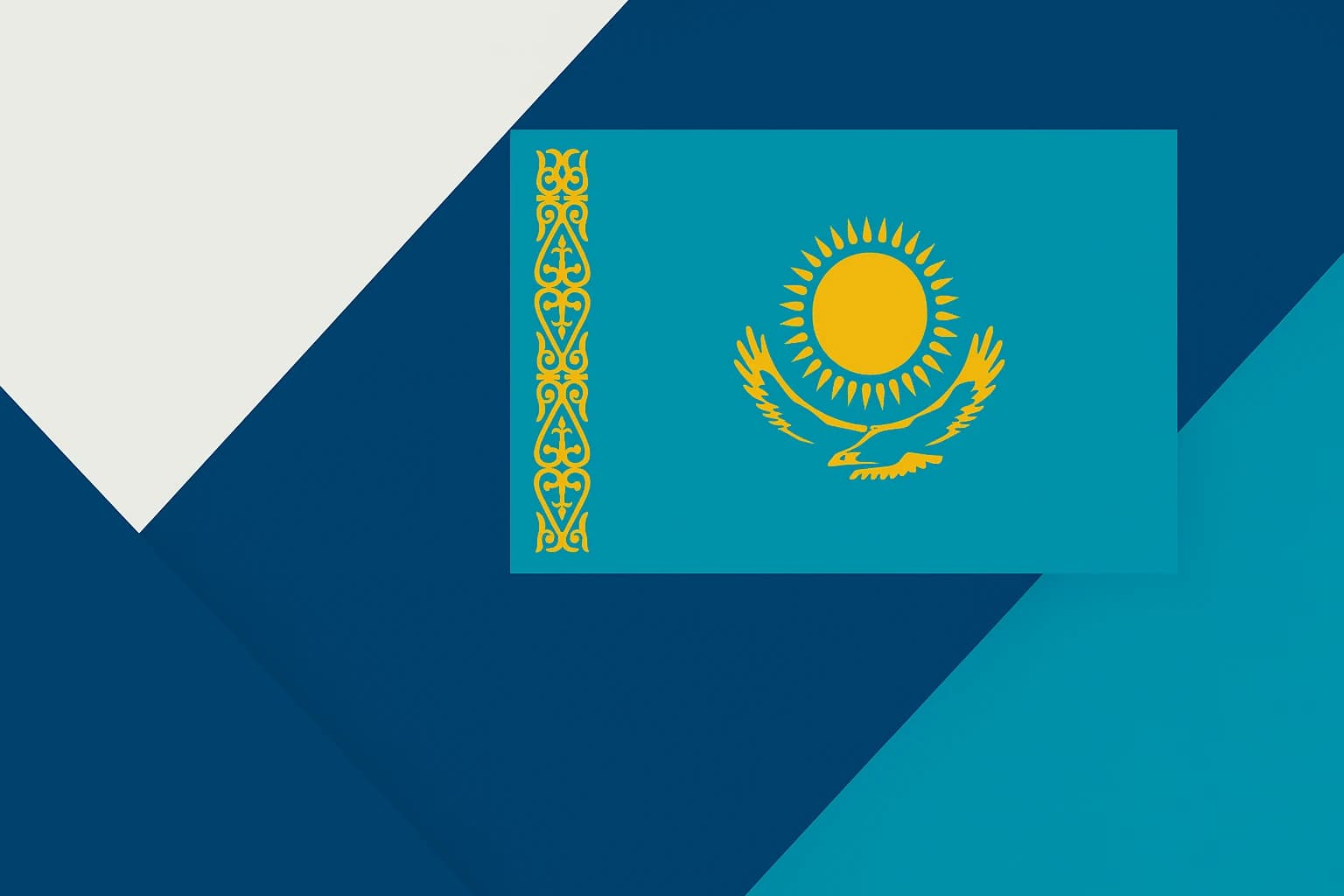
Kazakhstan's sky-blue banner features a golden sun, a steppe eagle, and, running along the hoist, a vertical band of traditional Kazakh ornamental pattern called koshkar-muiz (ram's horns). The structural parallel is obvious: both nations embedded a craft tradition directly into the flag's hoist side, signaling continuity with pre-Soviet nomadic culture.
The difference in complexity is enormous, though. Kazakhstan's ornamental strip repeats a single geometric motif standing for national unity in the abstract. Turkmenistan's contains five distinct, identifiable patterns carrying specific tribal and regional information. One is a decorative border; the other is a database.
Why textile heritage in both cases, rather than Soviet-era industrial imagery or pan-Turkic symbols? Carpets were the one tradition that came through Soviet collectivization more or less intact. The Soviets destroyed mosques, suppressed religious practice and reorganized nomadic life around collective farms, but carpet-weaving, filed under women's domestic labour, was largely ignored. Being politically safe in Soviet eyes is exactly what left it available afterwards as a cultural marker with no ideological baggage attached.
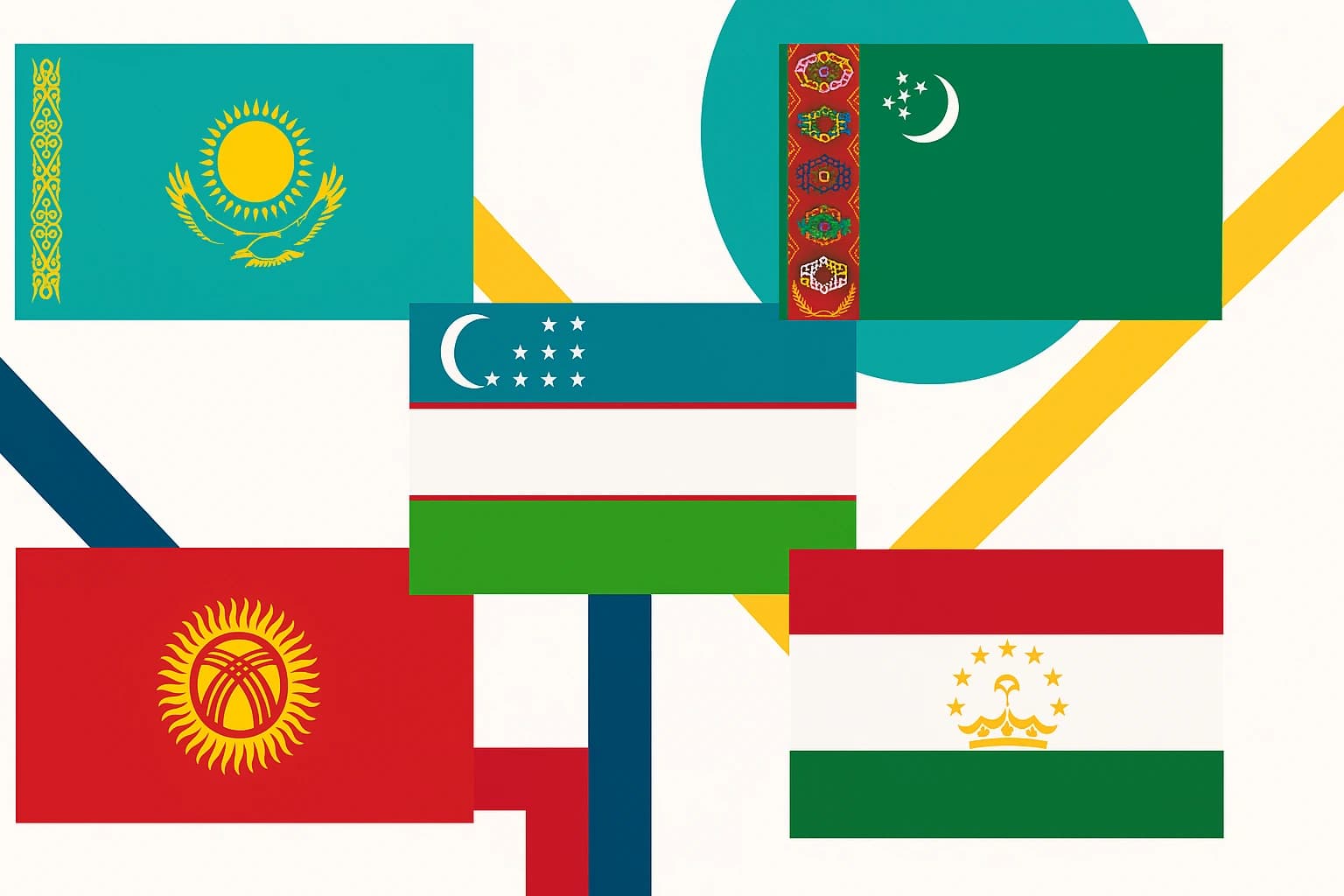
The other Central Asian republics took different approaches. Uzbekistan used an Islamic crescent and stars.
Kyrgyzstan placed the tunduk, the crown of a yurt, at the center of its flag.
Each is a different answer to the same question: when you are assembling a nation from scratch, what goes on the flag? Turkmenistan's answer was by far the most complicated.
Why the most complex flag is also the least understood
Turkmenistan is one of the most closed societies anywhere. There is no free press, travel is heavily restricted for citizens and foreigners alike, and international journalists and researchers face serious barriers to entry. One result is that the flag's design goes largely unanalyzed in Western vexillological and design writing.
The irony is not subtle. The flag encodes openness and diversity, five tribes and five regions and international neutrality, on behalf of one of the most secretive and repressive states on the planet.
The carpet strip also breaks a foundational rule of flag design theory. The conventional wisdom, set out by vexillologists like Whitney Smith and Ted Kaye in Good Flag, Bad Flag, is that a good flag should be simple enough for a child to draw from memory. By that standard Turkmenistan's flag is a disaster. A child could not reproduce those güls. Neither could most adults.
It works anyway. The carpet gül is a genuinely popular national symbol, turning up on Turkmen currency, government buildings and the livery of Turkmenistan Airlines. People recognize the patterns instantly because they grew up around real carpets carrying the same motifs. The güls are not abstract graphic elements. They are what was on the floor of the house, and on their grandmothers' looms, from a craft that predates every empire that ever ruled the region.
That is the part worth taking from it. Density rooted in a living tradition can produce very strong recognition even when it breaks every rule in the manual, because the simplicity principle assumes a flag is working as a graphic logo. Turkmenistan's is working as a cultural document instead. A single strip carries five tribal identities, five regions, centuries of weaving, a political hierarchy and a foreign policy doctrine, and it holds up because Turkmen women kept the underlying craft alive through empires and occupations while nobody in Moscow thought it was worth suppressing.
Julio Song
Writer
Julio is a staff writer at FlagDB. He studied Mathematics at the University of Madrid and has a passion for vexillology.
More from Julio Song →