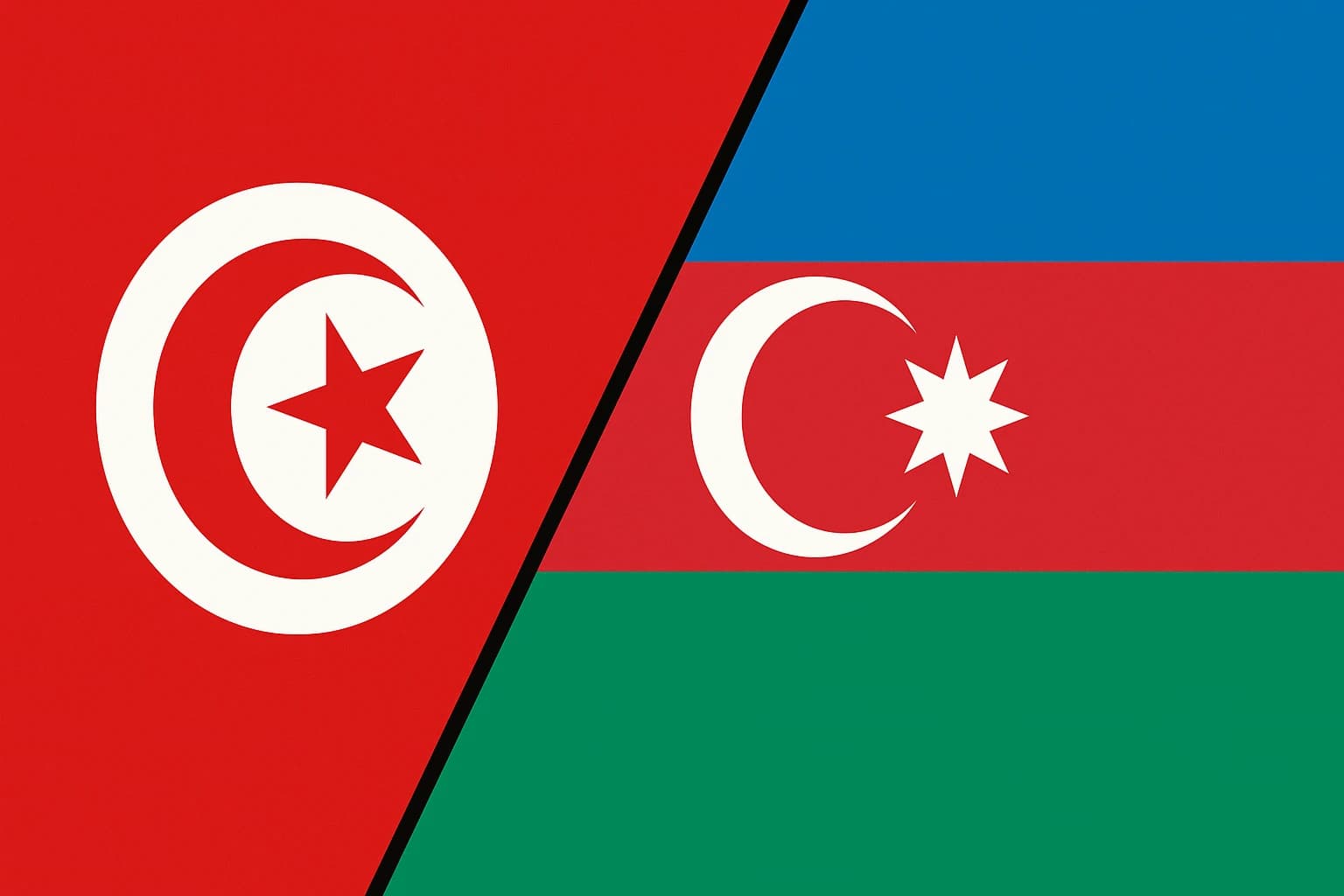
Place the flags of Tunisia and Azerbaijan side by side. Go ahead, pull them up on your screen.
Both have a white crescent and star on a strong background. The obvious assumption is that they mean the same thing, that both are markers of Islamic identity inherited from the Ottoman Empire. The assumption is wrong, and the reasons it is wrong are more interesting than the assumption.
The crescent and star is one of the most misread symbols anywhere. It is stamped onto more than a dozen national flags, printed on humanitarian aid packages, and reflexively associated with a single religion. But it predates Islam by centuries, and its adoption by modern nation-states has been shaped far more by local political struggles than by theology.
Tunisia (1827) and Azerbaijan (1918, restored 1991) make the case as clearly as any pair of flags could. In both, the crescent turns out to be less a fixed religious icon than a surface a state could load with its own account of sovereignty and belonging.
Before the Ottomans: a symbol older than you think
The crescent did not begin with Islam. It didn't even begin with the Ottomans.
The symbol appeared on coins in ancient Byzantium (modern Istanbul) as an emblem associated with the goddess Diana, known to the Greeks as Artemis. Some scholars trace it even further back, to Sumerian iconography in Mesopotamia, where the crescent moon represented the god Sin. This is a symbol with at least 3,000 years of history, and for most of that history, it had nothing to do with monotheism at all.
The Ottoman Empire adopted the crescent not from the Quran, which never mentions it, but likely from Byzantine and Central Asian Turkic traditions. The exact origin story is debated. One legend ties it to a dream of Osman I, the dynasty's founder, in which a crescent moon stretched across the Earth. Another connects it to the fall of Constantinople in 1453, when the Ottomans claimed the city's old symbols as their own. Neither story is confirmed. What matters is that the crescent entered the Ottoman visual vocabulary through cultural inheritance, not religious mandate.
By the 18th and 19th centuries, European powers had begun reading the crescent as shorthand for Islam and the Orient. Diplomats, cartographers and journalists flattened a long and tangled history into a single religious meaning, and the misreading has stuck. It shaped how both Tunisia and Azerbaijan were perceived from outside, even while each country was filling the crescent with a quite different meaning of its own.
The Ottoman Empire spread the crescent across its territories. The interesting part is what those territories did with it once they started asserting their own identities.
Tunisia's crescent: sovereignty before the empire fell
Tunisia's flag was adopted in 1827 under Hussein II Bey. That's roughly a century before the Ottoman Empire collapsed. This timing is critical. Tunisia was not "inheriting" a post-Ottoman symbol. It was actively choosing one while still nominally under Ottoman suzerainty.
The flag emerged from a specific crisis. The Battle of Navarino in 1827 saw a combined British, French, and Russian fleet destroy Ottoman and Egyptian naval forces. The Mediterranean was a contested, dangerous space. Tunisian ships needed to be distinguished from other Ottoman vessels, especially given ongoing European accusations of piracy. Hussein II Bey needed a distinct naval ensign. The flag was, in part, a practical act of maritime sovereignty.
Look at the design. The red field echoes the Ottoman red banner, a nod to the broader political world Tunisia inhabited. But the crescent and star enclosed within a white disc set it apart. This is a visual declaration: Tunisia is part of the Islamic and Ottoman world, yet distinct within it. The white circle functions almost like a frame, containing and localizing the symbol.
The crescent here marks Islamic identity fused with Tunisian political autonomy. We are Muslim, we are connected to the Ottoman sphere, and we are our own state. For 1827 that is a fairly sophisticated message, and it is carried entirely by design choices rather than doctrine.
After independence from France in 1956, Tunisia kept the flag almost unchanged. Habib Bourguiba's secular modernization project, one of the most aggressive in the Arab world, did not strip the crescent away. It reframed the symbol as cultural heritage rather than active religious governance, which was possible only because the crescent had never meant religion alone in Tunisia in the first place.
Azerbaijan's crescent: Turkic identity on a field of blue
Azerbaijan's story is completely different. The tricolor, blue, red, and green with a white crescent and eight-pointed star, was first adopted on November 9, 1918, by the Azerbaijan Democratic Republic (ADR). The ADR was one of the first secular democratic republics in the Muslim world, a fact that often surprises people.
The flag was designed with input from Mehmed Emin Resulzade and other ADR founders who were deeply influenced by pan-Turkic thought. The colour placement is where the argument sits. Blue represents Turkic heritage, red modernization and progress, green Islamic civilization. The crescent sits on the blue stripe, not on the green one, which ties it to Turkic identity rather than to Islam. The symbol is being recoded.
The star does similar work. Most crescent-and-star flags use a five-pointed star; Azerbaijan uses an eight-pointed one. In Arabic the form is called Rub el Hizb, but the ADR founders read it as representing the eight Turkic peoples. That is a deliberate departure, moving the symbol from a broadly Islamic icon to a specifically Turkic and ethnic one, and it is the kind of choice nobody makes by accident.
After Soviet annexation in 1920, the flag was banned. For seven decades, Azerbaijanis lived under Soviet-style banners. The tricolor existed only in diaspora communities and in national memory. Its restoration on February 5, 1991, months before the formal dissolution of the USSR, was an act of national resurrection. The flag carried the emotional weight of a suppressed identity, not merely a design preference.
The Azerbaijani crescent works on a different axis to Tunisia's. It points at ethnolinguistic kinship with Turkey, Turkmenistan, Kazakhstan and the other Turkic nations. It answers "who are we as a people" rather than "what do we believe".
Side by side: what the differences reveal
Now put them next to each other again and look closer.
Tunisia's crescent is enclosed in a white circle on a red field. It's self-contained, inward-looking, a symbol of a specific state's identity. Azerbaijan's crescent floats freely on a blue stripe within a tricolor. It's outward-reaching, connecting to a broader Turkic world beyond Azerbaijan's borders.
Tunisia's five-pointed star is conventional, shared with dozens of flags. Azerbaijan's eight-pointed star carries specific ethnic and national coding. The star choice alone tells you the two flags are speaking different languages.
Colour context does the rest. Tunisia's red links to Ottoman heritage and sacrifice; Azerbaijan's blue links to Turkic sky mythology, the old Tengri tradition of the Central Asian nomads, and pan-Turkic solidarity. The same crescent is coloured by what surrounds it.
Both flags survived enormous political upheaval, French colonialism and secular modernization for Tunisia, Soviet rule and post-Soviet independence for Azerbaijan, but for different reasons. Tunisia's flag endured because it was flexible enough to mean culture rather than theocracy. Azerbaijan's endured in national memory because it encoded an ethnic identity that Soviet internationalism could suppress but not erase.
So the crescent does not carry meaning into a flag. The rest of the design, the history and the politics pour meaning into the crescent.
The wider crescent family
Tunisia and Azerbaijan are not alone. The crescent appears across a wide family of flags, and each one is having a different conversation.
Jordan's flag uses a seven-pointed star representing the first seven verses of the Quran, set in a design rooted in the Arab Revolt flag.
The Ottoman resonance is deliberately turned around: the crescent becomes a pan-Arab and Hashemite symbol aimed at the empire that once wielded it.
Libya went further. Under Gaddafi the solid green flag of 1977 to 2011 rejected the crescent entirely in favour of monochrome austerity.
When the post-Gaddafi flag restored the crescent from the original 1951 Kingdom of Libya design, it was a deliberate act of counter-revolution and historical reclamation. The crescent came back because it represented the Libya that Gaddafi had tried to erase.
And then there's Turkey itself, the Ottoman successor state.
Turkey kept the crescent and star, and in 1936 codified the design under Atatürk's secularist republic. An imperial emblem was repurposed for a nation-state built on the rejection of imperial governance.
Even within one symbol family, then, no two flags are making the same claim.
Why this matters
Flags get read superficially in contemporary geopolitics. A crescent means Muslim country. A cross means Christian country. That flattening has consequences: it feeds civilizational clash narratives that reduce complicated nations to religious blocs and erase the political and ethnic layers underneath.
Knowing that Tunisia's crescent is about Mediterranean sovereignty and post-colonial identity while Azerbaijan's is about Turkic peoplehood and post-Soviet resurrection makes those readings harder to hold. It forces better questions.
Which is the case for taking flags seriously. They are compressed arguments about who a nation believes itself to be, and Tunisia and Azerbaijan show how far apart two of those arguments can be while looking, at a glance, like the same picture.
The useful question is not what the crescent means. It is what a particular nation needed the crescent to mean.