Flags of Revolution: The Colors and Symbols of History's Greatest Uprisings
Julio Song · · 3 min read
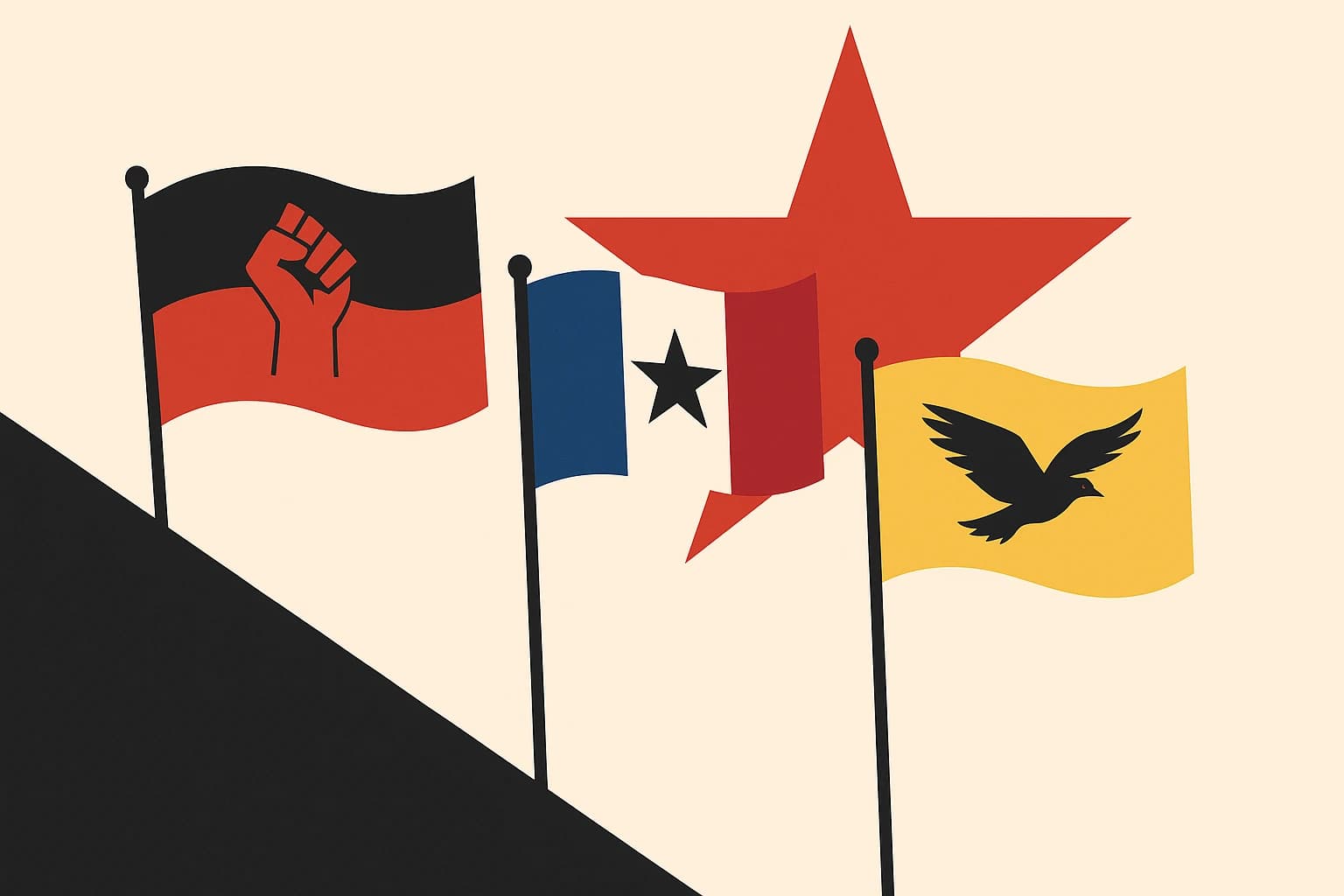
Revolutions need something to march behind. A flag gives a crowd a way to recognize itself, and it gives everyone watching a way to recognize the crowd. That is most of what the banners below have in common: the French tricolor, the red flag of the socialist left, the black flag of the anarchists, and the flags raised by colonies on their way out of empire.
The point is not that cloth has power on its own. A flag is cheap, visible from a distance, and difficult to argue with. A slogan invites a counter-slogan. A color, once a movement has claimed it, tends to stick.
The French tricolor
Blue, white and red came together in the late 18th century, during the French Revolution. Blue and red were the colors of Paris. White was the color of the Bourbon monarchy, which is an odd thing to find on a revolutionary banner, and part of why the combination worked: it put the city and the crown on the same piece of cloth.
The design traveled. Other countries adopted tricolors of their own, and the format came to stand for liberty and equality long after the revolution that produced it had ended.
The red flag
Red belongs to communism and socialism above all. The Russian Revolution flew it, and leftist movements still do.
What varies is the detail. Different countries put their own emblems on the same red field, fitting it to local struggles without giving up the association.
The black flag
Anarchism is a political position, not just disorder, and the black flag is its banner. It rejects the state itself rather than any particular government.
Black flags flew during the Spanish Civil War, carried by people who wanted to be rid of tyranny without installing a government of their own in its place.
Flags of independence
Independence is usually an argument about who gets to say what a place is. African and Asian countries breaking from colonial rule replaced imperial ensigns with designs of their own choosing, and the choosing was much of the point.
India's flag uses deep saffron, white and green.
Zimbabwe's is a later example of the same move, built out of the country's own heritage rather than a colonial template.
Protest flags now
The Arab Spring and Black Lives Matter both had banners, and both had social media, which distributes an image far more widely than a printing press or a parade ever did. The picture of a flag now travels further than the flag.
Protest designs today tend to take a traditional symbol and rework it with contemporary graphics, so the result reads as inherited and current at once.
Julio Song
Writer
Julio is a staff writer at FlagDB. He studied Mathematics at the University of Madrid and has a passion for vexillology.
More from Julio Song →