Flags Designed During a War Are More Specific Than Flags Designed in Peace
Julio Song · · 3 min read
Flags designed in peacetime tend toward abstraction: virtues, ideals, pleasing arrangements of color. Flags designed during or after a war are usually more specific, because the people choosing them have a particular set of events they want the country to remember. Afghanistan and Algeria are both in that second category.
What a flag has to carry
Vexillology covers the study of flags, and a national flag has a heavy brief. It has to work on a government building and at a funeral, on a border post and in a crowd. Every color, symbol and pattern is chosen deliberately, and in countries with contested histories the choices are argued over hard, because they decide which parts of the past the state is formally acknowledging.
Afghanistan
Afghanistan's flag has changed many times, tracking the country's turbulent history. Each version belongs to a particular government and a particular idea of what the country was.
The colors are consistent in meaning across the versions. Black stands for the dark history of the past, red for the bloodshed and the struggle for independence, green for hope and prosperity. In the center, an emblem stands for spiritual and national unity, tying faith into the design rather than leaving it to the colors alone.
Algeria
Algeria's road to independence ran through resistance and a liberation struggle, and the flag was adopted with that history in view.
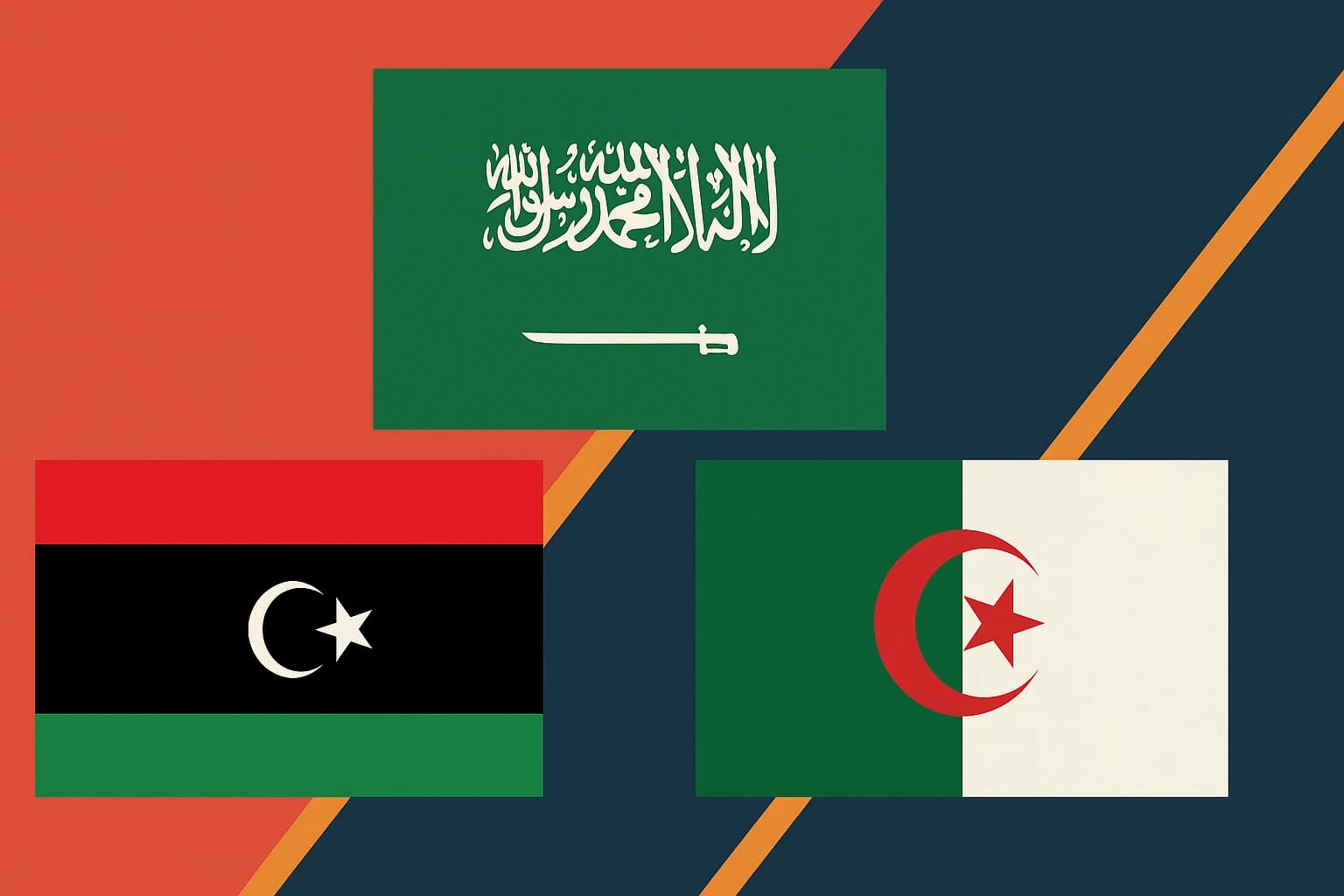
Green is linked to Islam, the crescent and star to religion, and the white to peace. The result is not a general statement about the country but a record of a specific fight and its outcome.
The pattern across war-torn flags
The same vocabulary keeps appearing. Red for blood, green for hope and steadfastness. It recurs because the design problem recurs: a flag adopted after a war has to acknowledge the cost without becoming a memorial, and has to point forward without pretending the cost was not paid.
These flags then do double duty. They mark the state, and they carry a cultural continuity that survived the conflict, which is often the thing people are most afraid of losing.
Why this is worth reading closely
A flag is one of the few places a country states, in public and without qualification, what it thinks happened to it. Learning to read Afghanistan's or Algeria's flag is a short route into a history that is otherwise easy to keep at a distance. That is a modest thing, but it is real: the symbol is the doorway, and the history is on the other side of it.
Julio Song
Writer
Julio is a staff writer at FlagDB. He studied Mathematics at the University of Madrid and has a passion for vexillology.
More from Julio Song →