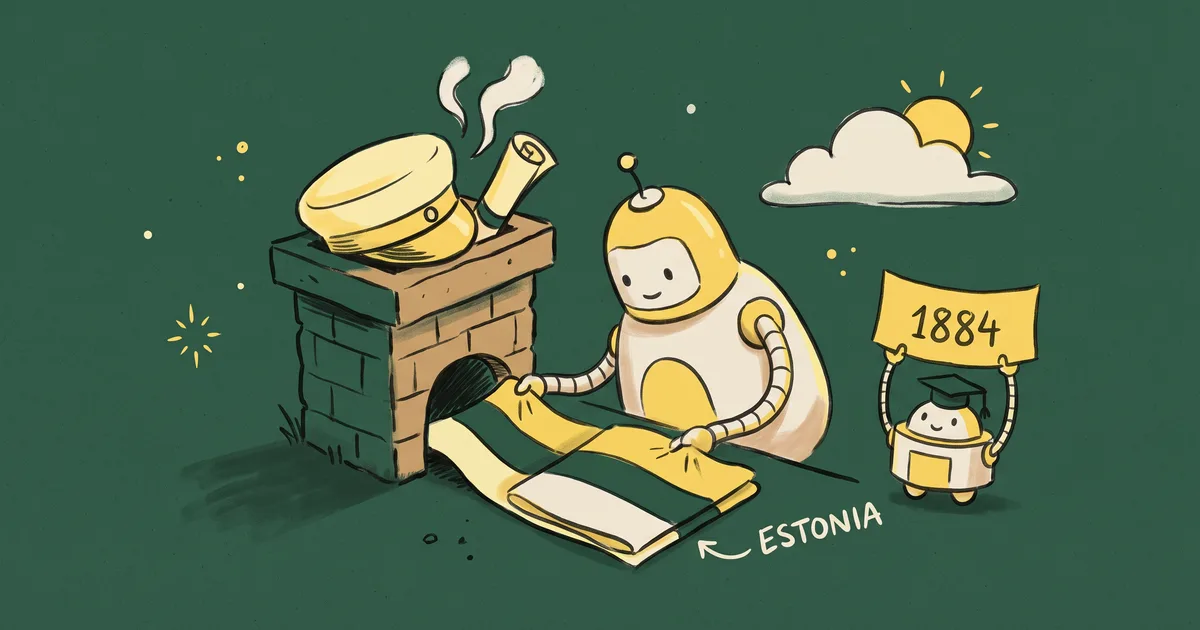
On December 26, 1991, a camera crew from Estonian Television stood on a farm in Jõgeva County and filmed people digging at the base of a chimney. Four months earlier, Estonia had regained its independence. Under the footing they found a wooden box sealed inside an iron box. Inside that was a silk flag, blue over black over white, sewn in 1884 and buried in the autumn of 1944.
That flag is older than the country it now stands for. It didn't start out as a national symbol. It started as the banner of a university club, and the club had it 34 years before the state did.
Club colours first, country later
The club was the Estonian Students' Society, known by its Estonian initials, EÜS. It was founded at the University of Tartu on April 7, 1870, by five students and three Estonian intellectuals, among them Jakob Hurt and Johann Voldemar Jannsen. They met to read the Estonian epic Kalevipoeg aloud.
The colours came eleven years later. On September 29, 1881, at the founding of a Tartu student group called Vironia, the exact combination of blue, black and white appeared for the first time. EÜS adopted the same three colours that year.
What did they mean? One early explanation, quoted in ERR's history of the flag, is almost bare: "The colors were to remind us of who we are, where we are heading and striving." Later readings got more specific. Flags of the World records the popular one, where blue is the sky, black is the soil, and white is snow and birch bark. Another version has blue for faith, black for suffering and white for hope.
Pick whichever one you like. The part worth holding on to is simpler. A group of students chose three colours to mean "us," and nobody in authority had approved them.
A flag that had to leave town
Colours on a student cap were one thing. A full flag was something else. Over the winter before 1884, the idea of an EÜS flag came up at the home of Karl August and Paula Hermann, and Paula decided to have one made. The sewing fell to Emilie Beermann, whose brother Christoph Wilhelm Beermann was the society's elder. She bought silk at a shop in Põltsamaa and sewed the flag in her room, with help from the wives and sisters of other members.
The result was big: 375 by 174 centimetres, close to 12 feet by 6.
Tartu was under Baltic German control, and the Estonian colours were not allowed on public display there. So the students took their flag out of town. On June 3, 1884, they set off by carriage for Otepää, unfurling the flag along the way. They dipped it in Lake Pühajärv. On the night of June 4, it was consecrated in the parsonage hall of Otepää's St. Mary's Lutheran Church.
That date stuck. June 4 is now Flag Day, listed in the Estonian Flag Act among the days the national flag goes up across the country.
From a fraternity to a republic
The state caught up in 1918. Estonia declared independence that February, and on November 21, 1918, the Provisional Government passed a resolution naming the blue-black-white the state flag. The same year it went up for the first time on Pikk Hermann, the tower of Toompea Castle in Tallinn, where the country's main flag still flies. The Riigikogu, Estonia's parliament, passed a Law on State Flag on June 27, 1922.
The current Estonian Flag Act, passed on March 23, 2005, pins down the details:
- three horizontal bands of equal width, blue on top, black in the middle, white at the bottom
- a hoist-to-fly ratio of 7:11
- a blue defined as Pantone 285 C
The Office of the President gives the standard size as 105 by 165 centimetres. Notice what the law leaves alone. It doesn't redesign anything. It puts into legal language what a student club in Tartu settled on in 1881.
Four years of hiding, then 47 underground
The original 1884 flag stayed the property of EÜS through the first period of independence. Then came 1940.
In June 1940, the Soviet Union occupied and annexed Estonia, and the new authorities banned the national flag. Karl Aun, the last president of EÜS before the occupation, took charge of the society's most valuable object. What followed, as ERR tells it, was four years of moving a banner from one hiding place to the next.
In the summer of 1940, the flag went under a shed on a farm in Viljandi. It spent a short spell back in Tartu. In the summer of 1942, Aun took it to his family's home, Läänemardi Farm in Jõgeva County. By then it was packed in a wooden box, which sat inside a pretreated iron box. At first, only two people knew where it was.
Aun's father had agreed on a final spot. The farmhouse had an unfinished chimney, and in the autumn of 1944 his father buried the box in its footing. Aun ended up cut off from occupied Estonia, living in Toronto and later Chicago. He came back for a visit in 1989. The flag stayed where his father had put it.
So for 47 years, the object that started it all sat under a farmhouse, while owning a copy of it was a crime.
When the box came out in December 1991, the silk needed months of conservation. Restorers washed it in a swimming pool drained for the job. They also logged its wear: a red lipstick stain, and old repairs done with cotton thread that didn't match. The flag had a life before the chimney, and it showed.
What everyone else did without it
The buried flag is the dramatic story. The quieter one is what happened to the colours above ground.
After the annexation, Estonia got a Soviet flag. The first version, adopted on October 31, 1940, was a standard red Soviet banner with the letters ENSV above the hammer and sickle.
On February 6, 1953, the design changed. Wavy blue and white stripes were added along the bottom to stand for the Baltic Sea. Their order was not left to chance. The arrangement was worked out, according to the history of the Estonian SSR flag, so the flag would never form blue-black-white when hung with a black mourning ribbon. That's how seriously the authorities took three colours.
People who ignored the ban paid for it. Raising the flag, or even owning one, was treated as a crime, and some people were arrested or sent to prison camps.
The colours lived on elsewhere. From 1940 to 1991, the tricolour was in constant use by the Estonian government-in-exile, its diplomats and the refugee diaspora. At home it had one brief return. During Otto Tief's interim government of September 18 to 22, 1944, the national flag went back up on Pikk Hermann for a few days.
Then came the Singing Revolution. By the late 1980s, crowds at open-air concerts and mass meetings were waving the tricolour in public. In October 1988, local authorities officially permitted its use again. EÜS was re-registered with the University of Tartu on December 30, 1988.
On February 23, 1989, the Soviet red flag came down from Pikk Hermann for good. The next morning, February 24, the 71st anniversary of the 1918 declaration, the blue-black-white went up in its place. The Estonian SSR flag was dropped on May 8, 1990, and on August 7, 1990, the tricolour became the state flag again. Full independence followed in August 1991.
Four months after that, the TV crew went to the farm.
Behind glass in Tartu
The original stayed with EÜS. For about 20 years it sat furled in a fireproof steel case in the precious metals store of the old Estonian National Museum building in Tartu.
On September 15, 2016, an honour guard of six men in ceremonial sashes carried it from the EÜS house at Jaan Tõnissoni 1 to the new Estonian National Museum. The museum opened to the public on October 1, 2016. The flag now hangs in a protective case in the permanent exhibition on Estonian identity and statehood.
If you go, you'll be looking at an unusual thing: a national flag with a single physical ancestor. Emilie Beermann sewed it in her room. Students blessed it out of town because it wasn't welcome in town. Aun's father buried it under a chimney.
A flag the state borrowed
Estonia's government never designed its flag. It inherited one.
A student club picked the colours in 1881. Its members sewed and blessed the first flag in 1884. The Provisional Government adopted it in 1918, parliament wrote it into law in 1922, and the 2005 Flag Act fixed the ratio and the shade of blue. At no point did anyone start over.
So when you see the blue-black-white rise over Pikk Hermann at sunrise, with the national anthem playing, you're looking at a copy of a club flag. The club still owns the original.