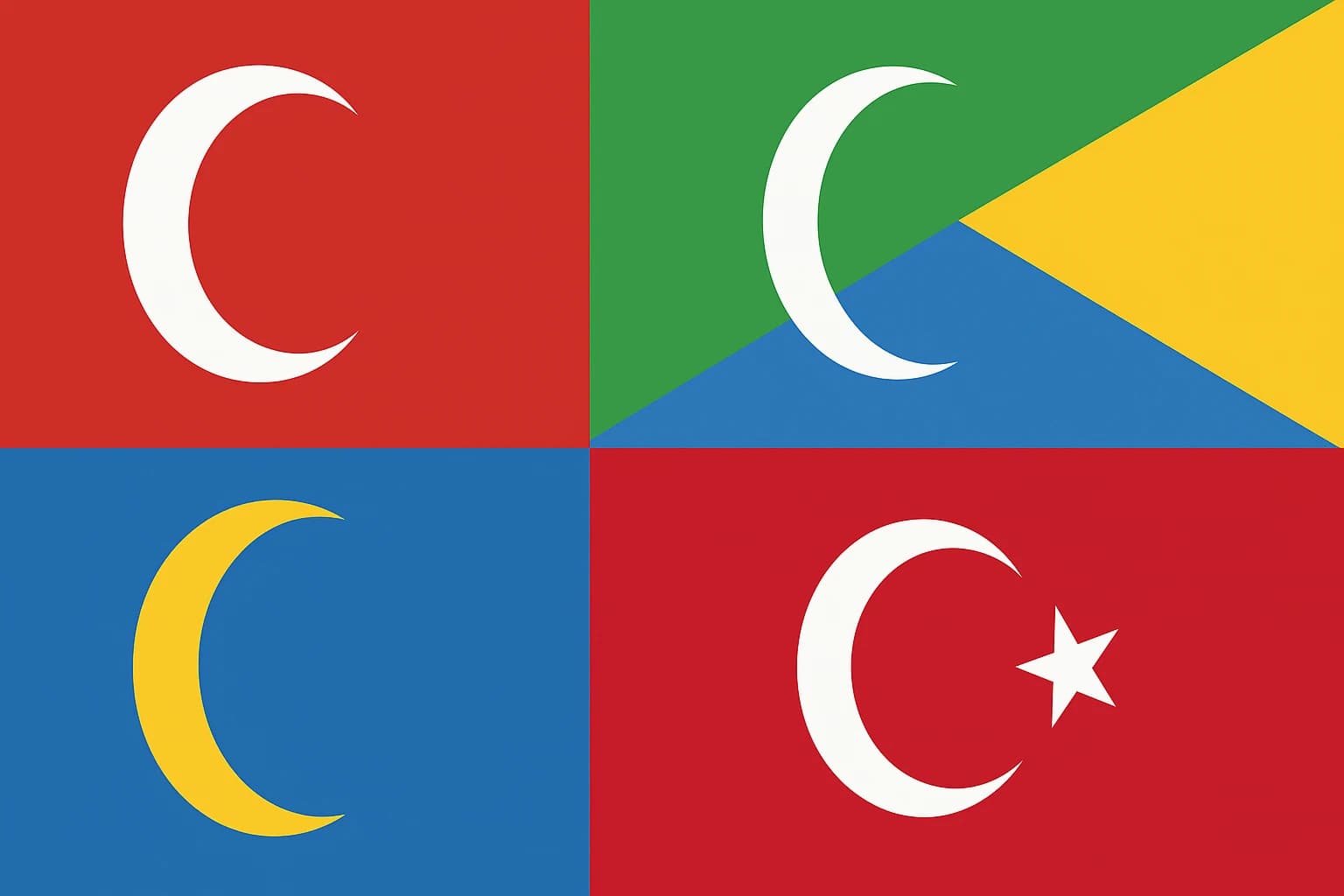
Picture four flags pinned to a wall. Turkey. Azerbaijan. Comoros. Palau. Now ask yourself: what do they have in common?
Most people will say "Islam" or "the crescent" without hesitation. They'd be wrong on at least one count and reductive on the other three. The crescent is one of the most common motifs in global flag design, showing up on the national flags of more than a dozen sovereign states. But the reflexive assumption that every lunar symbol signals Islamic identity is a lazy shortcut. It flattens centuries of divergent history, politics, and cosmology into a single story.
This article traces how four nations placed the moon on their flag for radically different reasons: Ottoman imperial legacy, secular Turkic modernism, direct religious expression, and indigenous Pacific agricultural tradition.
The lazy assumption: why "crescent equals Islam" falls apart
There is a kernel of truth in the assumption. The crescent-and-star became strongly associated with Islam, particularly after the Ottoman Empire popularized it, and organizations like the Red Crescent reinforce that link in 2026. Roughly 14 of the world's 193 sovereign flags feature a crescent or crescent-and-star combination. The pattern is real.
But the symbol predates Islam by millennia. Crescent motifs appear on ancient Sumerian cylinder seals dating to around 2100 BCE. They show up on Byzantine coinage. They decorated pre-Islamic Turkic standards across Central Asia. The association with Islam is historically contingent, not inherent. The crescent didn't "belong" to any one faith until political history assigned it one.
Even among flags belonging to Muslim-majority nations, the crescent carries wildly different freight: imperial nostalgia in one place, secular nationalism in another, direct piety in a third. And when you get to Palau, the moon's meaning escapes religion entirely. The four cases below run from the most famous crescent to the most surprising moon, and none of them fits the "crescent = Islam" formula cleanly.
Turkey: the crescent as imperial inheritance
The Turkish flag is probably the first image that pops into your head when someone says "crescent flag." Fair enough. It's iconic. But its origins are murkier than most people realize.
Contrary to popular belief, the Ottomans did not use the crescent-and-star consistently until the late 18th century. Earlier Ottoman flags were often plain red or green. The standardized red flag with a white crescent and star was formalized under Sultan Selim III's military reforms around 1793, then codified in the Ottoman flag law of 1844. Before that, the crescent was one symbol among many, not the symbol.
There's a famous legend about Sultan Murad seeing the reflection of the moon and a star in a pool of blood on a battlefield. It's a great story. It's also almost certainly a nationalist myth. But what the myth reveals is important: Turks narrativized the crescent as martial and imperial, not purely religious. The moon was a conqueror's emblem.
When Mustafa Kemal Atatürk founded the Republic in 1923, he aggressively secularized every other symbol of the state. He abolished the caliphate, switched to the Latin alphabet, banned the fez, and reformed the legal code. But he kept the flag almost unchanged. Why?
Because the crescent had already stopped being a religious marker in Turkish political culture. It was a continuity claim to Ottoman territorial sovereignty and national identity. The flag survived the secular revolution because it was understood as belonging to the nation, not to the mosque.
Today, under Turkish law (Law No. 2893, enacted in 1983), the flag carries deep emotional resonance. Flag desecration is a criminal offense. And domestically, Turks understand it as national, not confessional.
Azerbaijan: the crescent reimagined as secular Turkic modernism
If Turkey's crescent is an heirloom kept in the family, Azerbaijan's is a custom-built statement piece.
The Azerbaijan Democratic Republic, founded in 1918, was the first secular democratic republic in the Muslim world. Its tricolor flag (blue, red, green with a white crescent and eight-pointed star) was designed from scratch to express a triple identity: Turkic heritage (blue), modernity and progress (red), and Islamic cultural background (green).
Notice the word "background." Not foreground. The green stripe acknowledges Islam as part of Azerbaijani culture without making it the whole story.
The eight-pointed star is the real tell. It represents the eight Turkic peoples, making the symbol explicitly ethnic-linguistic rather than religious. The crescent here signals Turkic identity as much as, or more than, Islamic faith. Same shape as Turkey's. Completely different genealogy.
Then came the Soviet period. From 1920 to 1991, the tricolor was suppressed. Azerbaijan received a standard Soviet-style red flag. The original design became a symbol of what had been taken away.
The tricolor's revival on February 5, 1991, months before the USSR formally dissolved, was an act of anti-colonial reclamation. Azerbaijanis weren't returning to Islam. They were returning to their own pre-Soviet national identity, which happened to include a crescent that meant "we are a Turkic people with our own political tradition."
The Azerbaijani government in 2026 continues to frame the crescent in civic-nationalist terms. Under Heydar Aliyev's post-independence consolidation and the political culture that followed, the flag's crescent represents statehood and ethnic continuity, not a call to prayer.
Where Turkey's crescent is an Ottoman inheritance that a secular republic chose not to discard, Azerbaijan's is a post-imperial invention, designed from day one to balance religion, ethnicity, and Enlightenment-era political ideals. The same symbol, a fundamentally different story.
Comoros: the crescent as direct religious expression
If you want a flag where the crescent means exactly what most Western observers assume all crescents mean, Comoros is the case.
The current flag (adopted 2001, modified 2002) features a green triangle with a white crescent and four white stars representing the archipelago's four islands: Grande Comore, Mohéli, Anjouan, and Mayotte (the last still administered by France, which remains a sore point in Comorian politics).
Article 1 of the Comorian constitution declares Islam the state religion. The flag's crescent is a direct, intentional expression of that identity. Not inherited imperial baggage. Not cultural shorthand. An active theological and political statement.
The flag's turbulent history makes the point. Comoros has cycled through at least five different flag designs since independence in 1975, reflecting over 20 coups or attempted coups. Each redesign retained the crescent. Even amid radical political instability, Islamic identity remained the one consensus anchor. Governments fell. The crescent stayed.
So yes, in Comoros the crescent means exactly what the lazy assumption says it means. The point is that this directness is the exception among crescent-bearing flags rather than the rule. Reading Turkey's crescent and Comoros' crescent as the same statement collapses a secularist nation-state and a constitutional theocracy into one category, which is a reflex rather than an analysis.
Palau: a full moon with no religious meaning
Palau is where the whole framework breaks open.
Palau's flag, adopted January 1, 1981, when the country achieved self-governing status (and retained at full independence in 1994), features a golden-yellow circle on a sky-blue field. Many casual observers assume it represents the sun. It doesn't. It's the full moon.
In Palauan tradition, the full moon signals the optimal time for fishing, planting, harvesting, and community gatherings. Palauan fishers have timed their activities to lunar cycles for centuries, and the full moon (called buil) is considered a time of warmth, fertility, and peak human activity. The flag isn't a religious statement. It's a calendar.
The design has a good origin story too. It was chosen through a national competition, and the winning design by Blau J. Skebong intentionally offset the circle slightly left of center for aesthetic balance, mimicking the moon rising in the sky. That asymmetry is a deliberate design choice, not an error, and it gives the flag a gentle sense of motion that most people feel without being able to name.
And Palau is a predominantly Christian nation, roughly 65% Roman Catholic and about 25% Protestant based on the most recent census data. The moon on its flag has nothing to do with Islam, crescent symbolism, or Abrahamic religion of any kind. It is an indigenous cosmological and practical symbol rooted in Pacific Islander ecology, which makes it the strongest single argument against reducing lunar symbolism to one religious narrative.
The solar parallel: Japan and a sun that carries more than daylight
Japan's Hinomaru makes the same point from the other direction.
It's a red circle representing the sun, formally adopted under the Act on National Flag and Anthem in 1999, though the design has been in use since the 7th century. Its meaning has shifted over time: from Shinto cosmology (the sun goddess Amaterasu) to imperial authority to post-WWII pacifist national identity.
Same circle, different century, different meaning. Celestial symbols are vessels that cultures fill with their own content rather than fixed messages, and if we accept that Japan's sun is not "just Shinto," the same nuance should extend to every crescent on every flag.
Read symbols, not assumptions
Flags are arguments, not labels. Each of these four nations made a deliberate choice about what the moon means to them. Those choices reflect specific historical moments, political negotiations, and cultural values.
This framework applies well beyond these four examples:
- Pakistan's crescent carries minority-protection symbolism, with the white stripe representing non-Muslim citizens.
- Malaysia's crescent reflects constitutional Islam within a multi-ethnic federation.
- Mauritania added red stripes in 2017 to honor soldiers' blood, a non-lunar modification that recontextualized the entire flag.
Each flag repays close reading, and each resists the one-line summary.
The principle extends past moons. The same five-pointed star means revolutionary socialism on China's flag, statehood on the U.S. flag, and divine guidance on Morocco's flag.
Four moons, four stories
Back to that wall with four flags on it. Turkey's crescent is an empire's inheritance. Azerbaijan's is a modernist manifesto. Comoros' is a profession of faith. Palau's is a fishing calendar.
So when someone sees a crescent on a flag and says "that means Islam," the useful reply is not "no." It is "maybe, but which Islam, whose Islam, and are you sure it's Islam at all?"