Picture the simplest flags on Earth. Japan's red disc on white. Libya's old plain green field. Ukraine's two horizontal bars of blue and yellow.
Now picture the flag of Belize.
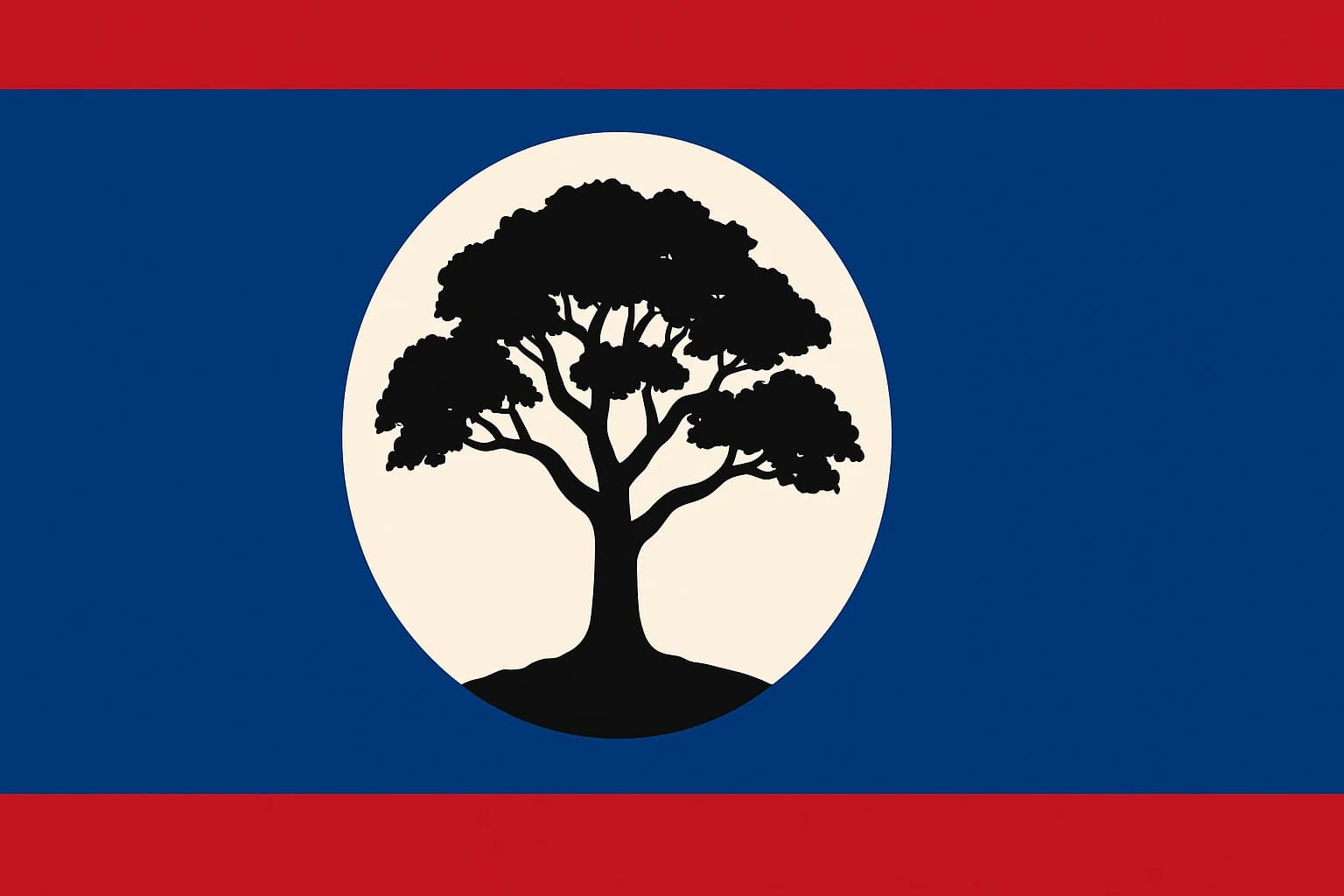
It looks like it was designed by a committee that refused to stop. A royal blue field. Two red stripes. A white disc. Inside that disc, an entire coat of arms packed with a mahogany tree, a sailing ship, tools, two human figures, and a Latin motto on a ribbon. It is the only national flag in the world to feature two human figures as a primary design element. And almost none of this happened by accident or for aesthetics. Every element on this flag is a political argument. The red and blue stripes framing the whole thing? They exist because a political party demanded them after losing an election.
The flag is less a set of symbols of nationhood than a compressed archive of colonial labor history, racial negotiation, and partisan compromise. It rewards a slow read.
A flag only a historian could love
The layout: a royal blue field bordered by a narrow red stripe at the top and another at the bottom. In the center sits a large white disc containing the full coat of arms of Belize. Inside that coat of arms: a mahogany tree, a shield divided into three sections showing tools and a ship, two men flanking the shield, a wreath of leaves, and a ribbon bearing the words "Sub Umbra Floreo."
If you know anything about flag design principles, you're wincing. The North American Vexillological Association (NAVA) promotes five principles for good flag design: keep it simple, use meaningful symbolism, use two or three basic colors, no lettering or seals, and be distinctive. Belize violates at least four of the five. The flag has lettering. It has a seal. It uses far more than three colors. It is not simple by any measure.
The violation is the point. The flag is not trying to be a clean graphic, it is trying to be a document, and the coat of arms at its center was granted by royal warrant in 1907 under British colonial rule. The most ideologically loaded part of the flag predates Belizean independence by 74 years, which leaves an obvious question: why did a newly independent country in 1981 keep a colonial coat of arms as its main national symbol?
The mahogany economy: why a tree ended up on a flag
The tree at the top of the coat of arms makes sense once you know what the territory of British Honduras was for. It was a logging camp, not a sugar colony and not a plantation economy in the Caribbean sense.
British settlers were drawn to the coast of Central America in the 17th century by logwood, a tree whose heartwood produced a dye enormously valuable to European textile industries. Logwood extract created deep reds, purples, and blacks that were hard to achieve through other means, and European merchants paid handsomely for it.
By the late 18th century, mahogany had displaced logwood as the dominant export. Mahogany trees (Swietenia macrophylla) in Belize's forests were among the largest and most commercially valuable in the Western Hemisphere. They grew deep inland, and extracting them required expeditions along river systems. Teams of workers would fell the trees during the dry season, then float the logs downriver when the rains came.
This is why the coat of arms shows both an axe and a paddle. The axe felled the tree. The paddle moved it to port. The entire economic logic of the territory is spelled out in two tools.
Britain's interest in holding the territory was tied directly to this trade. Unlike Jamaica or Barbados, British Honduras was not built on sugar plantations, and its whole social and economic structure ran on timber extraction. The mahogany tree on the flag is less a celebration of nature than a frank admission that the tree was the territory's entire reason for existing in British eyes. The flag names its own colonial purpose.
Two men, two tools
The two figures flanking the shield repay a close look. On the left stands a mestizo man holding a woodcutting axe. On the right stands a Black Creole man holding a paddle. Both stand beneath the mahogany tree. This makes Belize's flag the only one on Earth where human figures serving as supporters represent two distinct ethnic identities.
Who are these men, historically? The mestizo figure evokes the Baymen, the mixed-heritage settlers of British and Spanish descent who organized the logging operations and ran the camps. The Black figure represents the enslaved African laborers, and later the free Creole workers, who performed the physical labor of felling the trees and floating the logs downriver.
The political weight of this pairing shifted between 1907 and 1981. When the coat of arms was granted in 1907, the pairing was descriptive. It showed the labor hierarchy as the British understood it: one group directed, one group labored. By 1981, when an independent Belize adopted the coat of arms for its flag, the same image was being reinterpreted as a statement of multiethnic national unity. Two peoples, working together, building a nation.
The complexity does not end there. Critics have pointed out that the two figures were not equals in the historical record. One managed. One was enslaved. Encoding this relationship in a national symbol is either an honest reckoning with history or a troubling romanticization of it. Reasonable people disagree.
Other flags encode labor. The Soviet flag's hammer and sickle represented workers and peasants. The former flag of Zanzibar featured a dhow, the sailing vessel of the trade economy. But Belize's version is different from all of these because it encodes not labor in the abstract, but racialized labor in a specific colonial context. The axe and the paddle are not generic symbols of work. They are assigned to specific bodies, specific races, specific roles. You will not find another flag that does this so plainly.
"I flourish in the shade": the most quietly subversive motto on any flag
Beneath the shield, a ribbon carries seven Latin words: "Sub Umbra Floreo." I flourish in the shade.
The literal meaning is straightforward. Belize's forests are dense. The mahogany canopy creates deep shade. The colony thrived beneath those trees. But the double meaning is what makes this motto extraordinary.
In 1907, when the coat of arms was created, "the shade" almost certainly meant the shade of the British Crown. This was a colonial motto. It expressed loyalty and gratitude for imperial protection. We flourish under Britain. We thrive because you shelter us. It was, in essence, a thank-you note stitched into a coat of arms.
Then independence arrived in 1981. And the motto's meaning inverted entirely without anyone changing a single word. "The shade" could now be read as the shade of the mahogany tree itself, the nation's own natural wealth. What once said "we thrive under your empire" now says "we thrive under our own canopy." Colonial extraction became indigenous resilience.
This kind of reinterpretation is not unique to Belize. Jamaica's motto, "Out of Many, One People," originated in the colonial period and was repurposed for nationalist meaning after independence. It's a pattern across the postcolonial world: keeping the old words but filling them with new intent.
Belize's version is the most elegant case I know of. The ambiguity of the motto is the most sophisticated thing on the flag, letting the country carry its colonial history without being defined by it, and turning the language of subjugation into a statement of survival without anyone having to revise a word.
The red stripes nobody asked for
The next piece of the story sounds like political satire and is entirely real.
The People's United Party (PUP), under George Price, had led the independence movement and dominated Belizean politics for decades. The blue-field flag with the coat of arms was closely associated with the PUP. Price had used a version of it as a party banner during the long push for self-governance. Blue was the PUP's color.
The United Democratic Party (UDP), the opposition, was formed in 1973. As independence approached, the UDP had a problem. The proposed national flag looked like PUP campaign material. Flying it would feel, to UDP supporters, like conceding that the nation belonged to Price's party.
The compromise reached before independence on September 21, 1981, was blunt. Two red stripes, one at the top and one at the bottom, were added to the flag. Red was the UDP's party color. The opposition got its color on the national flag as a consolation prize for not having led the independence movement.
It is one of the few documented cases in modern flag history where the design of a national flag was altered as a direct concession to a losing political faction. Partisan power-sharing, encoded in cloth.
Most Belizeans today do not know any of this. The red stripes are just part of the flag, their political birth forgotten, which is roughly how national symbols work. They start as arguments and end as furniture.
What Belize teaches us about flags as arguments
Most flags are retrospective myths. They present a clean, heroic version of national origin. The United States flag's geometry gives no hint of slavery or indigenous displacement. France's tricolore erases the Terror. These are flags that tidy up.
The Belizean flag does not tidy up. It puts the axe and the paddle front and center, shows the tree the colony was built to cut down, and names the two races that did the cutting. It carries a motto that began as colonial flattery and became a statement of self-reliance, and it wears the colors of two rival parties because neither would let the other own the national symbol alone.
In 2026, this matters more than it might seem. Decolonization debates are alive across the Caribbean and Central America. Barbados completed its transition to a republic in 2021, and the ripple effects continue. Jamaica has ongoing public conversations about removing the Union Jack's influence from its flag and its broader national symbolism. Multiple nations are reconsidering what colonial-era symbols belong on their flags, their currencies, their public buildings.
Belize offers a third path, somewhere between erasing the colonial past and preserving it uncritically. The coat of arms stays, but its meaning shifts. The motto stays, but it reads differently now than it did in 1907. The figures stay, but they are understood as partners, not as master and laborer.
Whether that is enough is a hard question, and it is one the flag puts to its own citizens. Is keeping a coat of arms granted by a colonial power, depicting a colonial labor hierarchy, an act of honest memory? Or does it normalize a history of extraction and racial inequality by making it look dignified on a blue rectangle? The same argument is running on flagpoles and in parliaments across the postcolonial world in 2026, which makes the Belizean flag an active question rather than an artifact.
Still standing in its shade
What looks like design chaos is compression. Every element on the flag is doing argumentative work that most flags leave to the history textbooks. The mahogany tree names the commodity that made the territory worth colonizing. The axe and paddle name the workers, and their races, who made that commodity extractable. The motto holds colonial loyalty and postcolonial resilience in the same seven Latin words. The red stripes record the moment a brand-new country decided that even its flag would be a negotiation rather than a declaration.
There is something quietly radical about a flag that never pretended the past was clean, that planted a tree on its chest and said this is what we were built on, and we are still standing in its shade.