The Romani Flag
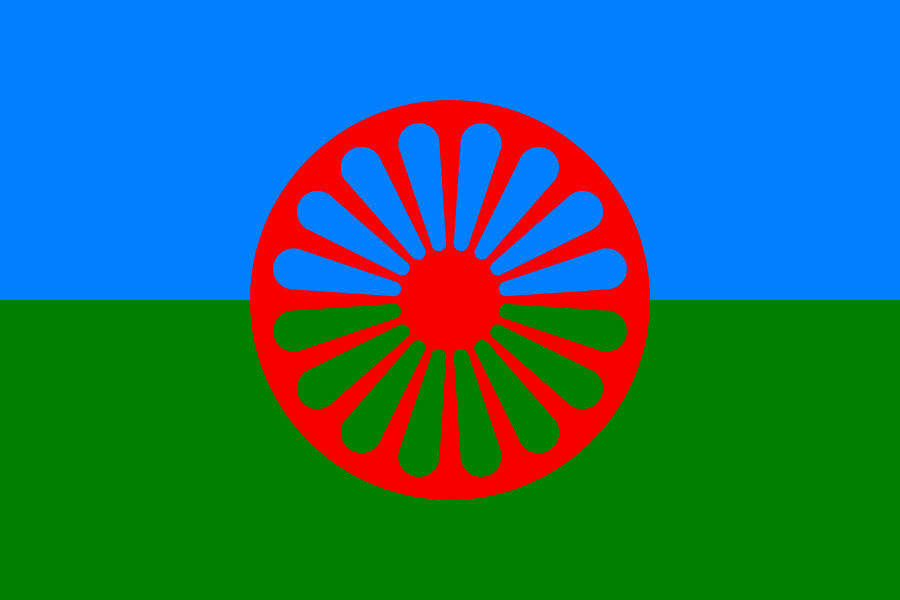
Flag of the Romani people
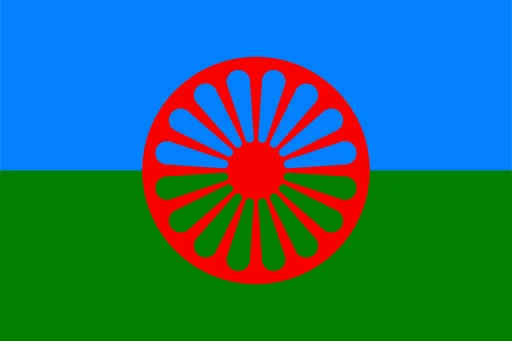
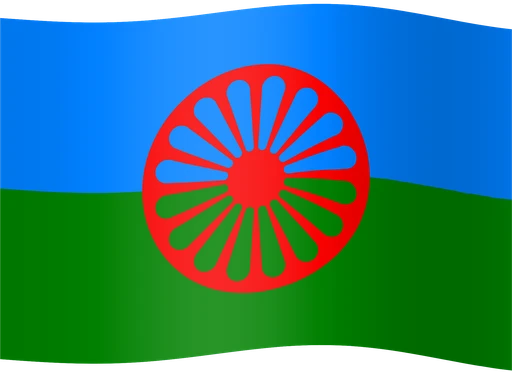
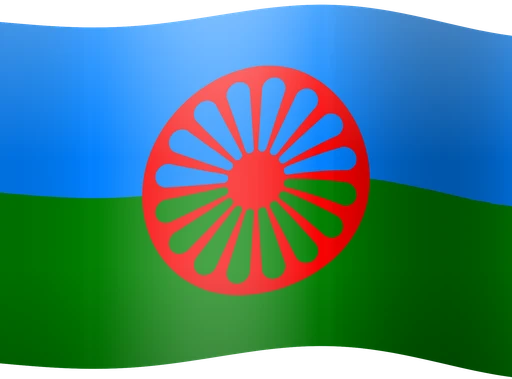
The Romani flag has two equal horizontal bands, blue above and green below, with a red sixteen-spoked wheel at the centre. Blue stands for the heavens and spiritual values. Green stands for the earth and the natural world. The wheel stands for life on the road, and its design echoes the Ashoka Chakra on the flag of India, a nod to the Indian origins of the Romani people. The first World Romani Congress approved the flag in 1971, and it belongs to the Romani people in every country rather than to any state.
Most flags belong to a state. The Romani flag belongs to a people with no state of their own, spread across Europe, the Americas and beyond. It is two bands of colour and a red wheel, and it has flown at congresses, memorials and protests for more than fifty years.
A bicolour older than the congress
The blue and green bands came first. Ian Hancock traces them to a world Romani flag proposed in late 1933 by Romania's General Union of the Romanies, on the initiative of Gheorghe A. Lăzăreanu-Lăzurică. That version had no wheel. Other historians, including Elena Marushiakova, note the lack of real historical evidence for this account, so the early history is contested.
Earlier symbols pointed in other directions. Affiliates of the Gypsy Lore Society promoted a red, yellow and black tricolour around 1890. A 1935 Romani congress in Bucharest, presided over by Gheorghe Nicolescu, displayed a Romani flag. Romanian activists also used a flag based on the Romanian tricolour. In the 1960s a green, red and blue triband was in circulation. None of these became a shared emblem. The 1971 bicolour did.
Orpington, April 1971
The first World Romani Congress met in Orpington, near London, in April 1971. About 30 official participants came from 14 countries, with observers from six more. The delegates agreed on the form of the Romani flag and on an international anthem, "Gelem, gelem."
The delegates did not design a new flag. They confirmed the two bands and allowed a red fire, a thin stripe or a wheel at the centre. The compromise appeased communist delegates, some of whom had campaigned for a red star.
How the wheel got its spokes
The second congress, in 1978, made the wheel a permanent feature. It is based on the Ashoka Chakra, the sixteen-spoked wheel on India's flag. The Indian Romologist Weer Rajendra Rishi is credited with the definitive design. The original description spoke of a carriage wheel, and the early drawings did not closely resemble the chakra.
The congress never gave the flag proportions, Pantone values or a technical drawing. Every master you see is an interpretation. The master used here is a public domain drawing on Wikimedia Commons, whose proportions its author estimated from existing drawings. That is why FlagDB lists 2:3 as the ratio of the drawing, not as an official figure.
What the colours say
Descriptions of the symbolism vary in wording. The common account is that blue stands for the heavens and eternal spiritual values, and green stands for the earth and earthly values. The red wheel stands for movement and progress, and for the Indian origin of the Romani people. Some accounts tie the sixteen red spokes to the earth element.
Where the flag flies
The flag first appeared at a remembrance event at the Natzweiler-Struthof camp in June 1973. In January 1975 Matéo Maximoff and a large Romani delegation took the blue and green flag to the Gypsy family camp at Auschwitz. It has since been shown at the Auschwitz-Birkenau Memorial and Museum.
Brazil's government displayed it in official settings during the National Day of the Gypsy, first instituted by President Lula in 2006.
Not everyone's flag
Critics have called the flag Eurocentric, and some object to the Indian imagery. Others associate the red with communism. The Ashkali and Balkan Egyptians, several Sinti groups and Irish Travellers do not use it. Local versions go their own way: Croatia's Gypsy Party uses a golden wheel, a Catalan flag has ten spokes, and a flag shown in Seville in 2008 has eight.
References
[1] "Flag of the Romani people," Wikipedia. https://en.wikipedia.org/wiki/Flag_of_the_Romani_people
[2] "50th anniversary of the international movement of Romani people celebrated worldwide," Romea.cz. https://romea.cz/en/world/50th-anniversary-of-the-international-movement-of-romani-people-celebrated-worldwide
[3] "Romani Flag," Flags of the World. https://crwflags.com/FoTW/FLAGS/qr.html
[4] "File:Flag of the Romani people.svg," Wikimedia Commons. https://commons.wikimedia.org/wiki/File:Flag_of_the_Romani_people.svg
[5] "File:Roma flag dimensions.svg," Wikimedia Commons. https://commons.wikimedia.org/wiki/File:Roma_flag_dimensions.svg
Common questions
- What do the colours of the Romani flag mean?
- Blue is the heavens, and stands for spiritual values. Green is the earth and the natural world. The red wheel at the centre stands for life on the road and for movement. Because the flag has never had an official specification, writers give slightly different wording for each element, but these meanings are the ones most often repeated.
- Who designed the Romani flag?
- No single designer is agreed. The blue and green bicolour is attributed to Gheorghe A. Lăzăreanu-Lăzurică in interwar Romania, though historians question the evidence. The Indian scholar Weer Rajendra Rishi is credited with the wheel. The first World Romani Congress approved the flag in 1971.
- Why does the Romani flag have a wheel?
- The wheel stands for travel and for the Indian roots of the Romani people. Its sixteen spokes follow the Ashoka Chakra, which sits at the centre of India's national flag. The first design described a carriage wheel. The 1978 congress settled on the chakra, and it has been part of the flag since.
- When was the Romani flag adopted?
- The first World Romani Congress approved it in April 1971, in Orpington near London. That congress confirmed the blue and green bicolour and allowed a wheel to be added. A second congress in 1978 fixed the wheel as a permanent part of the design.
- Do all Romani people use the same flag?
- No. Many Romani groups fly it, but some communities reject it or prefer their own symbols. Variants also exist. The Gypsy Party of Croatia uses a golden wheel, a Catalan version has ten spokes, and a flag shown in Seville in 2008 has eight.
Download this flag
Free in 12 styles, from 32px icons up to 2000px, as SVG, PNG, WebP and JPG.