The International Atomic Energy Agency
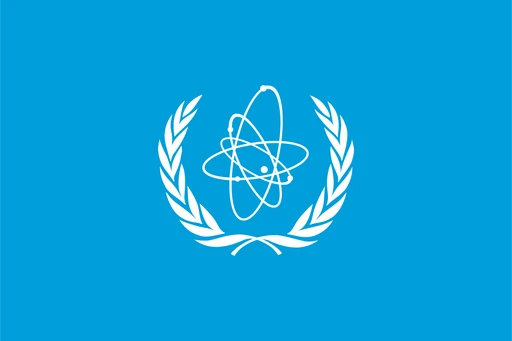
The flag of the International Atomic Energy Agency (IAEA) carries the agency's emblem in white on a light blue field, the same blue used by the United Nations. The emblem is a stylized atom framed by two olive branches. The agency's job is to promote the peaceful use of nuclear energy and to keep nuclear material out of military hands.
The International Atomic Energy Agency came into being in 1957 under the banner of "Atoms for Peace," and its flag carries a stylized white atom on a light blue field, the same blue as the United Nations flag. That colour places the organization visually inside the UN system while the atom marks out its own mandate. The atom had spent the previous decade as a symbol of annihilation, and the emblem was an argument that it could stand for something else.
Atoms for Peace, 1953
On December 8, 1953, President Dwight D. Eisenhower stood before the 470th Plenary Meeting of the United Nations General Assembly and delivered his "Atoms for Peace" address. He proposed an international body that would take fissile material out of the weapons race and redirect it toward energy, medicine, and agriculture. The world was frightened of the atom. Eisenhower wanted to give it a second reputation.
It took years to turn the rhetoric into an institution. The IAEA Statute was approved on October 23, 1956, and the agency came into existence on July 29, 1957, when the statute entered into force, with headquarters in Vienna. From the start it carried a tension at its core: it was tasked with promoting nuclear technology and preventing its misuse, cheerleader and watchdog at once. The emblem had to cover both halves of that mission.
The timing shaped the design. Atmospheric nuclear testing was rattling windows across the Pacific. The first civilian nuclear power plants were coming online. Millions of people associated the atom exclusively with annihilation. The agency's visual identity had to project optimism without naivety and authority without menace.
Anatomy of the emblem
At the centre of the flag sits a stylized Rutherford-Bohr atomic model in white, with elliptical electron orbits encircling a small nucleus. By the 1950s this image was already universal shorthand for science and modernity, appearing on everything from magazine covers to kitchen appliances. It conveyed cutting-edge physics without depicting anything that resembled a weapon.
The emblem did not arrive fully formed. The version on agency letterhead in July 1957 had three orbits, and someone eventually pointed out that an atom with three electrons is lithium, an element then closely associated with hydrogen bombs. A fourth orbit was added, moving the picture to beryllium and away from the awkward implication. A far more elaborate design was floated at the end of the decade, with a globe at the centre and a crowd of symbols around it, and it was quietly dropped. The Board of Governors settled the question on April 1, 1960, adopting the version still in use.
Flanking the atom are olive branches, borrowed from the UN emblem tradition. For an organization whose mandate includes non-proliferation and safeguards, they function as a statement of purpose and link the IAEA visually to the wider family of international organizations.
The light blue background matches UN blue, reinforcing the agency's place within the international system. The IAEA isn't a UN specialized agency, though. It's an autonomous organization created by its own statute, reporting to both the General Assembly and the Security Council, an arrangement that reflects the particular dangers of its subject matter. The shared colour signals kinship without implying subordination.
In official usage, the agency's name often appears in a surrounding ring or beneath the central device. The flag follows standard international organization proportions and flies at the Vienna International Centre alongside the flags of over 170 member states. Colour specifications are tightly controlled in IAEA branding guidelines, so the emblem looks the same printed on an inspection credential in Tehran or projected on a screen in New York.
What the orbits and branches carry
The electron orbits trace paths that cross and recross without regard for borders, which suits an agency dealing with a technology that respects no national boundaries. Radiation does not stop at customs.
The olive branches carry particular weight when you remember what the agency actually does day to day. IAEA inspectors verify that countries aren't diverting nuclear material from peaceful programmes to weapons. The branches are aspirational, and they're also a reminder of what's at stake if the system fails.
There's an unavoidable tension in the design. The same atom that powers cities also arms warheads, and the flag has to represent an organization that hands out nuclear technology with one hand and restricts it with the other. The emblem's meaning has shifted with events. In the 1950s and 60s it read as optimism about the atomic age. After Three Mile Island in 1979, Chernobyl in 1986, and Fukushima in 2011, it became more closely associated with safety and crisis response. As nuclear energy re-enters the conversation around climate change, it is being read differently again.
When the IAEA and Director General Mohamed ElBaradei were awarded the 2005 Nobel Peace Prize, the emblem got a burst of global visibility, appearing on front pages as a symbol of multilateral nuclear governance at a time when that governance was being tested by crises in Iran and North Korea.
Protocol and display
The flag flies daily at IAEA headquarters in the Vienna International Centre, surrounded by the flags of its member states. It also appears at international conferences, NPT Review Conferences, and treaty negotiations wherever nuclear issues are on the table.
Beyond Vienna, the emblem appears on official documents, inspection seals, and technical cooperation materials distributed across more than 170 countries. It travels with IAEA inspectors into politically sensitive locations. When inspectors enter an Iranian enrichment facility or arrive at a site in North Korea, the emblem on their credentials and vehicle markings carries the authority of the international community behind them.
Strict guidelines govern the emblem's reproduction and use, similar to the protections afforded to UN symbols under international law and codified in the IAEA Statute's provisions on privileges and immunities. Variants exist for different contexts: monochrome versions for print, simplified versions for digital platforms, and high-contrast versions for vehicle markings.
Among the flags of global governance
Most UN-family organizations follow the same basic template: a distinct central device on a blue field. The WHO uses the Rod of Asclepius, UNESCO its Greek temple, ICAO a pair of wings. The IAEA's atom fits into that visual family while remaining distinguishable from the rest.
Other bodies have used atomic imagery in their emblems. Brazil's National Nuclear Energy Commission (CNEN), the former US Atomic Energy Commission, and the European Atomic Energy Community (Euratom) all deployed similar motifs, but none achieved the same recognition. The IAEA version benefits from decades of visibility at the highest levels of international diplomacy.
One design choice is worth singling out. The IAEA chose an aspirational depiction of the atom rather than a cautionary one. The trefoil radiation hazard sign, designed to evoke danger, could not be more different in tone. The IAEA wanted its symbol to read as opportunity, not warning.
The emblem's influence extends to neighbouring organizations in Vienna, particularly the Comprehensive Nuclear-Test-Ban Treaty Organization (CTBTO), whose branding echoes the IAEA's blue-and-atom aesthetic. Together these Vienna-based nuclear governance bodies form a visual cluster that diplomats and policy specialists recognize on sight. The IAEA emblem is also the most enduring survivor of 1950s "Atoms for Peace" visual culture, outlasting the postage stamps, exposition logos, and posters of that era.
The emblem in a crisis
The flag has appeared at some of the worst moments in nuclear history. After the Chernobyl disaster in 1986 it became the visible face of the international response. During the Fukushima Daiichi accident in 2011, IAEA press conferences put the emblem in front of a global television audience. More recently, the monitoring of the Zaporizhzhia Nuclear Power Plant during the Russia-Ukraine conflict has put it on screen again, representing an agency trying to safeguard a nuclear plant inside an active war zone.
Public perception has swung from Cold War optimism to post-Chernobyl anxiety, from post-Fukushima scepticism to a cautious new interest in nuclear energy as a tool against climate change. Through all of it the flag has stayed the same: the same atom, the same olive branches, the same blue field. When IAEA inspectors show up at a disputed site, that unchanged emblem on their badges carries a claim with it, that the international community has both the right and the responsibility to know what is happening inside the building.
References
[1] IAEA Official Website, "About the IAEA: History." https://www.iaea.org/about/overview/history
[2] IAEA Statute, Article XVI: Privileges and Immunities, including emblem protections (INFCIRC/11).
[3] Eisenhower, Dwight D. "Atoms for Peace" Address to the 470th Plenary Meeting of the United Nations General Assembly, December 8, 1953. Eisenhower Presidential Library archives.
[4] Fischer, David. History of the International Atomic Energy Agency: The First Forty Years. Vienna: IAEA, 1997.
[5] Nobel Peace Prize 2005, Award Citation for IAEA and Mohamed ElBaradei. https://www.nobelprize.org/prizes/peace/2005/summary/
[6] Medhurst, Martin J. "Atoms for Peace and Nuclear Hegemony: The Rhetorical Structure of a Cold War Campaign." Armed Forces & Society, Vol. 23, No. 4, 1997.
[7] Smith, Whitney. Flags Through the Ages and Across the World. McGraw-Hill, 1975.
[8] IAEA Visual Identity and Branding Guidelines (internal publication, referenced in IAEA Annual Reports).
Common questions
- What does the IAEA flag's emblem represent?
- A stylised atom framed by two olive branches. The atom stands for nuclear science and the olive branches for peace, together expressing the agency's mandate: promoting the peaceful use of nuclear energy while keeping nuclear material out of military hands.
- Is the IAEA part of the United Nations?
- No, though it is closely related and uses the same light blue. The IAEA was created by its own statute, approved on 23 October 1956 and in force from 29 July 1957, which makes it an autonomous organisation rather than a UN specialised agency. It reports to the UN General Assembly and Security Council.
- When was the IAEA flag adopted?
- The Board of Governors formally adopted the finished design on 1 April 1960. An early version of the atom emblem was already in use on agency letterhead by July 1957, and the design was reworked over the following years before it was settled.
- Where is the IAEA flag flown?
- At the agency's headquarters in Vienna, at official events, and at facilities around the world where it runs inspections, training and assistance programmes. It marks the agency's presence in a role that often requires visible neutrality.
Download this flag
Free in 12 styles, from 32px icons up to 2000px, as SVG, PNG, WebP and JPG.