Symbols of Sovereignty: Analyzing the Flags of the Post-Colonial World
Julio Song · · 3 min read
A flag designed at independence has a harder job than most. It has to identify a country that did not exist in its current form the year before, and it has to do so without borrowing from whoever was running the place. Algeria and Angola both solved that problem, and they solved it differently.
Why the design mattered so much
In a newly independent country a flag is a rallying point before it is anything else. It has to hold together people who have just come through a war, and it usually does that by referring to the war itself. Look at post-colonial flags and you find the same materials again and again: a color for a resource the country owns, a symbol for the freedom it has just won, and nothing at all inherited from the colonizer.
Algeria: a flag made by a war
Algeria spent years as a battleground for independence from French rule, and won in 1962. The flag came with the new state.
It is a field split green and white with a red star and crescent. Green is for Islam, white for purity, and the red star and crescent carry both the revolution and solidarity with other Arab nations. Algerians abroad use it as readily as Algerians at home.
Angola: a flag made by a movement
Angola's break from Portuguese rule was no easier, and sovereignty arrived in 1975. Its flag is more explicitly revolutionary than Algeria's.
The field is red over black with a yellow emblem across the middle. Red is the bloodshed, black is Africa, and the emblem, a gear crossed with a machete and topped by a star, names industry, agriculture and progress in one image. It is a flag that states an economic program.
Two routes out
Both flags use red for struggle and victory, which is about as far as the similarity goes. Algeria's symbolism is religious, Angola's industrial, and the difference marks out the distinct paths of North African and sub-Saharan independence. Neither flag is a neutral design exercise. Both are markers of liberation, readable as such at a glance.
The same pattern elsewhere
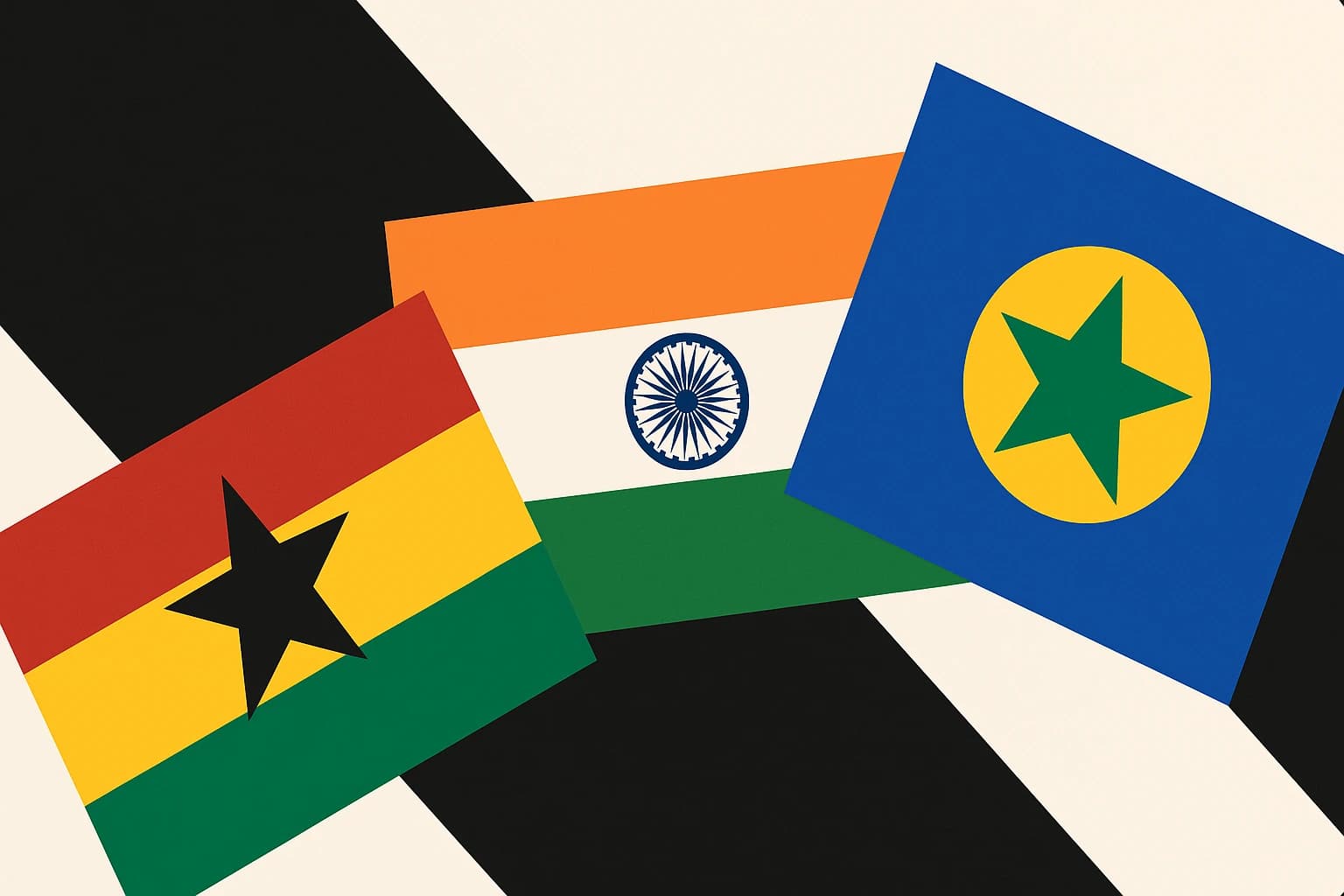
Decolonization reshaped symbols well beyond these two. Flags across Asia and the Caribbean use the same combination of rebirth and cultural continuity. India put a spinning wheel on its flag for self-reliance. Ghana's star was about unity among African nations rather than Ghana alone. These designs keep changing quietly as politics does.
Where the flags actually live
Most of the time a national flag is not doing constitutional work. It is at a festival, on a holiday, in a classroom, outside a public building, at a football match. That everyday presence is how the symbolism gets transmitted, especially to people too young to remember what the flag replaced.
Julio Song
Writer
Julio is a staff writer at FlagDB. He studied Mathematics at the University of Madrid and has a passion for vexillology.
More from Julio Song →