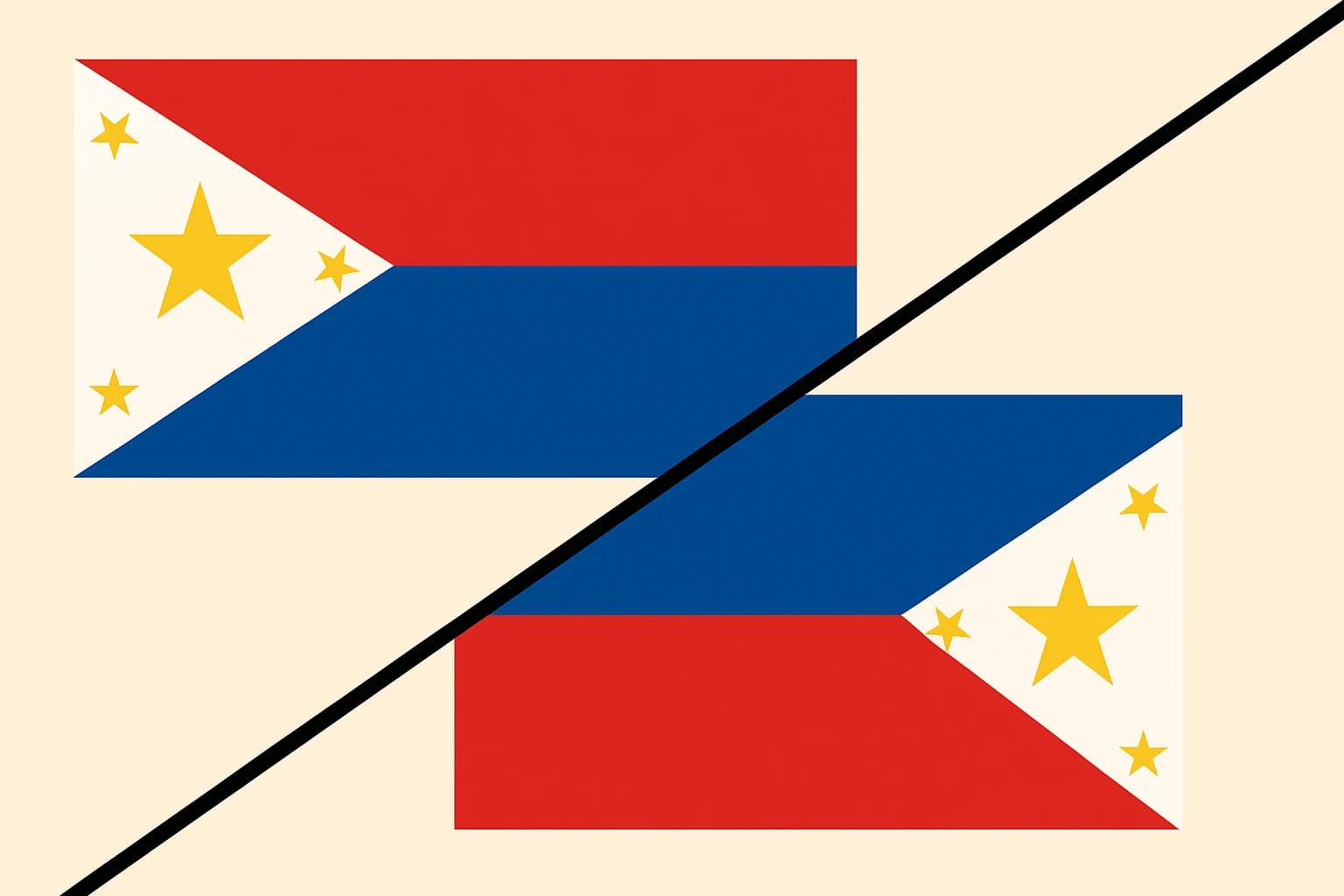
On 12 June 1898, in Kawit, Cavite, Emilio Aguinaldo stepped onto the balcony of his ancestral home and unfurled a new flag to declare Philippine independence from Spain. The crowd saw a white triangle, a sun, three stars, and two horizontal stripes, blue on top and red on the bottom. What most of them did not know was that the flag had a switch built into it. Flip it so the red stripe sits on top and it stops being a symbol of peace and becomes a declaration of war.
More than a century later, the Philippines is still the only sovereign nation whose flag is officially designed to be flown upside down as a codified wartime signal.
Most flags are static images, logos stamped on merchandise and embassy poles. The Philippine flag is a working communication tool, a piece of cloth engineered to carry two messages depending on its orientation.
A revolution stitched in silk
The flag's story begins in Hong Kong rather than the Philippines. In late 1897 Aguinaldo was in exile, planning his return and the next phase of the revolution. He commissioned the design and worked with three women who sewed the first version by hand: Mariana Agoncillo, her daughter Marcela, and Josefina Herbosa de Natividad.
Every element was deliberate. The white equilateral triangle stood for equality and fraternity, drawing on both Katipunan ideology and the Masonic influences common among the revolutionary leadership. The sun carried eight rays for the first eight provinces that revolted against Spain. Three stars represented Luzon, the Visayas and Mindanao.
Then the stripes. Blue for peace, justice and truth; red for patriotism and valor. Blue on top was the default. Inverted to red on top, the flag signaled a state of war.
This was a core design principle rather than a flourish added later. The revolutionaries knew their new nation would face continued conflict. In 1898 the Philippines was fighting Spain and about to collide with American colonization, and the fighters needed a banner that could communicate status across an archipelago of more than 7,000 islands with almost no telecommunications infrastructure.
When Aguinaldo unfurled the flag at Kawit, he displayed it blue on top. Peace, as an aspiration rather than a description. War with the United States was already coming.
When the war flag flew
The design got its first test almost immediately. When hostilities broke out between Filipino and American forces in February 1899, the inverted flag became the standard of Aguinaldo's First Philippine Republic for the duration of the Philippine-American War (1899-1902). War was declared through the orientation of cloth rather than a speech or a telegram, and this remains the design's longest activation.
Japan invaded in December 1941, and the Commonwealth government authorized the war orientation. The red-on-top flag became a symbol of resistance through three years of occupation, though its display was complicated: the Japanese-backed Second Philippine Republic used a version of the flag, while guerrilla fighters in the mountains carried their own.
When Ferdinand Marcos declared martial law in September 1972, some argued the flag should fly red on top because the nation was effectively under internal siege. Marcos never authorized the inversion, since doing so would have admitted that the state was at war with its own people. Whether martial law counts as "wartime" under the flag code was never resolved, and the question came up again during the early years of the Marcos Jr. administration.
It returned again in 2017. When ISIS-affiliated militants seized the city of Marawi in Mindanao, President Rodrigo Duterte declared martial law across the whole island group, and the inversion debate resurfaced in national media. The government did not invoke the war orientation.
The threshold for inversion has never been defined precisely. The 1998 Flag and Heraldic Code (Republic Act No. 8491) says the flag is displayed with the red stripe on top "in times of war," and leaves "war" ambiguous. Declared war? Armed conflict? Internal emergency? The ambiguity has kept the question live.
Paraguay's two faces are a different trick
There is one partial parallel. Paraguay is the only other sovereign nation whose flag officially has different obverse and reverse sides.
The front displays the national coat of arms: a star surrounded by a wreath and the words "República del Paraguay." The back shows the Treasury Seal, a lion guarding a liberty cap with the motto "Paz y Justicia."
The difference matters. Paraguay's two-sided design does not encode a message shift, and it does not signal peace versus war. It shows two institutional identities, the state and the treasury. The flag is always flown the same way and simply looks different depending on which side faces you.
The design dates to 1842 under President Carlos Antonio López, and it is one of the few surviving examples of a flag treated as a multi-layered object rather than a flat printed image. Maintaining two embroidered sides is expensive and technically demanding, so most Paraguayan flags in practice are single-sided prints.
The comparison sharpens what the Philippine flag does. Paraguay built in a spatial signal, this institution versus that one. The Philippines built in a temporal one, peace now versus war now. Only the Philippine design changes in real time.
Why nobody else copied it
Heraldic tradition worked against it. Most national flags were designed in the 18th and 19th centuries by European powers or under European influence, and heraldry favored fixed, unchanging symbols. A flag whose meaning depended on orientation would have looked unstable.
Signal systems also branched off. International maritime flag codes separated identity flags from communication flags, so nations had no need for their national banner to carry operational messages.
The geometry rarely works, either. A reversible flag only functions if the design is asymmetric in a particular way. Most flags are symmetric (France, Italy, Nigeria) or have elements that break when inverted. The U.S. stars would be upside down.
The Union Jack shifts in a way that looks like an error rather than an intention.
The Philippine flag's two-stripe horizontal design is one of very few configurations where inversion produces something legible and clearly intentional.
There was also a political disincentive. Building a war configuration into a flag implies you expect a war, which is not what most nation-builders want to announce. The Philippine revolutionaries of 1898 were unusually clear-eyed about the conflicts they knew were coming.
And the concept aged out. Nations now communicate war status through declarations, media and diplomatic channels rather than the orientation of cloth on a pole.
What was lost when banners became logos
For most of human history flags were functional communication tools. Maritime signal flags transmitted complex messages between ships. Medieval battle standards marked unit positions and commander status. The semaphore system used flag positions to spell out messages and preceded the telegraph.
National flags started out inside that tradition. The Philippine war-flag mechanism is a surviving example of a flag designed to do something rather than be something, carrying information that changes with circumstances.
In the 20th and 21st centuries national flags flattened into identity marks reproduced on lapel pins and airline liveries. Flying a flag upside down as a distress signal survives informally: in the United States, an inverted Stars and Stripes is recognized under the U.S. Flag Code (4 U.S.C. § 8(a)) as "a signal of dire distress in instances of extreme danger to life or property." That is an emergency improvisation, though, not a designed feature. The Philippines is the only country that formalized the upside-down signal as part of the flag's intended function.
The flag in 2026
The war orientation remains codified in Republic Act No. 8491, signed in 1998, exactly a century after the flag's creation. The law mandates fines and imprisonment for misuse, including unauthorized inversion.
Every 12 June, Independence Day celebrations display the flag in its peace orientation, but public discourse keeps returning to the war flag, especially during tension in the West Philippine Sea. Territorial disputes with China have escalated in recent years, and confrontations between Philippine and Chinese vessels near the Second Thomas Shoal in 2024 and 2025 brought back social media calls to fly the flag red on top.
The flag also intersects with the reckoning over the Marcos legacy. Whether the martial law period (1972-1986) counted as a "war" worthy of inversion remains politically charged under the presidency of Ferdinand Marcos Jr., who has resisted describing his father's regime as a dictatorship.
Among younger Filipinos the war-flag feature is a point of pride, and it circulates constantly in viral posts and educational content as one of the most surprising facts about any national flag. The red stripe stays folded beneath the blue, available if the moment demands it.