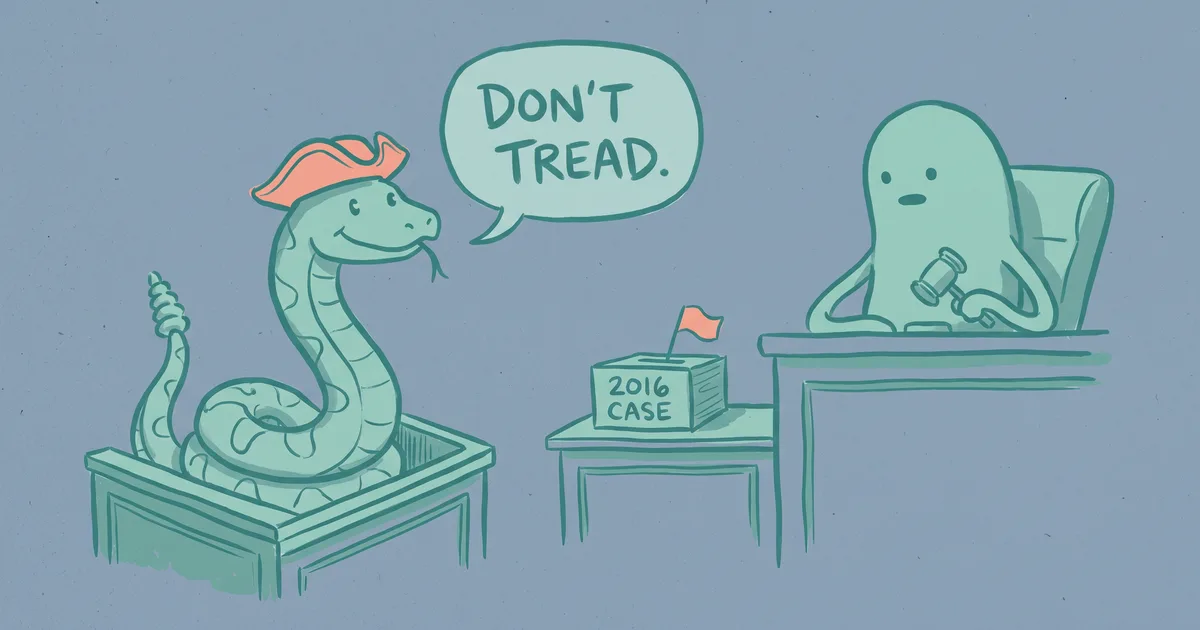
In December 1775, Christopher Gadsden handed a yellow flag to a naval commander whose fleet hadn't even sailed yet. The flag showed a coiled rattlesnake and three words: "Don't Tread on Me." Two hundred and forty-one years later, a federal civil rights agency spent pages explaining what that same flag does and doesn't mean, because a coworker's baseball cap had turned into a discrimination complaint. The design never changed. The argument over what it says never stopped.
A snake before it was a flag
Benjamin Franklin reached for a rattlesnake decades before Gadsden did. In 1751, he published a biting piece in the Pennsylvania Gazette proposing that the colonies ship rattlesnakes to England in exchange for the convicted felons Britain kept dumping on American shores, according to American Heritage. It was satire, not symbolism, but it planted the snake in Franklin's toolkit.
Three years later, he used it again, this time in earnest. On May 9, 1754, Franklin published a woodcut in the same paper showing a snake cut into eight pieces, each piece labeled for a British colony. He ran it ahead of the Albany Congress, where delegates were trying to organize a joint colonial defense against the French and their Native allies. The caption read "Join, or Die." Historians consider it the first political cartoon printed in an American newspaper, and it argued exactly one point: the colonies were weaker split apart than they were stuck together.
That cartoon had nothing to do with independence. Franklin wanted the colonies to cooperate under the British crown, not against it. But the image stuck, and twenty years later, with actual fighting underway, the snake came back carrying a different message.
Gadsden gives the snake a name
By late 1775, Christopher Gadsden was a delegate from South Carolina to the Continental Congress and one of seven members of its new Marine Committee, the body tasked with outfitting the Continental Navy. That December, Franklin watched Marines marching through Philadelphia and noticed one of their drums painted with a coiled rattlesnake and the words "Don't Tread on Me." He wrote an essay about it under the pseudonym "An American Guesser," making the case that the rattlesnake was a fitting choice. It has no eyelids, a sign of vigilance. It never attacks first, a sign of restraint. And its thirteen rattles are "distinct and independent of each other," yet "united together, so as never to be separated but by breaking them to pieces."
Gadsden had already commissioned a version of that design for the Navy. According to the Post and Courier, he presented a yellow flag with a coiled rattlesnake to Commodore Esek Hopkins that December, meant to fly as Hopkins's personal command flag aboard the Continental Ship Alfred. Two months later, Gadsden brought a matching standard home to Charleston and presented it to the South Carolina Provincial Congress, which ordered it preserved in its meeting hall. That Charleston flag is the one that survives in written record as a formal, documented gift, which is likely why the design carries Gadsden's name rather than Franklin's or Hopkins's.
The flag the Navy never flew
Here's where the story gets tangled, because two different rattlesnake flags get treated as one. The Gadsden flag is a solid yellow field with a single coiled snake. A second design, thirteen red and white stripes with a rattlesnake laid across them, is known today as the First Navy Jack. Historians still argue over whether Hopkins's fleet flew that striped version in 1776 at all, since his surviving orders describe only a plain "striped jack" with no snake mentioned anywhere. What's well documented is that Gadsden's yellow flag was a personal gift to one commander, not an official Continental Navy ensign. The Navy didn't adopt a rattlesnake jack as a standing fleet symbol until the country's bicentennial, two hundred years after Gadsden handed his flag to Hopkins.
Gadsden's design wasn't even the only rattlesnake flag of 1775. That July, militia companies in Culpeper, Fauquier, and Orange counties in Virginia organized under a white banner of their own, coiled snake included, but with Patrick Henry's "Liberty or Death" added alongside "Don't Tread on Me," according to the Sons of the Revolution, Virginia. The Culpeper flag flew at the Battle of Great Bridge that December, the same month Gadsden's yellow flag went to Hopkins. Two militias, two flags, one snake doing the same job for both of them.
The man Gadsden handed his flag to didn't wear it well. Congress censured Hopkins in August 1776 for sailing to raid Nassau instead of chasing the British ships he'd been ordered toward in the Chesapeake, and suspended him from command the following spring, according to Wikipedia's account of the record. Congress dismissed him from the Navy entirely on January 2, 1778, after he had two of his own officers arrested for reporting his treatment of British prisoners of war. The flag outlasted the man who first flew it by two and a half centuries and counting.
A war-on-terror comeback, then a retreat
That bicentennial revival stayed a minor tradition, flown by a single ship in the fleet as an honor. Then September 11 happened. On May 31, 2002, Secretary of the Navy Gordon England ordered every commissioned warship to swap its blue, star-spangled jack for the First Navy Jack for the duration of what the instruction called the Global War on Terrorism. Ships made the switch on the first anniversary of the attacks, September 11, 2002, and the rattlesnake flew from the bow of the entire fleet for the next seventeen years.
It came down again on June 4, 2019. Chief of Naval Operations Admiral John Richardson ordered ships back to the traditional Union Jack, timed to the anniversary of the Battle of Midway, and tied the switch to a change in strategic focus. "We have entered a new era of competition," Richardson said, pointing at rival naval powers rather than terrorism as the fleet's central concern. Only the Navy's oldest active warship kept flying the rattlesnake, the same arrangement that had existed before 2002.
The Tea Party finds a mascot
While the Navy was flying the rattlesnake against terrorism, a different group entirely adopted the plain yellow Gadsden flag for a different fight. On February 19, 2009, CNBC commentator Rick Santelli went on air from the floor of the Chicago Mercantile Exchange and called for a modern Boston Tea Party in protest of the new administration's economic policies. The remark helped launch the Tea Party movement, a coalition of libertarians and fiscal conservatives pushing for lower taxes and smaller government. The movement reached for Revolutionary War imagery to make its case, and the Gadsden flag, with its warning about being provoked into a fight, turned into its most visible symbol at rallies and protests.
That civilian, explicitly political adoption is the detail that would matter most a few years later, in a workplace three thousand miles from Independence Hall.
A cap, a complaint, and a federal ruling
In 2014, a Black employee at the U.S. Postal Service filed a complaint after a coworker repeatedly wore a cap bearing the Gadsden flag to work. He argued it counted as racial harassment. He pointed to two things. First, Gadsden himself: his Charleston wharf, completed in 1767, is estimated to have brought roughly 100,000 enslaved Africans into the country over the decades it operated, and he still held enslaved people at his death in 1805, according to Wikipedia's account of his estate records. Second, the flag's more recent association with the Tea Party and other groups.
The Postal Service dismissed the complaint. The Equal Employment Opportunity Commission's Office of Federal Operations disagreed, ruling in 2014, in the case Shelton D. v. Brennan, that the claim deserved an investigation rather than a dismissal. The Postal Service asked the Commission to reconsider. On June 3, 2016, it declined, and the order to investigate stood. Its written decision is careful about what it is and isn't saying. It states plainly that "the Gadsden Flag originated in the Revolutionary War in a non-racial context," while noting that the symbol "has since been sometimes interpreted to convey racially-tinged messages in some contexts," including "the modern Tea Party political movement, gun rights activism, patriotic displays, and by the military." The ruling adds that the Commission is "not prejudging the merits" of the underlying complaint. It didn't call the flag racist, and it didn't ban it from federal workplaces. It said a complaint about it deserved a real investigation instead of an automatic dismissal, a narrower finding than most of the news coverage that followed suggested.
What one design never settles
Line up the timeline and the pattern is hard to miss. A colonial assembly locked the flag away as a treasured gift. The Navy claimed it, dropped it for two centuries, brought it back to fight terrorism, then dropped it again to focus on rival fleets. A political movement claimed it to argue for smaller government. A federal agency had to decide whether wearing it to work amounted to harassment. None of these institutions changed a single line of Gadsden's drawing. They kept disagreeing, one generation after another, about what a coiled snake and three words are supposed to warn you about.