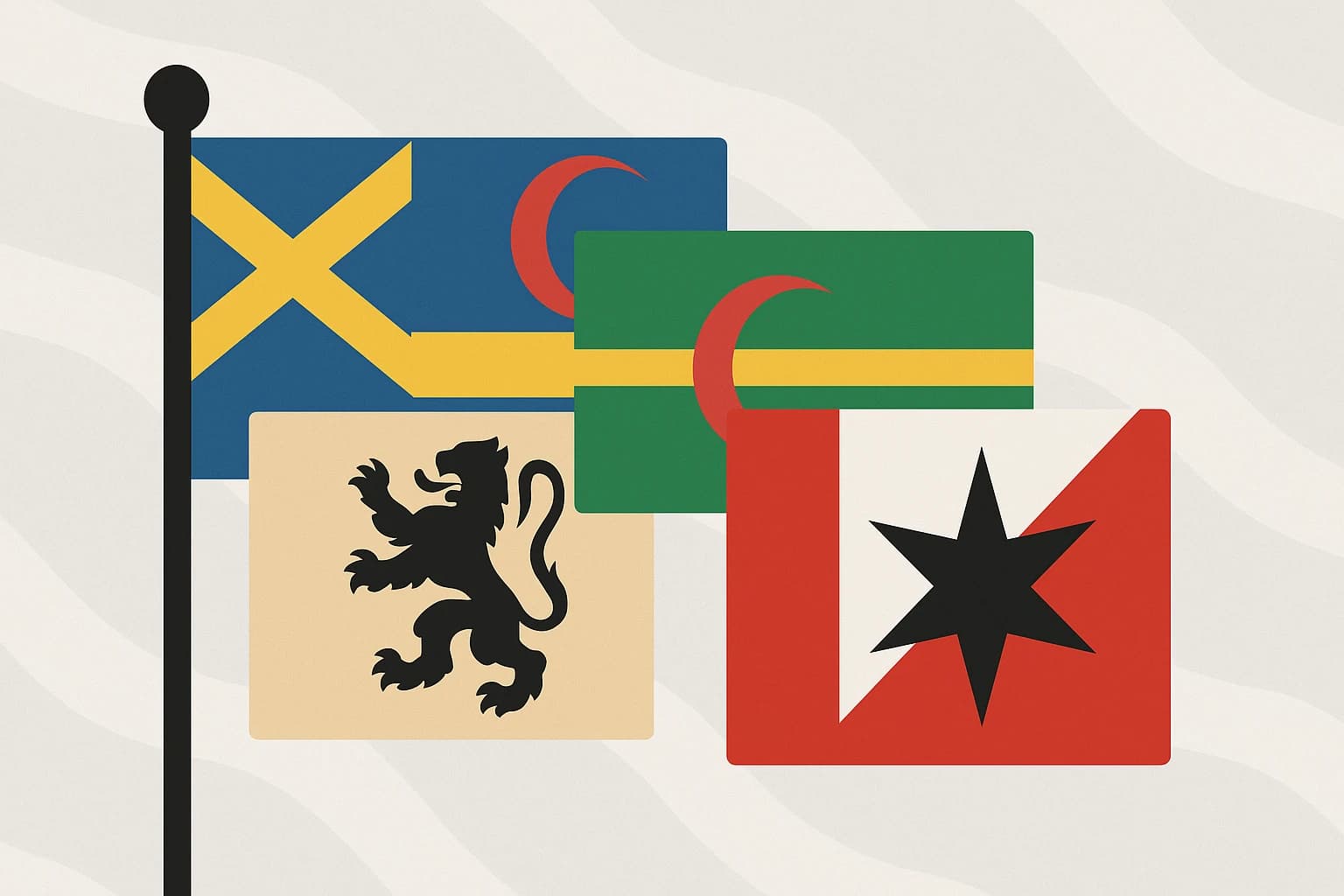
Most surveys of national flags stop at the countries that currently exist. That leaves out a good number of banners once flown over real territory by real governments, and it also skips past the flags of small states that do exist but rarely come up. Both groups are worth a look, for different reasons.
Flags of countries that are no longer countries
The Kingdom of Sardinia had a flag, and it did the ordinary work of announcing regional power to anyone who came within sight of it. The Republic of Texas had one for the brief span in which it was a country in its own right.
Neither is a national flag today. Both are still about the shortest summary available of what those states believed themselves to be, which is why historians keep coming back to them.
Bhutan and Brunei, still flying and still unusual
Bhutan's dragon comes out of the country's religious and cultural tradition rather than out of European heraldry, which is why the flag looks like nothing else in a lineup of national designs.
Brunei's flag works differently. Its symbolism is royal, drawn from the country's monarchical history, and it announces what kind of state Brunei is without any ambiguity at all.
The flags nobody looks at
Most people can pick out a handful of national flags on sight. Palau is rarely one of them.
Cyan and yellow, and very little else. The restraint is the point.
Nauru's flag is closer to a diagram. It marks where the island sits in relation to the Equator, which for a country that isolated is as useful an identifier as any symbol would be.
What makes a flag stick
Flag design rewards restraint. A design built on simple shapes and a small number of colors survives being shrunk to the size of a lapel pin, printed badly, or seen from the far end of a stadium. A cluttered one does not, and a flag nobody can recall is a flag doing half its job.
Museums and vexillological societies do the unglamorous work of keeping the record: cataloging the flags of states that dissolved, the versions that were replaced, and the designs that were proposed and never adopted. Without that record, a flag stops existing the moment the last one is taken down.