What flags are asked to carry
Vexillology is the study of flags, and one of its recurring findings is how much information countries try to pack into a very small format. Some flags settle for two colors and a shape. Others put a full coat of arms in the middle and expect it to be legible at fifty meters. Belize, Bhutan and Brazil sit at the crowded end of that range, and each is worth reading closely.
Belize
A royal blue field with a white circle and a coat of arms at the center. The blue and red are the colors of the country's two main political parties, which is a rare thing to admit on a national flag: the design encodes a rivalry rather than papering over it. Thirty olive leaves ring the arms, for peace.
The arms show a wooden shield held by two men of different ethnic backgrounds. Below the shield runs the motto "Sub Umbra Floreo", which means "I Flourish in the Shade".
Bhutan
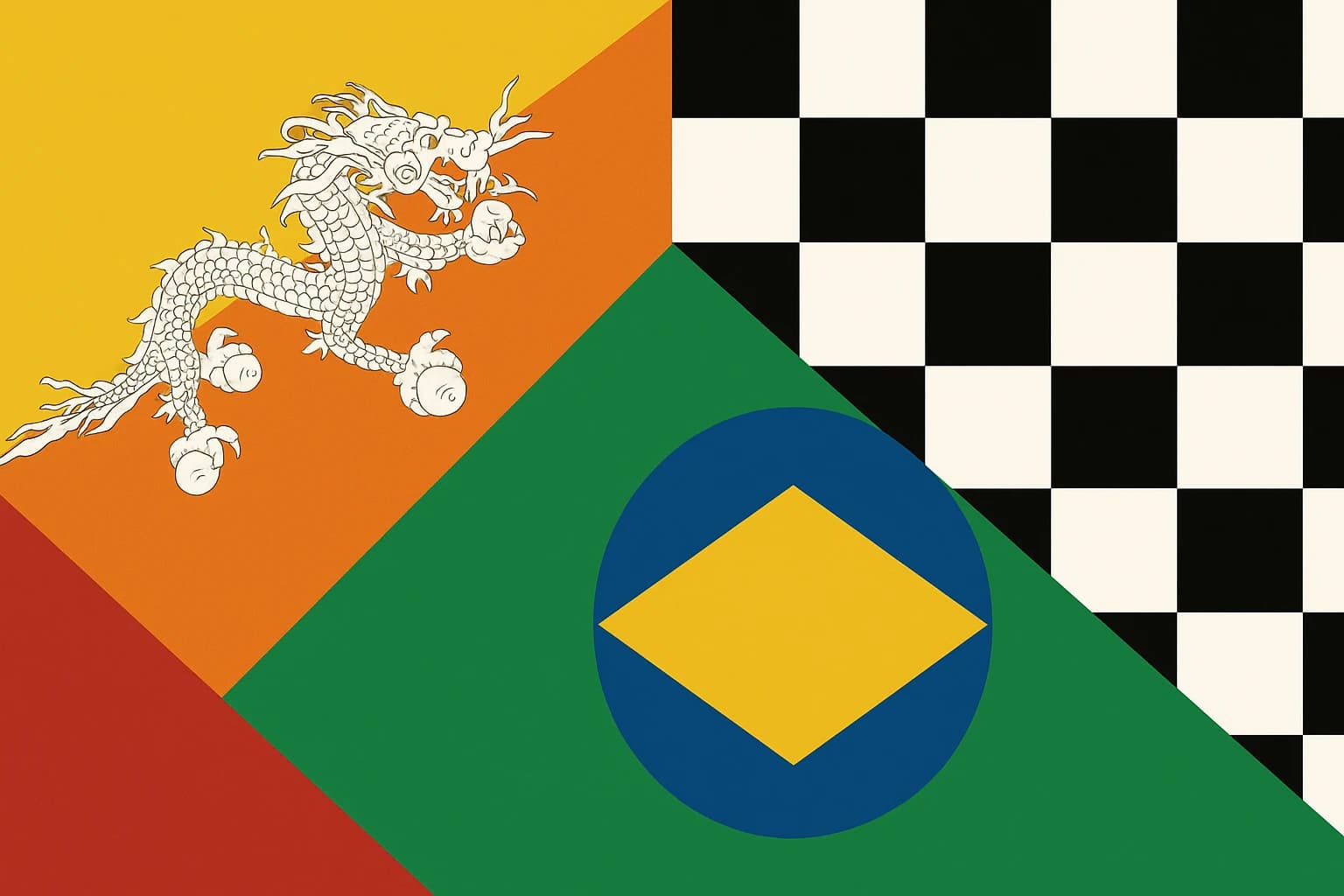
Divided diagonally, gold on one side for Bhutan's secular tradition and its wealth, orange on the other for Buddhism. Across the join sits Druk, the white dragon.
The dragon holds jewels in its claws, for the country's wealth and security, and its white color stands for purity and for the loyalty of the people. Most flags represent their institutions with abstractions. Bhutan uses an animal, and it works.
Brazil
A green field with a yellow diamond, for the landscape and the mineral wealth, and a blue globe carrying stars for the sky over Rio de Janeiro and for the states of the country. The motto "Ordem e Progresso" runs across the globe.
Two outliers
Nepal's flag is not a rectangle. Its two stacked triangles refer to the Himalayas and to the country's two main religions, Hinduism and Buddhism. Eswatini's flag works differently again, carrying traditional elements that are read as cultural rather than political.
Newer flags tend to move the other way, toward simple lines and a small number of strong colors.
What makes a flag work
Flag design rewards restraint. A design has to be recognizable at a distance, reproducible by anyone, and meaningful to the people it represents, and those three requirements pull against each other. Japan and Switzerland manage all three with almost nothing on the field.
The failures are usually failures of ambition. A flag with too much detail stops being recognizable at the size and speed a flag is actually seen, and once that happens the symbolism does not matter.