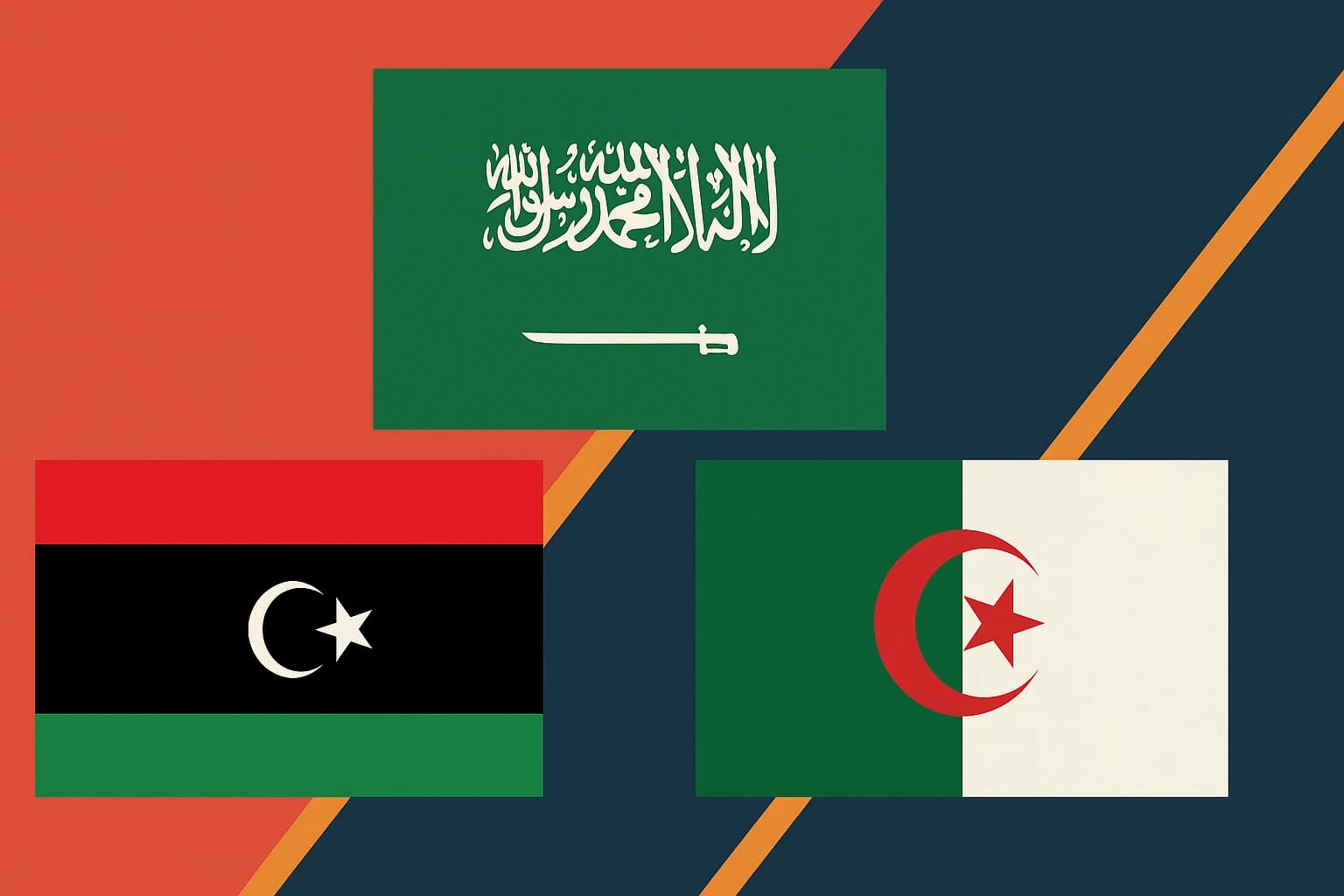
The Serrated Secret: Why Bahrain and Qatar Share the Same Zigzag, and What Britain Had to Do With It
Julio Song · · 10 min read
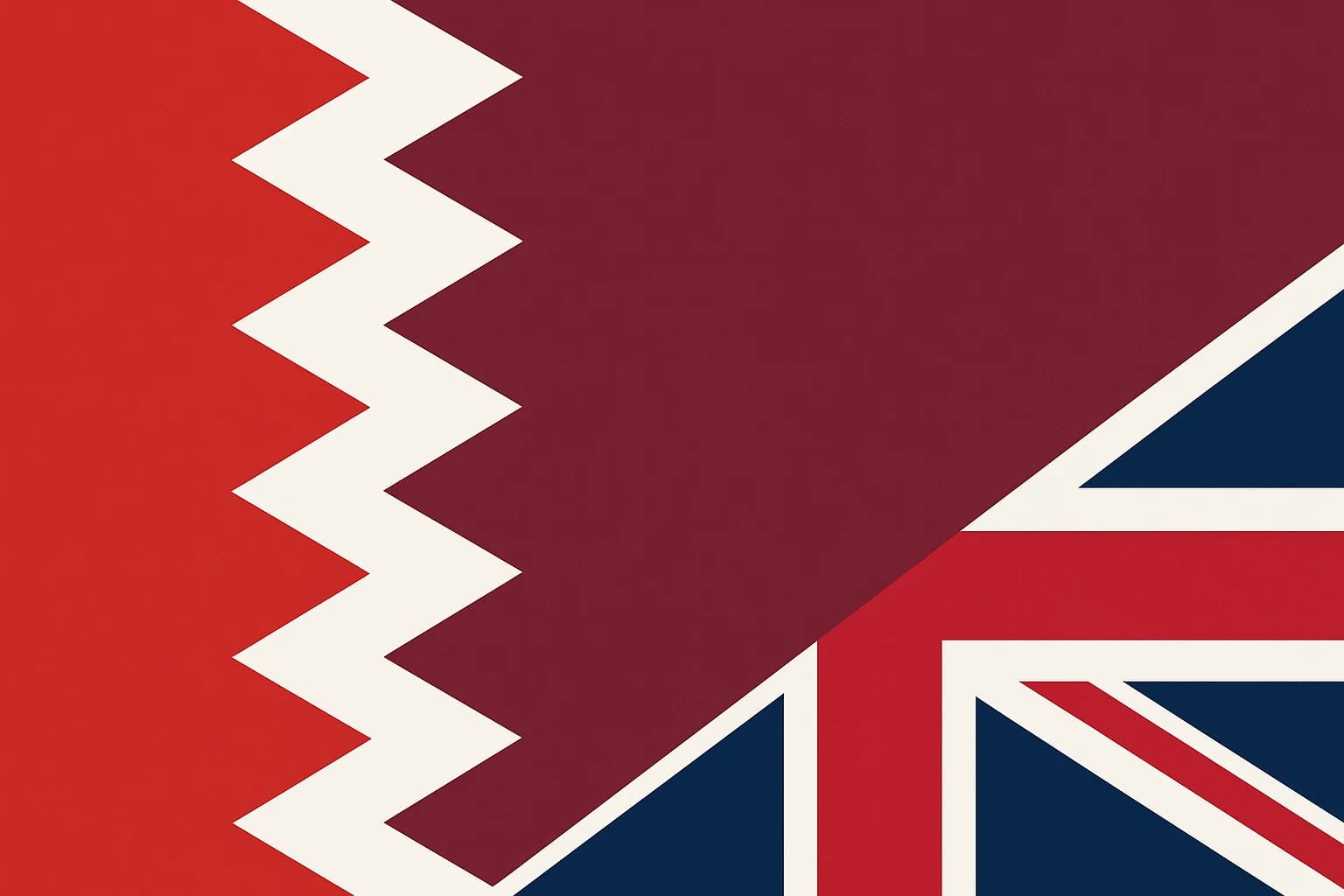
Open a map of the Arabian Gulf and look at the flags fluttering over Manama and Doha. At first glance, they seem almost embarrassingly similar. Bold fields of red, sliced by a jagged white zigzag. Now consider that these two nations spent the better part of the 20th century locked in one of the Gulf's bitterest territorial disputes, nearly going to war over a cluster of islands called the Hawar. Yet their flags are, in design terms, twins.
The serrated dividing line, that distinctive white-and-red sawtooth, appears on exactly two sovereign nation flags in the entire world. This is not a coincidence. It is a story about colonial administrators with ink pens, tribal merchants with dyed cloth, and how the visual identity of an entire subregion was quietly stitched together by the British Protectorate, often without the full awareness of the rulers who flew the results.
Two flags, one motif, and a mystery vexillologists keep circling
In heraldic terminology, the serrated or "indented" dividing line is a zigzag border. On national flags, it appears nowhere on Earth except Bahrain and Qatar. That alone makes it worth paying attention to.
Bahrain's flag features five white serrations against a red field, a number standardized in 2002 to represent the five pillars of Islam. The white band is relatively wide, giving the flag an airy balance.
Qatar's flag carries nine serrations and uses a noticeably deeper color, often described as maroon rather than red. Even that color distinction has a contested origin story. Some accounts say the maroon resulted from natural dye fading under years of relentless Gulf sun. Others insist it was a deliberate choice to distinguish Qatar's banner from Bahrain's. Nobody agrees.
If these were rivals for territory, prestige, and regional influence, you would expect a record of at least one ruler choosing the shared motif, and probably a complaint from the other side along the lines of "that's our zigzag, not yours." The historical record is strangely silent on both counts.
Popular vexillology writing does not help much. The typical "10 Most Unusual Flags" listicle mentions Qatar and Bahrain separately, noting the odd proportions or the unusual color, and almost nobody puts the two together.
The shared design goes back to the 1820s and a British naval campaign that reshaped the Gulf.
Red flags and the General Treaty of Peace
In 1820, the British East India Company's naval forces concluded the General Treaty of Peace with the sheikhdoms along the Gulf coast. The treaty's purpose was straightforward: end maritime raiding (what Britain called "piracy") and establish a system of identification for friendly vessels.
The practical problem was simple. Hundreds of dhows sailed the Gulf flying plain red flags, a traditional color for Arab maritime communities, and British naval patrols could not tell friend from foe at a distance. The fix was to require treaty signatories to add white to their flags, which created a recognizable category of "protected" vessels.
This imposed a colonial taxonomy on Gulf identity. Sheikhdoms that had never used standardized flags were suddenly required to carry British-approved designs as a condition of protection. The flags worked less like expressions of national pride than like maritime license plates, issued by an occupying power that controlled the sea lanes.
At this stage the dividing line between red and white was straight. The serration had not yet appeared, which leaves the question of when the zigzag showed up and why.
The key actors in this story are the Political Residents, British officials stationed first in Bushire (on the Persian coast) and later in Bahrain itself. These men served as de facto design authorities for an entire coastline, approving or modifying flag designs with the casual authority of someone reviewing a building permit.
Three competing theories for the serrated line
The zigzag's origin sits in a frustrating zone of historical ambiguity. Three theories circulate among flag historians, and none has a knockout piece of evidence.
The first theory is British colonial differentiation. By the mid-19th century Britain's Indian Ocean portfolio was getting crowded. Oman flew a plain red flag, Zanzibar had its own red banner, and several Trucial States were using variations of red and white. The Political Residents needed a way to separate the Gulf Protectorate flags from everything else in that palette, and on this reading the zigzag was a bureaucratic fix, a flourish applied to solve a visual crowding problem. It sounds exactly like the kind of thing a colonial administrator would do, which is both the argument for it and the reason to be careful with it.
The second theory looks at tribal textile tradition. Some historians point to the serrated and scalloped edges on traditional Gulf khanjar (dagger) sheaths, tent borders, and woven textiles. The zigzag was already familiar in the material culture of the region, and local rulers or their advisors may have carried a recognizable decorative pattern into their flag designs. This version gives Gulf actors more agency, which is welcome, but nothing documents it. No letter survives in which a sheikh says, "Make the edge like my tent flap."
The third theory is the pinking shear solution, and it is the most prosaic: the zigzag was functional. Straight-cut cloth frays in salt air, wind, and heat, while a serrated edge, of the kind pinking shears leave, resists unraveling. Someone, a local sailmaker or a flag supplier in Bombay, may simply have hit on it as a practical answer to the Gulf climate, making national symbolism an accident of textile engineering.
British Political Resident correspondence from the 1860s through the 1880s, held in the India Office Records at the British Library, shows standardization instructions for Gulf flags. These documents confirm that London cared about flag uniformity. They do not, frustratingly, explain the serration's rationale.
The silence in the record is itself revealing. Whoever introduced the motif, no ruler appears to have objected to sharing it with a neighbor, which says something about how national identity worked in the pre-nation-state Gulf. These were not countries in the modern sense but tribal polities, merchant families, and fishing communities, and a shared flag motif was barely worth noticing, let alone taking as an insult.
The Hawar Islands dispute and the absurdity of twinned flags
That changed once there was territory to argue about.
The Hawar Islands are a group of 16 small islands lying between the Qatar peninsula and the main island of Bahrain. From the 1930s onward, both countries claimed them. In 1939, the British government controversially awarded the islands to Bahrain, a decision Qatar never accepted.
The dispute simmered for decades. In 1986, it nearly boiled over into armed confrontation when Qatari forces briefly seized a coral reef being developed by Bahrain. The matter was eventually referred to the International Court of Justice, which issued a landmark ruling in 2001, splitting the contested territories between the two nations. Bahrain kept the Hawar Islands. Qatar received Zubarah and other areas.
The flags make the standoff faintly ridiculous. For decades both countries flew nearly identical banners over rival military and administrative outposts on contested ground, soldiers watching each other across a disputed border under what looked like the same piece of cloth. The symbols of sovereignty they were defending had been designed, in large part, by the same colonial power.
Qatar's response was gradual but persistent. Over the 20th century its flag shifted from a brighter red toward a deeper maroon and the number of serrations grew. None of it amounted to a dramatic redesign. It was slow differentiation, a country pulling its visual identity away from its neighbor's without conceding that the two had been nearly identical to begin with.
Bahrain moved later and more decisively. In 2002 it formalized the flag and reduced the serrations to exactly five, one for each pillar of Islam. That was a nation-building act: a design inherited from colonial administration, reread through an Islamic framework. The colonial substrate stayed where it was, with new meaning layered on top.
The Hawar dispute turns the shared design from a curiosity into a case study, showing how a colonial visual framework outlasted and complicated the political relationships it was meant to organize.
Kuwait as contrast: breaking the pattern
If Bahrain and Qatar kept the serrated motif, Kuwait shows us what happens when a Gulf state walks away from it entirely.
Kuwait was a British Protectorate too. It historically flew red-and-white designs, fitting the same regional pattern. But upon independence in 1961, Kuwait adopted a completely new flag: a green, white, red, and black horizontal design with a trapezoid at the hoist. The colors were drawn from pan-Arab symbolism, the palette of the Arab Revolt, shared by Jordan, Palestine, and others. The new flag represented Kuwait's post-independence alignment with Arab nationalism under Emir Abdullah III.
Kuwait works as a control case. It shed the British-imposed red-and-white framework completely while Bahrain and Qatar kept theirs and elaborated on it, which means the serrated design persisted by choice, even if the choice was rarely made consciously or debated out loud.
Other Gulf states made their own decisions. The UAE adopted a design using pan-Arab colors.
Oman developed a distinctive national flag with a khanjar emblem.
The region had real options. Bahrain and Qatar's retention of the serrated red-and-white motif stands out precisely because alternatives existed and were taken by their neighbors.
Both states found enough meaning in the inherited design to keep it, adding Islamic symbolism, a color distinction, and adjusted proportions on top of the colonial substrate without disturbing the foundation.
What the zigzag reveals about colonial aesthetics and Gulf identity
The British Protectorate era governed the Gulf through treaties and trade agreements, and also by sorting the region visually. Those categories turned out to be sticky. Within two or three generations, designs imposed by colonial administrators had started to feel traditional to the people they were imposed on.
This is a textbook case of what historians Eric Hobsbawm and Terence Ranger called "invented tradition," a practice that appears or claims to be old but is quite recent in origin. The serrated flag line fits the framework perfectly. A 19th-century administrative decision calcified into perceived heritage. Nobody alive today remembers a time before the zigzag.
Both Bahrain and Qatar's governments have, in the 21st century, promoted their flags as ancient symbols of national identity. Tourism materials, National Day imagery, school curricula, all present the flags as organic expressions of the nation's character. The British Protectorate origin is rarely acknowledged.
This is politically sensitive territory. In a region where sovereignty and independence carry deep weight, tracing a national flag to a colonial administrator's standardization circular is not a comfortable narrative. It explains, in part, why the design history remains underexplored. Scholars who work on Gulf flag history note the difficulty of accessing certain archives and the reluctance of official sources to engage with the colonial layer of the story.
The serrated line can be a mark of colonial imposition and a genuinely shared Gulf aesthetic at the same time. It was grafted onto a region that already had its own textile traditions and its own sense of color and pattern, and whether or not a local craftsman suggested it, Gulf societies absorbed it and made it theirs. The ambiguity of the flag matches the ambiguity of the region's relationship with its Protectorate past.
One inherited line
The serrated line between red and white on the flags of Bahrain and Qatar is the residue of a 19th-century British administrative project meant to bring visual order to a maritime world Britain was starting to control. It survived independence, the Hawar Islands crisis, and Qatar's long effort to deepen its red into maroon and multiply its serrations.
The zigzag a British Political Resident once sketched into a standardization circular now flies over two sovereign stadiums, two central banks, and two national identities, each of which is confident the design was always its own.
Julio Song
Writer
Julio is a staff writer at FlagDB. He studied Mathematics at the University of Madrid and has a passion for vexillology.
More from Julio Song →Related articles
The Serrated Edge: Why Bahrain and Qatar Chose Zigzag Lines While Every Other Nation Drew Straight Ones

One Poem, Two Flags: How the Arab World's Colors Split Into Rival Family Trees