The Acadian Flag
Acadia
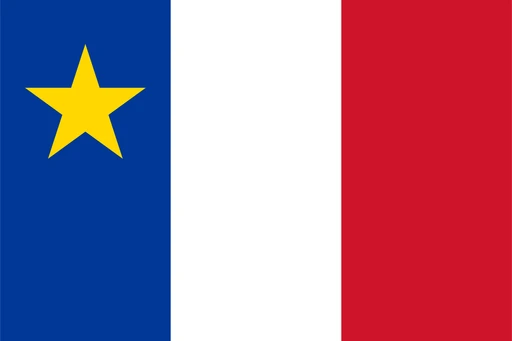
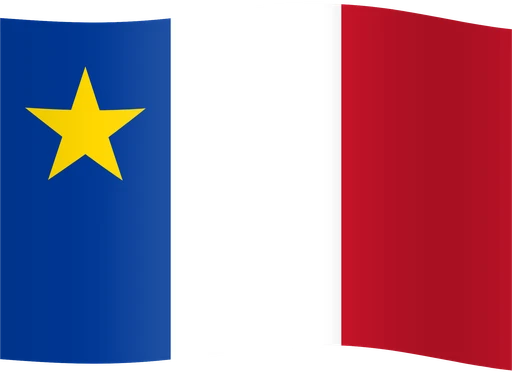
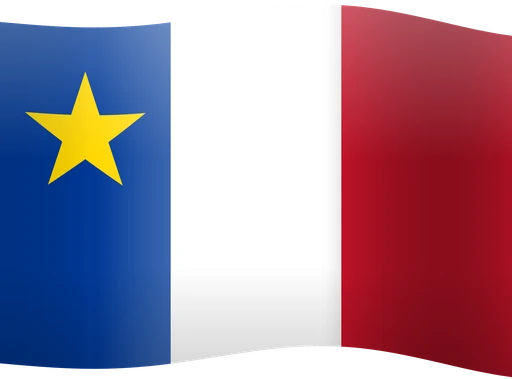
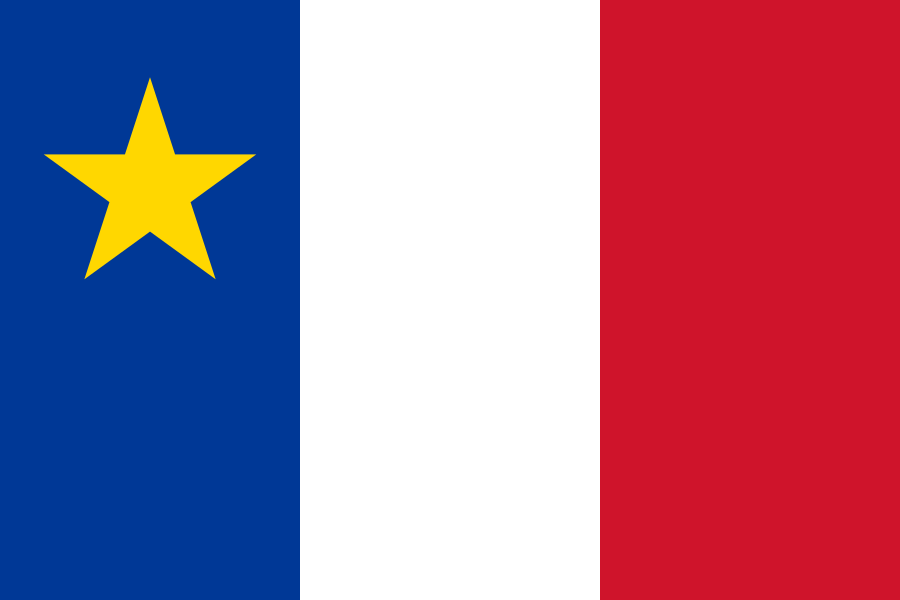
The Acadian flag is the French tricolour of blue, white and red vertical stripes with a gold five-pointed star at the top of the blue stripe. The tricolour says that Acadians descend from France. The star is the Stella Maris, the star of the sea, a title of the Virgin Mary, whose feast of the Assumption on 15 August is the Acadian national holiday. Its gold is the papal colour and marks the Acadian attachment to the Catholic Church. Delegates adopted the flag on 15 August 1884 at the second Acadian National Convention in Miscouche, Prince Edward Island, on the proposal of Father Marcel-François Richard.
The Acadian flag is the flag of France with one thing added: a gold star at the top of the blue stripe. No parliament or king adopted it. A convention of Acadians did, on 15 August 1884, in a village on Prince Edward Island. Acadians are the descendants of the French colonists who settled Acadia in the 17th century, and they have never had a state of their own. The flag has stood in for one since.
An army needs a standard
The flag was the second decision in a longer argument about who Acadians were. In July 1881 delegates met at Collège Saint-Joseph in Memramcook, New Brunswick, for the first Acadian national convention. The main item was a national holiday. One side wanted 24 June, Saint-Jean-Baptiste Day, the holiday of French Canadians. The other wanted 15 August, the feast of the Assumption, a date that belonged to Acadians alone.
Father Marcel-François Richard, a priest born in Saint-Louis-de-Kent in 1847, argued for the Assumption. He asked Acadians to "defend their rights as a distinct people, with their own history and destiny to fulfill". His side won the vote, and the bishops of the Maritimes approved the holiday that September.
The second convention met at Miscouche, Prince Edward Island, on 15 August 1884. Richard chaired the commission on the flag. "An army needs a standard," he told the delegates. Several designs had been proposed, and some people wanted a flag with no link to France. Richard disagreed. The tricolour, he said, "tells us simply that we are French and that our motherland is France".
Then he made his proposal. "I would like Acadia to have a flag that reminds it not only that its children are French, but that they are also Acadian." His answer was the tricolour "with the addition of a star in the papal colour on the blue section". The delegates approved it unanimously and sang La Marseillaise.
One star in the papal colour
The design has two parts, and Richard explained both.
The three vertical stripes of blue, white and red are the flag of France. They state where Acadians come from. The convention also tied the blue to devotion to the Virgin Mary, according to the Canadian Heraldic Authority.
The star is the Stella Maris, the star of the sea, an old title of Mary. Our Lady of the Assumption is the patron saint of Acadians, so the star and the holiday point to the same figure. Its gold is the papal colour, a mark of the Acadian attachment to the Catholic Church. The Heraldic Authority's record adds a second reading, that the star stands for hope and renewal.
That record is the nearest thing the flag has to an official specification. It describes a French tricolour "charged in the canton with the Star of Acadia", in heraldic terms only. It gives no measurements and no colour codes. In practice the flag follows the 2:3 shape of the French flag, and the first one made is close to that.
The flag that was ready before the vote
Richard had not waited for the result. As the convention closed that evening, he announced that he had a flag prepared. Ferdinand Robidoux, who was in the hall, wrote that Richard and Father Cormier "unfolded a beautiful tricolour adorned with a single star in papal colours".
The crowd wanted a song. Some called for La Marseillaise. Richard began Ave Maris Stella instead, and the hall joined in. Pascal Poirier then stood up and said the anthem had been found. Pierre-Amand Landry, the chairman, put it to a vote, and the hymn became the Acadian national anthem. The flag was hoisted for the first time the next day, Saturday 16 August, in front of the church of St. John the Baptist in Miscouche.
Tradition says Marie Babineau, a parishioner of Richard's from Saint-Louis-de-Kent, sewed that first flag. A study of the flag at the Musée acadien tells a plainer story. Richard asked Babineau for the flag on the evening of 14 August, with the session due the next day. The flag itself is a commercially made French tricolour. Babineau's work is the star, cut from a single piece of yellow wool about 44 centimetres across and stitched on by machine.
A lost flag comes home
After the convention the flag flew from the mast of the steamer that carried delegates back to Shediac. Anselme Léger, the delegate for Shediac, kept it. Like many Acadians of his time he left to find work in the United States, and the flag went with him.
It resurfaced in 1940, when his son Marcel Léger, living in Waltham, Massachusetts, handed it to Father Clarence Léger to take back to Acadia. It went to the museum of the Notre-Dame-de-l'Assomption cathedral in Moncton, and from there into the collection of the Musée acadien at the Université de Moncton. The Canadian Conservation Institute repaired tears and insect damage, and the flag returned to display in a protective case in September 1983. It measures about 1.83 metres by 2.75 metres and is on permanent display.
Challenged, then kept
The flag has had opponents. Some Acadians disliked it before the 1890 convention because the tricolour was a republican flag. In the early 20th century some clergy wanted all French-speaking Canadians under the Carillon Sacré-Cœur. That idea faded after the 1912 Congress on the French Language in Quebec, where the Acadian flag flew beside the others. In the 1960s young Acadians voted to demote the religious symbols to folklore. The Canadian Encyclopedia notes that the vote had the opposite effect.
Official recognition followed. On 15 August 1995 the Canadian Heraldic Authority granted arms and a flag to the Société nationale de l'Acadie, and its register calls the starred tricolour "the national flag of Acadia". Canada's National Acadian Day Act of 2003 names 15 August as National Acadian Day across the country.
The provinces fly it too. Nova Scotia raised it at Province House on 2 April 2004 for the 400th anniversary of the founding of Acadia, and has offered an Acadian flag number plate since 1 January 2012. Prince Edward Island lists it in its official flag guidelines. The design has travelled as well. The Canadian Encyclopedia counts the Cajun flag of Louisiana's Acadian descendants among the symbols it influenced.
References
[1] Canadian Heraldic Authority, Public Register of Arms, Flags and Badges of Canada, "Société nationale de l'Acadie," Vol. III, p. 74. https://www.gg.ca/en/heraldry/public-register/project/591
[2] National Acadian Day Act, S.C. 2003, c. 11. https://laws-lois.justice.gc.ca/eng/acts/N-1.4/FullText.html
[3] Patrick-Olivier Meunier, "Le premier drapeau acadien du Musée acadien de l'Université de Moncton," Conserveries mémorielles (2016). https://journals.openedition.org/cm/2360
[4] Patrick-Olivier Meunier, "The Acadian Flag," The Canadian Encyclopedia. https://thecanadianencyclopedia.ca/en/article/the-acadian-flag
[5] "The Origins of the Acadian Flag and National Holiday: the Memramcook and Miscouche Conventions," Encyclopédie du patrimoine culturel de l'Amérique française. https://www.ameriquefrancaise.org/en/articles/origins-acadian-flag-and-national-holiday-memramcook-and-miscouche-conventions
[6] "Richard, Marcel-François," Dictionary of Canadian Biography. https://www.biographi.ca/en/bio/richard_marcel_francois_14E.html
[7] Government of Prince Edward Island, "Guidelines for Flying and Displaying the Provincial Flag and other Flags in the province of Prince Edward Island." https://www.princeedwardisland.ca/sites/default/files/publications/eco_flagpro.pdf
[8] Government of Nova Scotia, "Acadian Heritage Recognized at Province House," 5 April 2004. https://news.novascotia.ca/en/2004/04/05/acadian-heritage-recognized-province-house
[9] Acadian Flag Number Plates Regulations, N.S. Reg. 325/2011. https://novascotia.ca/just/regulations/regs/mvacadianplates.htm
[10] "Flag of Acadia," Wikipedia. https://en.wikipedia.org/wiki/Flag_of_Acadia
Common questions
- What does the star on the Acadian flag mean?
- The star is the Stella Maris, the star of the sea, a title of the Virgin Mary. Our Lady of the Assumption is the patron saint of Acadians, and her feast on 15 August is their national holiday. Father Marcel-François Richard asked for the star to be in the papal colour, so its gold also marks the Acadian attachment to the Catholic Church. The Canadian Heraldic Authority adds that the star stands for hope and renewal.
- Who designed the Acadian flag?
- Father Marcel-François Richard, a priest from Saint-Louis-de-Kent, New Brunswick, proposed the design at the second Acadian National Convention in Miscouche, Prince Edward Island, on 15 August 1884. He asked his parishioner Marie Babineau to make the first one. Research at the Musée acadien found that the first flag is a commercially made French tricolour with a wool star added by Babineau.
- Why does the Acadian flag look like the flag of France?
- It is the flag of France, on purpose. Richard told the 1884 convention that the tricolour "tells us simply that we are French and that our motherland is France". He rejected proposals for a wholly different flag. The star was added so that the flag would remind Acadians that they are French and also Acadian, a people apart from France and from French Canada.
- When was the Acadian flag adopted?
- Delegates to the second Acadian National Convention adopted it unanimously on 15 August 1884 in Miscouche, Prince Edward Island. It was unfolded in the hall that evening and raised outdoors for the first time on Saturday 16 August, in front of the church of St. John the Baptist in Miscouche. No government passed a law to adopt it. A convention of the people it stands for did.
- Where is the original Acadian flag?
- The flag unfolded at Miscouche in 1884 is on permanent display at the Musée acadien of the Université de Moncton in New Brunswick. It spent decades in the United States with the family of Anselme Léger, the Shediac delegate who kept it after the convention. His son Marcel sent it home from Massachusetts in 1940. It measures about 1.83 metres by 2.75 metres.
- When is the Acadian flag flown?
- Its main day is 15 August, the feast of the Assumption, which Acadians have kept as their national holiday since 1881. Canada's National Acadian Day Act of 2003 gives the date that name across the country. The flag also flies at the Congrès mondial acadien. Nova Scotia raised it at Province House in 2004 and has offered a number plate with the flag since 2012.
Download this flag
Free in 12 styles, from 32px icons up to 2000px, as SVG, PNG, WebP and JPG.