What a diaspora carries
Diasporas form for different reasons. Some are the result of forced migration, some of people following work, some of the ordinary churn of a globalized economy. The Irish in the United States and Indian communities across Africa and the UK came about through different combinations of those pressures.
What they have in common is that people take their culture with them, and the flag usually comes along.
Why the flag, specifically
A flag abroad does something a flag at home does not. At home it is background. Spotted at a festival on the other side of an ocean, it is a marker of where a family came from, and it accumulates meaning the longer the distance holds. Diaspora flags often end up carrying more weight than the official version does.
The Afghan flag abroad
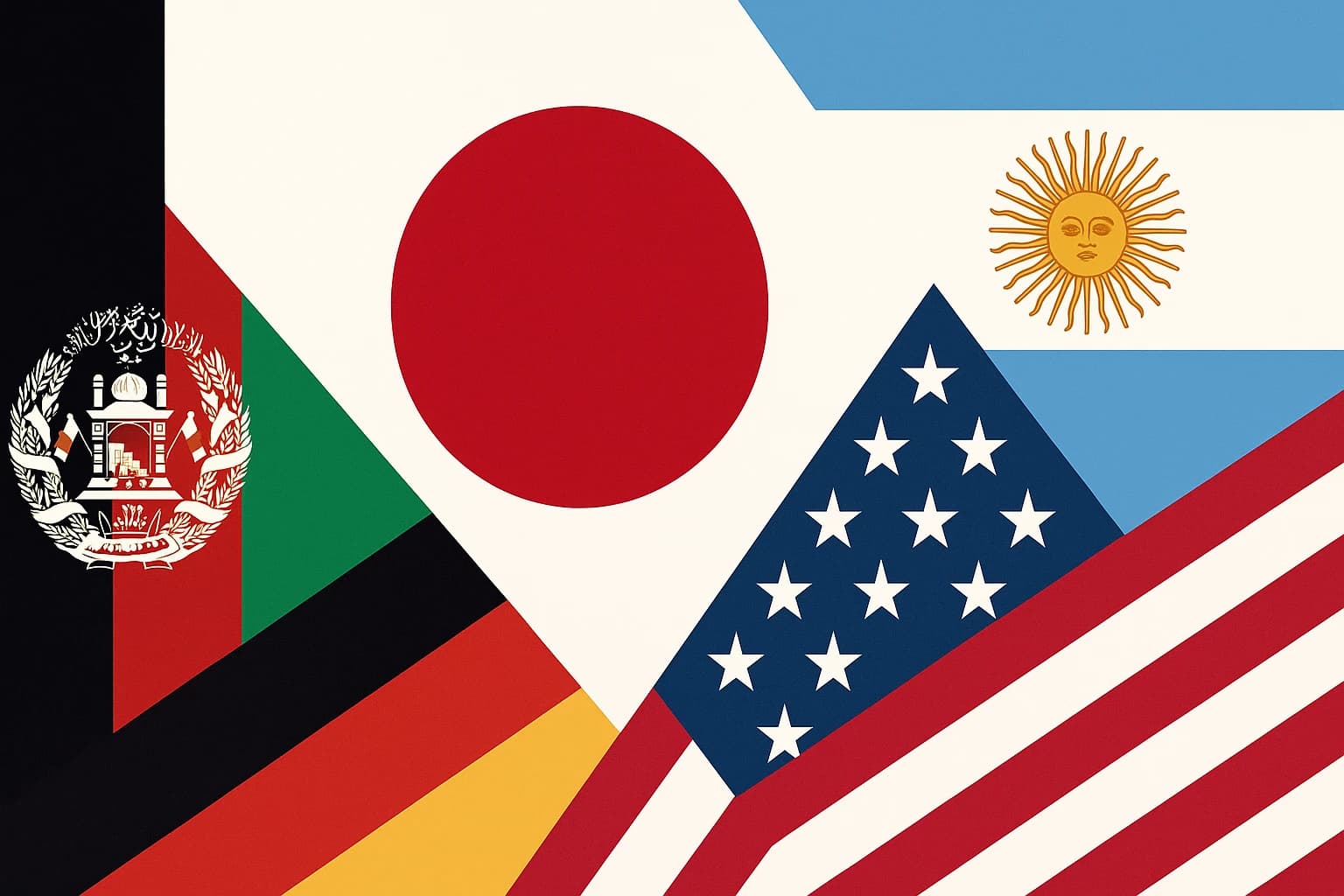
The Afghan flag has been through a lot of revisions, and its colors and emblem carry meanings tied to identity and sovereignty.
In Afghan communities outside the country, it works as a link to traditions and values that are otherwise hard to keep hold of. It stands for unity and for staying put, which matters when the homeland is distant and unstable.
The Argentine flag abroad
The Argentine flag, sky blue and white, does similar work for Argentine communities in North America and Europe.
It turns up at national holidays, where people gather and the flag ends up at the center of the room. It functions there as shorthand for a shared background rather than as a political statement.
Regional flags as well as national ones
Diaspora communities also fly flags that are not national at all. The Kurdish flag and the Catalan flag both travel with the communities that use them, and both express a local identity that the national flag of the state they live under does not cover. The result is that a single household can have more than one flag with a legitimate claim on it.
Social media changed the display
Instagram and Facebook gave diaspora communities somewhere public to put all of this. Videos of flag ceremonies, stories tagged with hashtags, footage from national holidays: it adds up to an informal archive of how these communities mark themselves. Online organizing has also given some flags a new political charge they did not have offline.
What happens with the next generation
Younger people who grew up with global identities may read these flags differently. Whether a flag keeps the same pull in a hyper-connected world is an open question, and the honest answer is nobody knows yet. What tends to survive is the underlying thing the flag is standing in for, which is where a family is from and who else shares that.